Bengaluru, NFAPost: With demand for 200–300 new satellites over the next six to seven years, Narayanan calls for deeper industry, startup and academic participation to scale India’s space economy.
India’s space programme is entering a new phase of expansion, with the Indian Space Research Organisation (ISRO) targeting a launch cadence of up to 50 missions a year and calling for significantly greater participation from private industry, startups and academia to meet the country’s growing demand for space-based services.
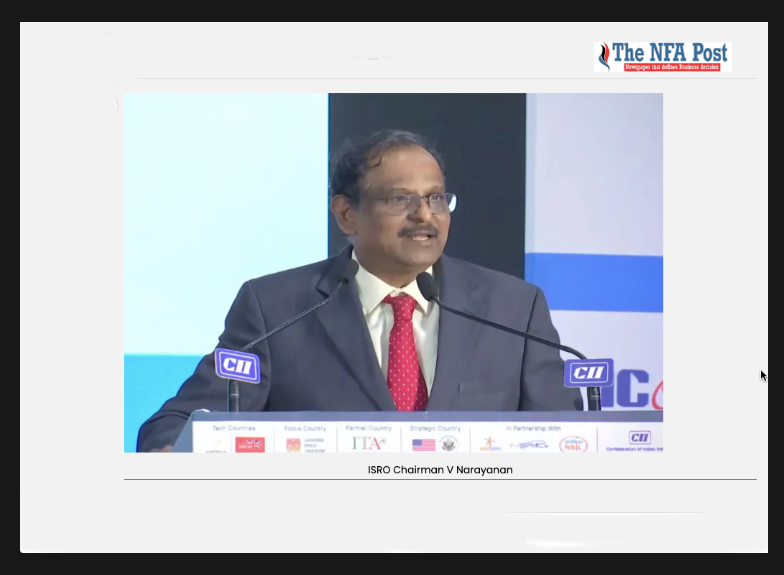
ISRO Chairman and Secretary, Department of Space, Dr. V. Narayanan, said India currently has only 56 space assets serving the country, while the requirement could rise to between 200 and 300 satellites over the next six to seven years.
“Today we are having only 56 space assets serving from space. But the need is huge. At least 200 to 300 satellites have to be built and launched in maybe six to seven years’ time frame. And this cannot be done only by ISRO,” Narayanan said while addressing the 9th edition of Bengaluru Space Expo 2026.
His remarks underline the scale of the transition underway in India’s space sector, where a programme historically led by ISRO is increasingly being complemented by private launch companies, satellite manufacturers, technology startups, MSMEs and international partners.
Narayanan said India’s launch capability has expanded significantly over the past four decades. Recalling his early years in ISRO, he said the organisation once conducted a launch only once every three years. The country subsequently moved to a two-year cycle and has now reached a stage where launches are taking place roughly once a month.
The next objective, he said, is to reach around 50 launches annually, requiring the entire ecosystem to work together.
“When I joined ISRO in 1984, we used to have a launch once in three years, then once in two years. Today we are launching once in a month. But the need is around 50 launches per year. So we all have to work together,” Narayanan said.
Industry already carries a major share of the programme
Narayanan stressed that the private sector is not a new participant in India’s space programme, but an integral part of its existing industrial base.
He said approximately 80% of the budget associated with a rocket launch flows to Indian industries, underlining the extensive role played by companies in manufacturing and supplying components, subsystems and other critical hardware.
“Whenever a rocket lifts off — a PSLV, GSLV or LVM3 rocket — please understand, 80% of the budget goes to Indian industries,” he said.
“That means the success of the Indian space programme is because of the partnership with Indian industries and academia,” Narayanan added.
According to the ISRO chief, around 450 startups are now active in India’s space ecosystem, reflecting the impact of reforms introduced to open the sector to private participation.
The government’s reforms have created institutional mechanisms for this transition, with IN-SPACe responsible for authorising and facilitating private space activities and NewSpace India Limited (NSIL) focused on commercialisation and industry engagement.
The objective now is to move from participation to scale.
From one startup to more than 450
Pawan K. Goenka, Chairman, IN-SPACe, highlighted the rapid growth of India’s private space ecosystem, noting that the country had only one space startup in 2014 compared with more than 450 today.
“From a single space startup in 2014, we now have over 450. This year alone, more than $160 million of private capital has already come in,” Goenka said.
He cited the development of Skyroot Aerospace as an example of how government institutions and private companies can work together to accelerate innovation.
Skyroot developed India’s first privately built rocket and subsequently demonstrated orbital launch capability, marking a significant milestone in the emergence of a commercial launch industry.
“The partnership is India’s real strength. The depth of a national space agency built over six decades, now working hand in hand with a young and ambitious private industry. ISRO and industry are rising together,” Goenka said.
The evolution, he said, is creating a full-spectrum space ecosystem involving ISRO, IN-SPACe, NSIL, private companies, MSMEs, academia and investors.
Goenka also called for Indian companies to move higher up the value chain and compete in international markets. At the same time, he urged global companies to view India as a potential base for manufacturing, technology development and long-term space-sector partnerships.
Funding and manpower not seen as immediate constraints
Narayanan also addressed questions surrounding ISRO’s workforce and funding.
ISRO currently has around 20,000 employees, including more than 8,000 scientists. The organisation has recorded approximately 150 resignations annually over the past five to six years.
Narayanan characterised the attrition level as normal for an organisation of ISRO’s size and said it was not affecting the agency’s ability to execute its programmes.
He also pushed back against concerns over funding constraints, saying the government has consistently provided the budget sought by the Department of Space and has shown willingness to provide additional resources when required.
Goenka similarly said ISRO’s ongoing programmes were not facing a slowdown because of staffing or funding constraints.
He said the organisation’s technology-transfer activities are progressing in line with the Indian Space Policy, allowing capabilities developed within the national space programme to increasingly reach private industry.
Ambitious missions ahead
The expansion of launch capacity is expected to support an increasingly ambitious pipeline of national space missions.
Narayanan highlighted several major programmes, including Chandrayaan-4 and Chandrayaan-5, the Venus Orbiter Mission, the Bharatiya Antariksh Station, the Next Generation Launch Vehicle, human lunar exploration and the expansion of the NavIC constellation.
The scale of these programmes, combined with growing commercial demand for satellite communications, Earth observation, navigation and other space-enabled services, is expected to create opportunities across the private space ecosystem.
For India, the challenge is therefore no longer limited to developing launch vehicles or spacecraft. It is increasingly about building the manufacturing capacity, launch infrastructure, financing mechanisms and customer base required to support a much larger space economy.
India’s $44-billion space economy ambition
Goenka said India’s space economy is currently estimated at around $8 billion and has a target of reaching approximately $44 billion by 2033.
Achieving that target, he said, will require sustained collaboration between ISRO and private industry rather than relying on government programmes alone.
The message from the Bengaluru Space Expo was consequently one of scale: India has developed the technological foundation and policy framework for a private space economy, but the next stage will depend on how quickly that ecosystem can translate capability into production, launches, satellites and commercially viable services.
As India moves towards a target of 50 launches a year, the distinction between the national space programme and the private space industry is likely to become increasingly blurred.
The next chapter of India’s space story, Narayanan’s remarks suggest, will not be written by ISRO alone. It will be built collectively by ISRO, industry, startups, academia and international partners working together to put hundreds of new satellites into orbit and establish India as a major global space power.