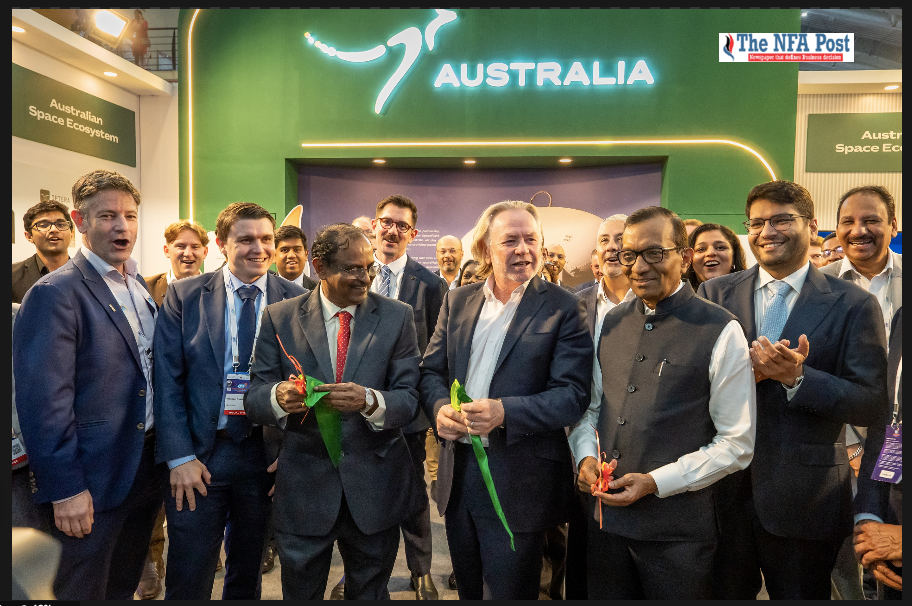
Bengaluru, NFAPost: Australia is seeking deeper space-sector ties with India, with officials highlighting complementary strengths in manufacturing, technology, launch services and two-way investment.
Australia is looking to deepen its partnership with India across the space ecosystem, with both countries increasingly exploring how their respective capabilities can complement each other and create new opportunities in the global space economy.
Nathan Davis, Trade and Investment Commissioner, Australia, said several Australian companies seeking to expand internationally are increasingly viewing India as an “important partner” for growth, manufacturing and technology collaboration.
Speaking on the sidelines of Bengaluru Space Expo 2026, Davis said the focus of the emerging partnership was less on competition and more on identifying areas where the two countries could bring complementary strengths to their respective ecosystems.
“What we’re seeing in terms of how we’re able to develop further, what we talk about is complementarity,” Davis said.
“It’s really been about not as competitors, but what do we each offer each other’s ecosystem that is very advantageous?” he added.
Complementary capabilities
Davis said India’s increasingly mature manufacturing ecosystem presents opportunities for Australian space and technology companies looking to expand their operations, scale production and establish partnerships.
“From India’s perspective, a very mature manufacturing ecosystem across the N10 spectrum – how are Australian companies able to grow here, scale, and partner?” he said.
At the same time, Australia believes it can offer capabilities that complement India’s manufacturing and engineering strengths.
Davis highlighted Australia’s “vast, dark, quiet skies” as a strategic advantage for activities such as astronomy, satellite operations and space-related services.
“ Australia has a significant advantage with its ‘vast, dark, quiet skies’, which offers a great opportunity for Indian companies looking at launch and re-entry services, for example,” he said.
The combination of India’s engineering and manufacturing capabilities with Australia’s geographic and environmental advantages could create opportunities across launch support, re-entry, satellite operations, space science and related commercial activities.
Two-way investment gaining momentum
Davis also pointed to growing two-way investment between India and Australia, saying companies in both countries are increasingly viewing the other market as an advantageous destination for expansion.
“It goes both ways. We have a number of companies, not just in the space ecosystem but in the broader tech sphere, that see Australia as a really advantageous partner, particularly due to our ease of doing business, the stable regulatory environment, and the size of the market potential that they see,” he said.
He said several Indian technology and related companies are exploring opportunities in Australia, while major Australian companies are also establishing and expanding their presence in India.
“So, we’re seeing that investment grow on a bilateral level in very, very interesting ways. Certainly, tech is a very central part of that two-way investment as well,” Davis said.
The growing investment relationship provides a broader foundation for cooperation in the space sector, where companies often require access to specialised infrastructure, manufacturing partners, research capabilities and international markets.
India emerging as a strategic space partner
The increasing interest from Australian companies comes as India seeks to expand its private space ecosystem and integrate domestic companies more deeply into global supply chains.
For Australia, India offers access to a large engineering and manufacturing base, a growing startup ecosystem and an increasingly open commercial space market.
For Indian companies, Australia can provide access to a stable regulatory environment, specialised space infrastructure and opportunities linked to its geographic location and large areas of sparsely populated land.
The emerging relationship reflects a broader shift in bilateral space cooperation—from government-to-government engagement towards commercial partnerships involving startups, technology companies, manufacturers, investors and research institutions.
India and Australia are therefore increasingly positioning their space relationship around complementarity rather than competition, with both sides looking to connect their respective strengths to build a more integrated and globally competitive space economy.
According to data shared by the Ministry of Commerce, India’s merchandise exports to Australia stood at USD 7,284.17 million in FY 2025-26 under the India-Australia Economic Cooperation and Trade Agreement (ECTA), providing a wider trade and investment backdrop to the expanding technology partnership.