Bengaluru, NFAPost: High Commissioner Philip Green points to Australia’s space capabilities and India’s launch, manufacturing and technology strengths as natural complements.
Australia and India are positioning their growing space partnership around a simple proposition: each country brings capabilities, geography and expertise that complement the other, creating opportunities for deeper cooperation across human spaceflight, launch services, satellite technology, Earth observation and space research.
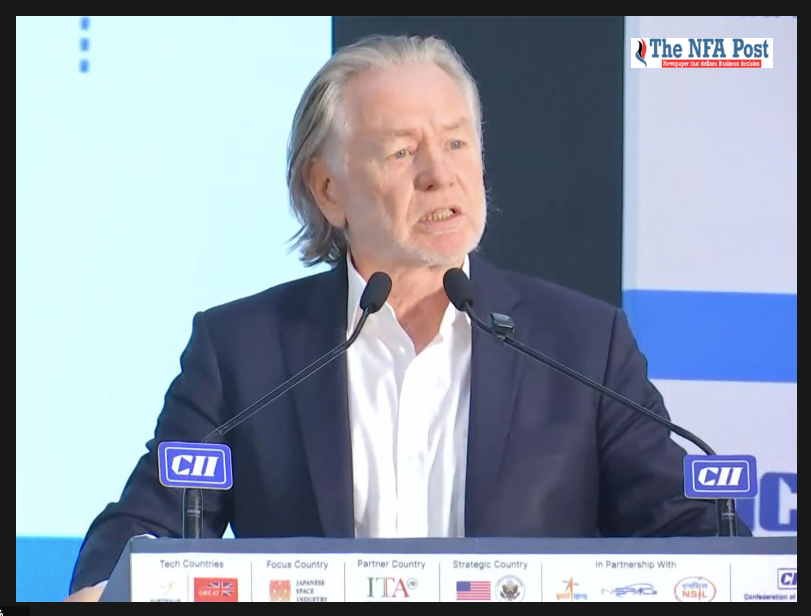
Australian High Commissioner to India Philip Green made the case for closer collaboration while addressing the 9th Bengaluru Space Expo (BSX) 2026 on Monday, highlighting the expanding strategic and commercial relationship between the two countries.
“We have the things you don’t and you have the things we don’t. So partnership is natural and relatively simple,” Green said, describing the complementary strengths of the Australian and Indian space industries.
While acknowledging the historical achievements of larger space powers represented at the event, Green argued that Australia’s value to India lies not in competing with the major space powers on their terms, but in bringing specialised capabilities, distinctive geography and an increasingly sophisticated private-sector ecosystem.
Space becomes a core pillar of India-Australia technology ties
Green said the strategic relationship between Australia and India has strengthened significantly, both bilaterally and through the Quad, creating a broader framework for cooperation in critical and emerging technologies.
He pointed to the recently announced Partnership for Cyber Critical Technologies and Supply Chains (PACT) between the two countries, describing it as an important framework for technologies expected to shape future economic growth and national security.
“The PACT agreement makes clear that space is no longer a peripheral field of interest but a core arena for bilateral technology collaboration, industry integration and regional security,” Green said.
The Bengaluru Space Expo, he added, represents the first major opportunity since the agreement was signed to translate that strategic alignment into practical industrial engagement.
Green said the relationship was increasingly moving beyond diplomatic cooperation towards technology partnerships, supply-chain integration and direct participation in each other’s space programmes.
Australia to support India’s Gaganyaan mission
One of the most concrete examples of that cooperation is Australia’s involvement in India’s Gaganyaan human-spaceflight programme.
Green said Australia has formally commissioned a dedicated space-tracking terminal on the Cocos (Keeling) Islands in the eastern Indian Ocean to support India’s human-spaceflight activities.
The location provides strategically important coverage for Indian spacecraft operating over the Indian Ocean.
“When Indian astronauts orbit Earth aboard Gaganyaan, Australia will be holding the ground line,” Green said.
The tracking facility is expected to provide telemetry, tracking and coverage support for both uncrewed and crewed ISRO missions. Green said Australian support would also extend to rescue and recovery operations associated with controlled landings in Australian waters off the coast of Western Australia.
The cooperation, he said, demonstrates that Australia is becoming a trusted operational partner in India’s human-spaceflight programme.
“This collaboration underscores that Australia is a trusted partner in ISRO’s human spaceflight mission,” Green said, describing Australia’s role as an increasingly important component of the Gaganyaan programme.
The partnership gives India access to additional tracking and communications infrastructure across a strategically important region while providing Australia with a direct role in one of India’s most significant space programmes.
30 Australian companies at Bengaluru Space Expo
The third pillar of the partnership, according to Green, is commercial.
Australia has brought a delegation of 30 companies to BSX 2026, representing capabilities across the space value chain, from research and satellite design to manufacturing, propulsion, launch, re-entry, Earth observation, analytics and in-space research.
“Collectively, our companies represent a space sector that takes ideas from the laboratory to orbit and beyond,” Green said.
He highlighted Australia’s broader scientific and technological strengths, pointing to the country’s contributions to areas including wireless technologies, digital mapping and precision timing.
Green argued that Australia’s particular geographic and demographic characteristics have also shaped capabilities that could be relevant to India’s space and defence requirements.
Australia’s geography creates a distinctive advantage
Australia has a landmass approximately two and a half times the size of India but a much smaller population, Green noted.
That combination has encouraged the development of technologies for operating over large distances with limited human presence, particularly in robotics, automation and remote operations.
As an example, he cited mining operations in Western Australia, where large fleets of remotely operated vehicles are controlled over hundreds of kilometres.
“For us, because we are a big landmass and we don’t have many people, we have to know about doing things at distance and with machines,” Green said.
Those capabilities, he suggested, have applications extending beyond mining into space operations, robotics, autonomous systems and remote infrastructure management.
Australia’s geography also provides direct advantages for space activities.
Its position in the eastern Indian Ocean offers opportunities for spacecraft tracking, launch-related operations and recovery activities. Green said Australia has access to launch profiles supporting both equatorial and polar orbits.
“Our position in the East Indian Ocean means that we are ideally located to support India’s space journey,” he said.
A young space industry growing alongside India
Green also emphasised the relatively recent development of Australia’s commercial space industry.
Australia’s space sector is growing at nearly three times the rate of the country’s overall economic growth, he said, creating an increasingly dynamic ecosystem of private companies and research institutions.
Unlike the world’s largest aerospace companies, Australian firms are relatively smaller, which Green argued could become an advantage in building partnerships with Indian companies.
“Our industry is big enough to be consequential for India, but small enough to want to work closely with you,” he said.
He described the Australian and Indian space industries as effectively “growing up” together, with companies in both countries developing new commercial capabilities while learning from one another.
Government support is also playing a role. Green said the Australian government is investing nearly ₹1,500 crore specifically in the space sector, with the aim of attracting and leveraging additional private-sector investment.
Indian diaspora strengthens commercial links
Green also pointed to the large Indian-origin community in Australia as an additional bridge between the two countries’ technology sectors.
More than one million Australians of Indian origin, he said, are strongly represented across Australian business, science and technology.
Many Australian space companies are led by people of Indian origin, Green noted, giving those businesses an additional understanding of India’s commercial environment and making cross-border partnerships easier to establish.
The diaspora, he suggested, can serve as an important informal bridge between the two innovation ecosystems.
India brings scale, Australia brings specialised capabilities
The strongest argument for the partnership, however, lies in what Green described as the complementary nature of the two industries.
Australia brings niche technological capabilities, specialised scientific expertise, remote-operations experience and strategically important geography. India, meanwhile, offers large-scale manufacturing, cost efficiencies, engineering talent and an increasingly mature launch and satellite ecosystem.
“India has end-to-end manufacturing capabilities, cost efficiencies, and world-class engineering talent at scale,” Green said.
He argued that the combination creates opportunities that neither country could necessarily achieve as efficiently on its own.
The partnership is therefore evolving across several layers—from government-to-government strategic agreements and mission support to commercial partnerships between companies and research institutions.
Green ended his address with an invitation to Australian and Indian companies to turn that complementarity into practical cooperation.
“So come and dock in to the Australian companies here at BSX and let’s fly to the moon together,” he said.
For Australia and India, the emerging space relationship is increasingly about more than diplomatic alignment. It is about combining India’s scale and manufacturing strength with Australia’s specialised technology, geography, research capabilities and operational expertise to build a partnership capable of supporting the next generation of space missions and commercial opportunities.