Bengaluru, NFAPost: Industry leaders at a CII panel say India’s next space-sector challenge is no longer proving technology, but building manufacturing depth, launch cadence, growth capital and global demand to compete at scale.
India’s private space industry is entering a decisive new phase, with the focus shifting from demonstrating technological capability to building the industrial capacity, financing and customer base required to sustain commercial growth.
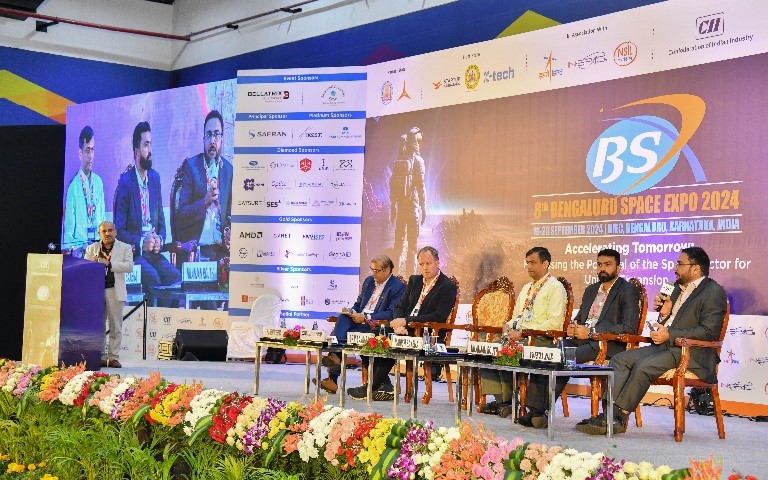
That was the central message from a high-level panel discussion, “Scale & Speed: Role of the Private Sector in Achieving the ‘Right to Win’ in the Space Economy,” held on September 7. The session brought together senior representatives from IN-SPACe, L&T, Centum Electronics, Hindustan Aeronautics Limited (HAL), Japan’s ArkEdge Space, Ankur Capital, Cooley LLP, Skyroot Aerospace and Dhruva Space.
Moderated by Air Vice Marshal Dhananjay Khot, Director (Strategy & Planning), IN-SPACe, the discussion examined whether India’s emerging space ecosystem can move from a successful technology and policy foundation to a high-volume, globally competitive industry.
India is now roughly six years into its space-sector reforms, four years into the establishment of IN-SPACe and three years into the Indian Space Policy. The ecosystem has expanded to around 450 startups, while commercial launches and increasing participation of private industry in national missions are signalling a transition from policy formation to execution.
The next challenge, speakers said, is considerably harder: producing rockets and satellites at higher volumes, securing regular launch opportunities, attracting growth capital and winning customers in international markets.
From reliability to repeatable production
For established aerospace companies, the transition to scale will require manufacturing systems to evolve beyond processes designed primarily around reliability and individual mission requirements.
Raghavendra BM, Joint General Manager, L&T Precision Engineering Systems, said L&T’s long association with ISRO has gradually taken the company from manufacturing components and subsystems to participating in the production and integration of larger launch-vehicle structures.
L&T’s aerospace facility in Coimbatore, spread across approximately 240 acres, has developed capabilities spanning motor casings, alloy structures, heat shields and large-format manufacturing for launch vehicles including the GSLV and LVM3. Its participation in PSLV production has also given the company experience in the complex processes involved in rocket manufacturing, integration and qualification.
However, increasing India’s launch frequency from two or three missions a year to eight, 10 or more would require a fundamental shift in manufacturing philosophy.
Raghavendra said the industry must increasingly adopt design for manufacturability, cost reduction and higher production volumes rather than treating production as an activity that follows technology development.
A rocket motor casing, he noted, can take eight to nine months to progress from raw material to a finished product using conventional manufacturing methods. Technologies such as flow forming and additive manufacturing could significantly reduce those cycle times.
The challenge, however, is that redesigning an already qualified flight system can trigger costly and time-consuming requalification programmes. In the near term, companies may therefore have to rely on additional fixtures, process improvements and targeted productivity gains.
For future systems, including the proposed Next Generation Launch Vehicle, manufacturing efficiency needs to be incorporated into the design from the beginning, Raghavendra argued.
The message was clear: scalability cannot remain an afterthought once a launch vehicle has already been qualified.
Capacity must be driven by customers
The same principle applies to satellite and electronics manufacturing, where simply increasing factory capacity does not guarantee commercial growth.
Nikhil Mallavarapu, Joint Managing Director, Centum Electronics Ltd, said the industry needs to distinguish between developing technological capability and creating production capacity.
Centum has evolved over more than 25 years from manufacturing components to modules, subsystems and complete systems. Its expansion higher up the value chain has required investments in systems engineering, mission engineering, solution engineering and production planning.
Mallavarapu said companies also need to develop a deeper understanding of the customer rather than responding only to technical specifications.
The industry, he argued, must understand the complete mission, the end user and the ultimate commercial requirement before deciding what capabilities and capacity to build.
Centum is developing a new manufacturing facility and incorporating artificial intelligence into its future operating model. But Mallavarapu cautioned that additional manufacturing capacity, by itself, does not create demand.
“If you manufacture ahead of customer demand, you risk creating assets that remain underutilised,” was the broader concern raised during the discussion.
That challenge becomes more significant as Indian companies attempt to expand into international markets. Centum already has a substantial export business across defence, aerospace and industrial sectors, although its space business has historically been more India-focused.
For India to become globally competitive in space, Mallavarapu said companies will need to secure international customers and integrate themselves into global supply chains and markets.
HAL looks beyond the traditional supplier role
Balaji N, General Manager, Hindustan Aeronautics Limited (HAL), described the public-sector aerospace major’s evolving role in the space ecosystem as extending well beyond that of a traditional supplier to ISRO.
HAL has supported India’s space programme for more than five decades, progressing from hardware supply to stage integration and the delivery of critical systems for launch vehicles such as the GSLV and LVM3.
Through its consortium with L&T, HAL is preparing to undertake rocket production for ISRO following the necessary clearances.
Balaji said HAL sees itself performing three broad functions in the expanding ecosystem: helping startups mature their products, acting as an integrator for rockets and stages, and taking on responsibilities that enable ISRO to focus on higher-priority missions.
The company is pursuing opportunities related to LVM3 and SSLV, with the latter potentially providing a platform to develop greater end-to-end launch-vehicle manufacturing and commercial capabilities.
HAL is also attempting to move beyond simply reproducing legacy ISRO designs. Its SRDC division has brought together around 40 experienced engineers covering areas such as aerostructures, electrical systems and mission-control systems to absorb and build upon knowledge developed within the national space programme.
Balaji stressed that technology and knowledge transfer cannot be achieved merely by handing over technical documentation.
It requires sustained interaction, practical experience and the ability to ask informed questions about design, reliability and operations.
The broader challenge for India, he said, is to combine the agility of startups with the engineering discipline and reliability required for long-duration aerospace programmes.
The visibility surrounding a rocket launch, he noted, often conceals the years of engineering, testing, qualification and investment required to make that launch possible.
India and Japan confront a similar commercialisation challenge
The gap between technological demonstration and commercial deployment is not unique to India.
Takayoshi Fukuyo, CEO, ArkEdge Space, Japan, said Japanese and Indian space companies face a similar challenge in moving from advanced technology demonstrations to repeatable production and deployment.
ArkEdge Space operates across the nano- and microsatellite value chain, including spacecraft design, manufacturing, operations and downstream data services. Its platforms include 6U and 10-kilogram-class satellites supporting applications such as maritime monitoring, communications, imaging and navigation.
Japan has created more than 100 space startups over roughly the past decade, covering areas ranging from satellite integration and launch services to constellation development and space access.
Fukuyo argued that companies should focus on repeated development, iteration and deployment rather than attempting to perfect a single spacecraft before proceeding to the next stage.
In the satellite industry, he said, learning from multiple missions can be more valuable than maximising the performance of a single technology demonstrator.
Launch access, however, remains a critical constraint.
Satellite manufacturing and operations can scale only when companies have sufficient opportunities to place spacecraft into orbit. India’s established PSLV ecosystem, combined with its growing private launch sector, could therefore provide an important platform for Japanese companies seeking more frequent deployment opportunities.
A stronger India-Japan space ecosystem could connect complementary capabilities across spacecraft manufacturing, launch, operations and downstream applications rather than leaving startups and suppliers to develop independently.
Growth capital remains the missing link
While early-stage funding has become more accessible, the more significant financing gap emerges when companies move from technology demonstration to commercial production.
At that stage, startups need substantial capital for factories, production lines, testing infrastructure, workforce expansion and customer acquisition.
Dr Ritu Verma, Managing Partner, Ankur Capital, said deep-tech investors must be prepared to support companies through both the development and scaling phases.
Space businesses typically face long development cycles, high capital requirements and revenue models that do not scale as quickly as software companies.
India’s ecosystem has strengthened through government support, ISRO’s industrial partnerships, IN-SPACe and the emergence of successful private space companies. Around 80 per cent of the ISRO supply chain has been attributed to micro, small and medium-sized enterprises, providing the sector with a broad industrial base.
But the capital requirement for space companies can range from approximately $15 million to $200 million, depending on their stage of development and infrastructure requirements.
Meeting those requirements will require larger pools of institutional, private-equity, family-office and high-net-worth capital.
For investors, however, technology alone is not enough.
The critical question is whether a company has predictable demand.
Speakers emphasised the importance of anchor customers and clear evidence of product-market fit in unlocking larger rounds of growth capital. India’s increasingly active IPO market could eventually offer stronger exit opportunities, but access to public markets cannot substitute for a sustainable commercial model.
Space companies ultimately need to demonstrate that technological capability can be converted into recurring revenue.
Regulation must enable speed without compromising responsibility
Regulation was identified as another potential constraint on the sector’s ability to scale.
Space companies increasingly operate across multiple regulatory frameworks covering spectrum, satellite imagery, launch activities, foreign investment and export controls. Because commercial space businesses operate globally, companies must also navigate the regulatory requirements of every country in which they launch, operate or sell services.
Tony Lin, Partner, Cooley LLP, who has more than two decades of experience in communications and space law in the United States, argued that regulators should avoid responding to every new space mission by creating an entirely new regulatory framework.
Many existing regulations were developed around earlier generations of space technology, including large geostationary satellites. Those frameworks may not always be well suited to small spacecraft, low-Earth-orbit constellations or emerging lunar missions.
Lin said regulators should first determine whether a proposed mission can operate within the objectives of existing regulations, eliminate unnecessary requirements where possible and consider waivers for provisions that are not relevant to a particular mission.
He also urged regulators to view applicants as partners rather than treating licensing as a purely transactional process.
At the same time, companies must understand that obtaining a licence is not the end of the relationship with the government but the beginning of a continuing responsibility.
Applicants, he said, need to clearly explain their missions, demonstrate an understanding of space sustainability and responsible operations, and provide regulators with confidence that they will remain responsible participants in the space environment.
For IN-SPACe, which combines regulatory and promotional responsibilities, this creates an opportunity to maintain oversight while improving the speed and efficiency of approvals.
Skyroot targets monthly launch cadence
For launch startups, the immediate test is whether a successful first mission can be transformed into a repeatable commercial service.
Naga Bharath Daka, Co-founder, Skyroot Aerospace, said the company’s challenge is no longer simply achieving a successful launch, but repeating the process reliably and increasing launch frequency.
Skyroot is targeting a cadence of one launch every month by the second half of next year, a goal aligned with the broader ambition of enabling approximately 50 launches annually from India.
Bharath said Skyroot had designed its launch vehicle with production requirements in mind and was working to resolve the manufacturing and operational challenges that remain between an initial successful flight and routine commercial service.
He also identified talent and growth capital as key constraints.
While seed funding and patient early-stage capital are becoming increasingly available, companies require significantly deeper pools of capital as they enter commercial production.
Bharath suggested that the amount of mass India is capable of delivering to orbit could become an important indicator of the country’s progress in the space economy, comparable in some respects to the way energy consumption is used as a measure of national development.
Dhruva Space seeks to build an end-to-end ecosystem
Sanjay Nekkanti, Founder and Chief Executive Officer, Dhruva Space, outlined an ambition to build a broader Indian space stack spanning satellite manufacturing, launch, spacecraft operations and downstream services.
Dhruva Space is developing satellite platforms across CubeSat, nanosatellite and microsatellite classes, alongside a larger 350–500-kilogram-class platform aimed at communications and related applications.
The company is also developing what it describes as one of India’s largest satellite-manufacturing facilities in Hyderabad. It has filed plans for a constellation of 175 satellites and is targeting a model in which spacecraft are manufactured in India, sold to Indian and international customers and supported across the mission lifecycle.
Nekkanti said the larger objective is to create an India-based space stack that integrates launch, satellite manufacturing, spacecraft operations and downstream services.
The strategy reflects a broader shift across the Indian space industry. Companies are increasingly seeking to move beyond individual missions and isolated component supply towards integrated capabilities capable of serving customers across the full lifecycle of a space service.
The real test is execution
The message emerging from the CII panel was ultimately straightforward: India has established the foundations of a private space economy, but the next stage will be determined by execution.
Large aerospace companies will need to modernise manufacturing infrastructure that was historically optimised for reliability rather than high-volume production. Startups will have to demonstrate that successful missions can become dependable, repeatable services. Investors will need stronger evidence of customer demand before committing substantial growth capital, while customers and government agencies will need to provide greater visibility into future requirements.
The ecosystem will also need deeper collaboration between ISRO, IN-SPACe, NSIL, public-sector enterprises, private companies, academia and international partners.
India’s space reforms have created the conditions for private participation. The next question is whether those foundations can support an industry capable of producing more rockets, more satellites and more space services—faster, more affordably and for customers around the world.
That, ultimately, will determine whether India can convert its growing technological capability into a durable competitive advantage in the global space economy.