


Senior Officials, ISRO and 14 U.S. Firms Discuss Policy Alignment, Regulatory Frameworks and Commercial Partnerships
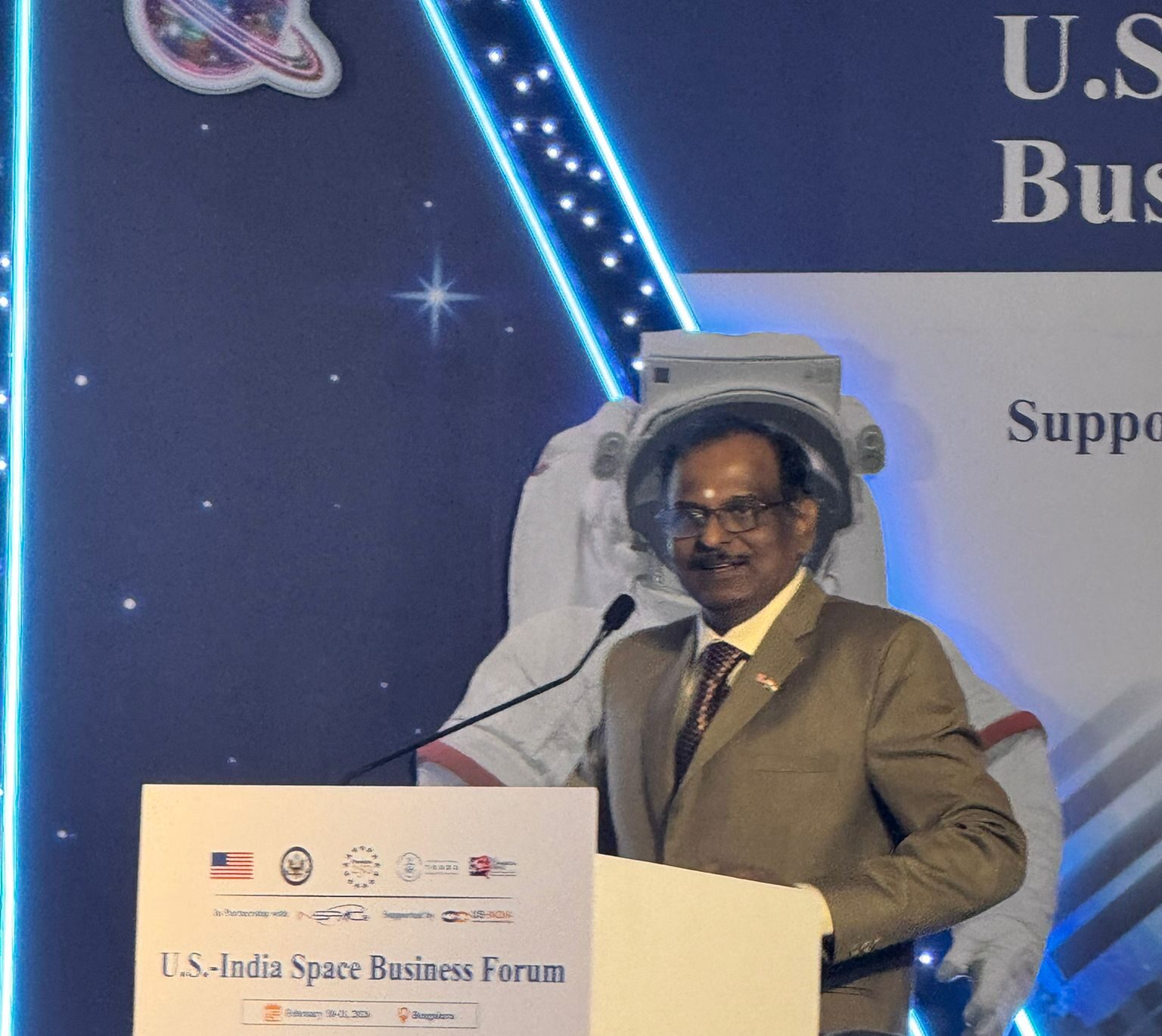
Bengaluru, NFAPost: The US-India Space Business Forum opened in Bengaluru on Tuesday, bringing together senior government officials, space agencies and industry leaders from both nations in a two-day effort to deepen strategic and commercial cooperation in the space sector.
The forum is focused on enhancing policy coordination, aligning regulatory frameworks and unlocking commercial opportunities, while advancing collaboration under the US–India Civil Space Joint Working Group (CSJWG). Discussions centred on moving beyond traditional cooperation toward co-creation—joint development, shared investment and market expansion.
From Cooperation to Co-Creation
Addressing the gathering, Carey Arun, US Consul General, underscored the scale of American participation, noting the presence of 14 US space companies along with officials from the US Department of Commerce.
He praised India’s strides in space science and innovation and expressed confidence that the bilateral relationship is poised to expand from technology exchange to deeper commercial integration.
The emphasis throughout the opening session was clear: regulatory alignment and predictable policy frameworks are essential to accelerate joint ventures, satellite missions, earth observation services and downstream space-based applications.
ISRO Chief Highlights 50 Years of Partnership
The keynote address was delivered by Indian Space Research Organisation Chairman V. Narayanan, who traced India-US space cooperation back to 1975.
Describing the partnership as “human-centric and application-oriented,” Narayanan highlighted landmark collaborations including Chandrayaan-1, the NISAR Earth observation mission, cooperation under the Gaganyaan programme, and the upcoming Axiom-4 mission.
“The Indian space programme was started not to compete with anybody but to bring advanced space technology for the benefit of the common man of India,” Narayanan said.
“Today, we strongly believe it is not only for the common man of India, but it also serves the global community. It is a human-centric, application-oriented programme.”
He reiterated India’s openness to global collaboration, investment and shared growth in the expanding space economy, calling for deeper international partnerships in exploration, satellite applications and commercial ventures.
Policy Alignment and Commercial Opportunity
The Civil Space Joint Working Group framework, under which the forum operates, aims to institutionalise dialogue on spectrum management, export controls, satellite licensing, data-sharing mechanisms and private sector participation.
With India’s space sector liberalisation accelerating in recent years, and US companies seeking reliable international partnerships amid growing global demand for satellite services, both sides view regulatory harmonisation as key to unlocking commercial scale.
Narayanan welcomed the American delegation and industry participants, describing the forum as symbolic of “growing convergence” between the two nations in space.
“This type of programme should be collaborative; an internationally collaborative one. In that context, the US-India Space Business Forum has brought almost 14 business partners from the USA,” he said.
A Strategic Moment
The timing of the forum is significant. India’s expanding private space ecosystem, coupled with US expertise in commercial launch, satellite manufacturing and downstream analytics, creates natural areas of synergy—from Earth observation and climate monitoring to deep space exploration and human spaceflight.
For Bengaluru—already home to ISRO and a thriving space-tech startup ecosystem—the event reinforces the city’s role as the epicentre of India’s space diplomacy and commercial expansion.
As deliberations continue over the two-day conference, the message is unmistakable: the India-US space partnership is evolving from collaboration to co-creation, from dialogue to deployment.
And Bengaluru, once again, is at the centre of that trajectory.














Leave a Reply