From record-breaking spacewalks to commanding the International Space Station, the Indian-origin astronaut redefined endurance, leadership, and exploration beyond Earth
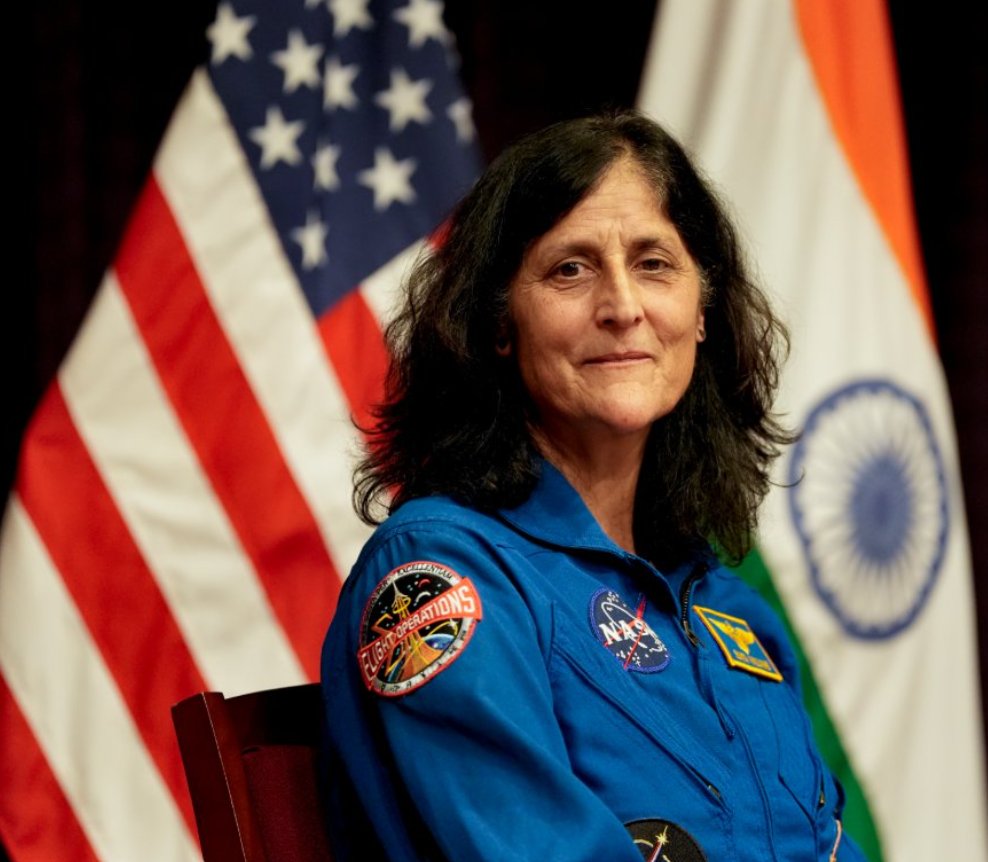
Bengaluru, NFAPost: With the quiet dignity that has defined her extraordinary career, Sunita Williams—one of NASA’s most accomplished astronauts and a global icon of human spaceflight—has retired after 27 years of service with NASA. Her retirement, effective December 27, 2025, marks the close of a remarkable chapter in space exploration, one defined by endurance, technical excellence, and an unyielding spirit of discovery.
Over the course of three long-duration missions aboard the International Space Station, Williams logged an astonishing 608 days in orbit, placing her second among NASA astronauts for cumulative time spent in space. She also etched her name into the record books as the first person to run a marathon in space, completing the Boston Marathon on a treadmill while orbiting Earth—an achievement that captured the public imagination and symbolised the expanding limits of human capability.
A Career Written in Records and Firsts
Williams’ career is a tapestry of milestones. She completed nine spacewalks, spending 62 hours and six minutes outside the space station, the most by any woman astronaut and the fourth-highest cumulative spacewalk time in human history. She is also tied for sixth place on NASA’s list of longest single spaceflights by an American, having spent 286 consecutive days in orbit during one mission.
“Anyone who knows me knows that space is my absolute favourite place to be,” Williams said in a statement released by NASA.
“It’s been an incredible honour to have served in the Astronaut Office and to have had the opportunity to fly in space three times. I’m super excited for NASA and its partner agencies as we take these next steps, and I can’t wait to watch the agency make history.”
From Space Shuttle to the New Commercial Era
Williams first travelled to space in December 2006 aboard the space shuttle Discovery on the STS-116 mission, returning to Earth in June 2007 on Atlantis as part of STS-117. During this early phase of her career, she served as a flight engineer on Expeditions 14 and 15, completing four spacewalks—a record at the time—and playing a key role in station assembly and maintenance.
Her second spaceflight came in 2012, when she launched aboard a Russian Soyuz spacecraft from the Baikonur Cosmodrome in Kazakhstan for a 127-day mission. As a member of Expeditions 32 and 33, Williams later assumed command of the International Space Station during Expedition 33, overseeing scientific operations and complex repair tasks. During this mission, she conducted three spacewalks, including critical work to repair a radiator leak and replace a power distribution component—operations vital to the station’s continued functioning.
Her final mission placed her at the heart of NASA’s transition to commercial human spaceflight. In June 2024, Williams and astronaut Butch Wilmore launched aboard Boeing Starliner for NASA’s Crew Flight Test, the first crewed mission of the spacecraft. The mission marked a turning point for commercial access to low Earth orbit. Williams later joined Expeditions 71 and 72, once again serving as space station commander.
After completing two additional spacewalks, Williams returned to Earth in March 2025, concluding a nine-month stay in orbit aboard SpaceX Crew Dragon as part of the Crew-9 mission.
A Leader Respected Across Generations
NASA leadership has been unanimous in its praise of Williams’ contributions. Jared Isaacman, NASA Administrator, described her as a force that shaped the future of exploration.
“Suni Williams has been a trailblazer in human spaceflight, shaping the future of exploration through her leadership aboard the space station and paving the way for commercial missions to low Earth orbit,” he said.
At the NASA Johnson Space Center in Houston, where Williams spent much of her career, Vanessa Wyche, Director of the centre, said her career set a benchmark for future astronauts.
“From her indelible contributions to the space station to her groundbreaking role in the Boeing Starliner test flight, her exceptional dedication will inspire generations of explorers,” Wyche noted.
Within the astronaut corps, Williams was known not just for her technical mastery but for her mentorship and humility. Scott Tingle, Chief of NASA’s Astronaut Office, reflected on her influence:
“She’s inspired so many people, including myself and countless other astronauts. Her professionalism and passion for the mission elevated everyone around her.”
Beyond Space: Service, Skill, and Science
Williams’ contributions extended well beyond her missions. Early in her career, she was part of NASA’s Extreme Environments Mission Operations (NEEMO) programme, spending nine days living and working in an underwater habitat—an experience designed to simulate the isolation and challenges of spaceflight.
Following her first mission, she served as Deputy Chief of NASA’s Astronaut Office, later becoming Director of Operations in Star City, Russia, where she worked closely with international partners. In her later years at NASA, she played a key role in developing a helicopter training platform to prepare astronauts for future Moon landings, reflecting her deep involvement in shaping the agency’s next era of exploration.
A retired US Navy captain, Williams is also a highly experienced aviator, with more than 4,000 flight hours across 40 aircraft, including helicopters and fixed-wing planes—skills that proved invaluable both in space and in training the next generation of astronauts.
Looking Back, Looking Forward
Reflecting on her journey, Williams credited the collective effort behind human spaceflight.
“The International Space Station, the people, the engineering, and the science are truly awe-inspiring,” she said. “They have made the next steps of exploration—to the Moon and Mars—possible.”
As Sunita Williams steps away from active service, her legacy remains firmly in orbit: in the records she set, the missions she led, and the inspiration she continues to provide to aspiring explorers across the world—particularly in India and among women in science and engineering. Her career stands as a powerful reminder that endurance, curiosity, and leadership can quite literally take humanity beyond Earth.