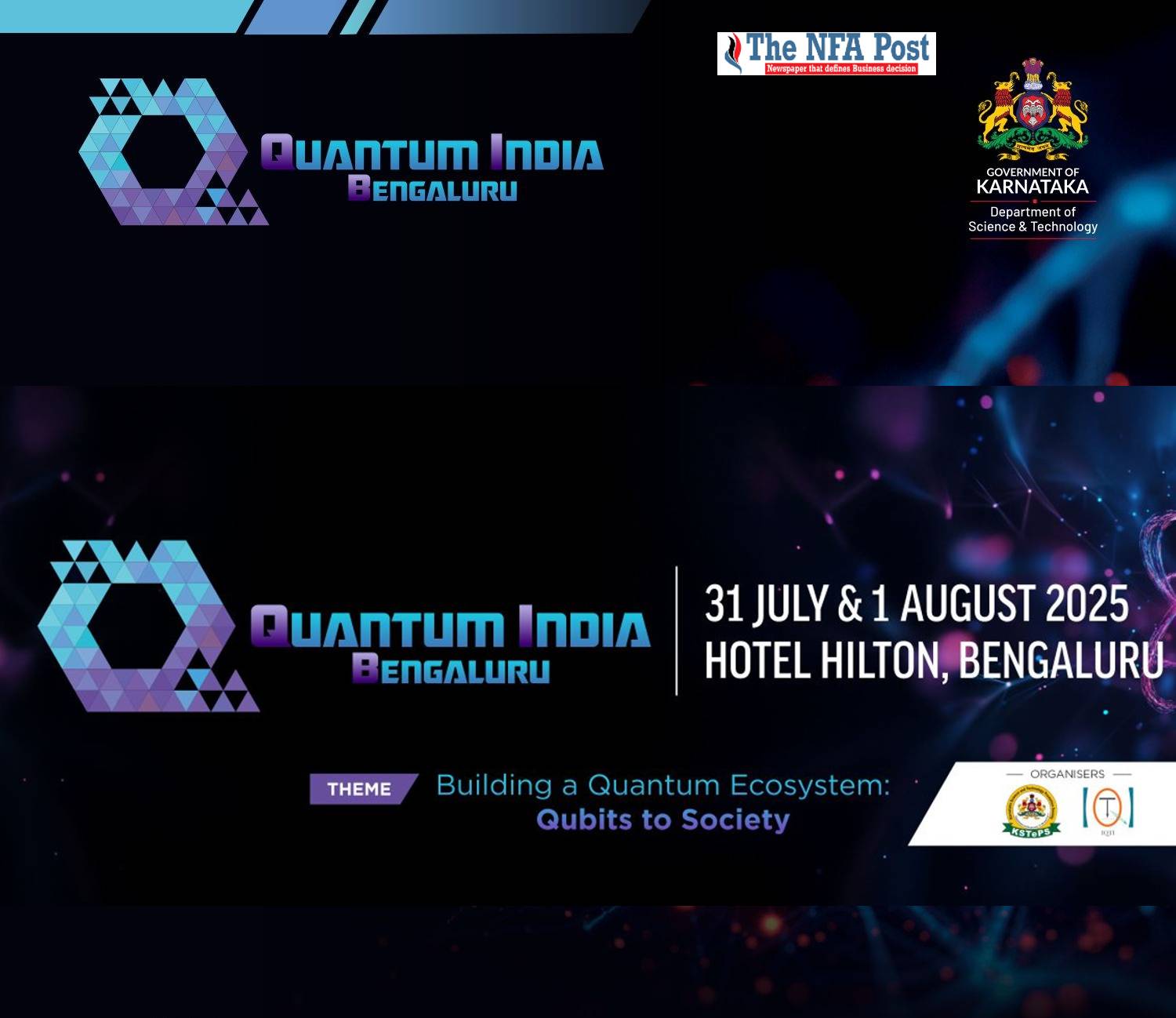
Bengaluru, NFAPost: Setting the stage for India’s ambitious journey to gain quantum technology supramacy, the city is hosting the first edition of two day summit Quantum India Bengaluru 2025 (QIB 2025) starting on July 31st.
Speaking on the event, Indian Institute of Science (IISc) Professor and Quantum India Bengaluru (QIB) 2025 Conference Chair Arindam Ghosh said Quantum India Bengaluru 2025 has been thoughtfully designed to unite innovation with real-world impact.
“Moving beyond conventional academic silos, we have identified five priority sectors of healthcare, strategic security, computing and AI, quantum hardware, and societal engagement, where quantum technologies can create both immediate and long-term value,” said QIB 2025 Chair Arindam Ghosh.
Bengaluru is hub of quantum technology with the support of premier institutions such as the Indian Institute of Science (IISc), the Raman Research Institute (RRI) and the International Center for Theoretical Sciences (ICTS) serving as key nodes in national research efforts.
QIB 2025 Chair Arindam Ghosh also said the summit actively builds an ecosystem where collaboration between academia, startups, industry, and strategic sectors begins at the foundational level.
“Our vision is to drive inclusive, application-focused quantum development that delivers meaningful economic and technological outcomes aligned with national priorities,” said QIB 2025 Chair Arindam Ghosh.
QIB 2025 will feature five major themes, which will be conducted as parallel sessions during the conference.
- Quantum in Computing, finance, and AI
- Quantum in Healthcare
- Quantum in security
- Quantum Peripherals and Hardware
- Quantum in Society and Art
With a mission to lay a solid foundation for the field of quantum technologies, and to establish a framework to promote collaborations between physicists, material scientists, computer scientists and engineers, IISc launched its Quantum Technology Initiative (IQTI) in September 2020.
Speaking to TheNFApost, QpiAI Founder Nagendra Nagaraja said with an ambitious vision to inspire young researchers, foster deep-tech startups, and attract global investments, the first edition of Quantum India Bengaluru 2025 (QIB 2025) will drive Bengaluru’s transformation into a quantum innovation hub.
“It is only fitting that the inaugural edition of QIB will take place in 2025—The International Year of Quantum—marking a defining moment for India’s quantum ambitions. I am also happy to know that Quantum Research Park (QuRP), a Hub for Quantum Computing and related technologies, is shapping up in the state of Karnataka,” said QpiAI Founder Nagendra Nagaraja.
A year later Quantum Research Park (QuRP), a Hub for Quantum Computing and related technologies is a project administered by Foundation for Science Innovation and Development (FSID), IISc with support from Karnataka Innovation and Technology Society (KITS), Government of Karnataka was set up at IISc. The state government has announced a grant of Rs 48 crore for the 2nd phase of QuRP.
“QuRP will encourage scientific inventions & innovations in the field of Quantum Computing and related technologies. We envision creating QuRP to foster skill development, mentorship, and industry/startup collaborations in the domain of quantum technologies,” said QIB 2025 Chair Arindam Ghosh.
It may be noted that the Union Cabinet had approved the National Quantum Mission (NQM) on April 19, 2023 at a total cost of Rs 6003.65 crore from 2023-24 to 2030-31, aiming to seed, nurture and scale up scientific and industrial R&D and create a vibrant & innovative ecosystem in Quantum Technology (QT). This will accelerate QT led economic growth, nurture the ecosystem in the country and make India one of the leading nations in the development of Quantum Technologies & Applications (QTA).
As part of this mission, four Thematic Hubs (T-Hubs) have been set up, bringing together 14 Technical Groups across 17 states and 2 Union Territories. These hubs focus on technology innovation, skill development, entrepreneurship, industry partnerships, and global collaborations, ensuring a truly national impact. Women scientists from every corner of the country are actively encouraged to participate and benefit from the mission’s exciting programmes.
The four T-Hubs have been established across leading institutions in India: Indian Institute of Science (IISc) Bengaluru; Indian Institute of Technology (IIT), Madras in association with the Centre for Development of Telematics, New Delhi; Indian Institute of Technology (IIT), Bombay and Indian Institute of Technology (IIT), Delhi.
These hubs were selected through a rigorous competitive process and each hub focuses on a specific quantum domain, driving advancements in Quantum Computing, Quantum Communication, Quantum Sensing & Metrology, and Quantum Materials & Devices.