India positions itself as the torchbearer of inclusive, people-centric solar development ahead of COP30
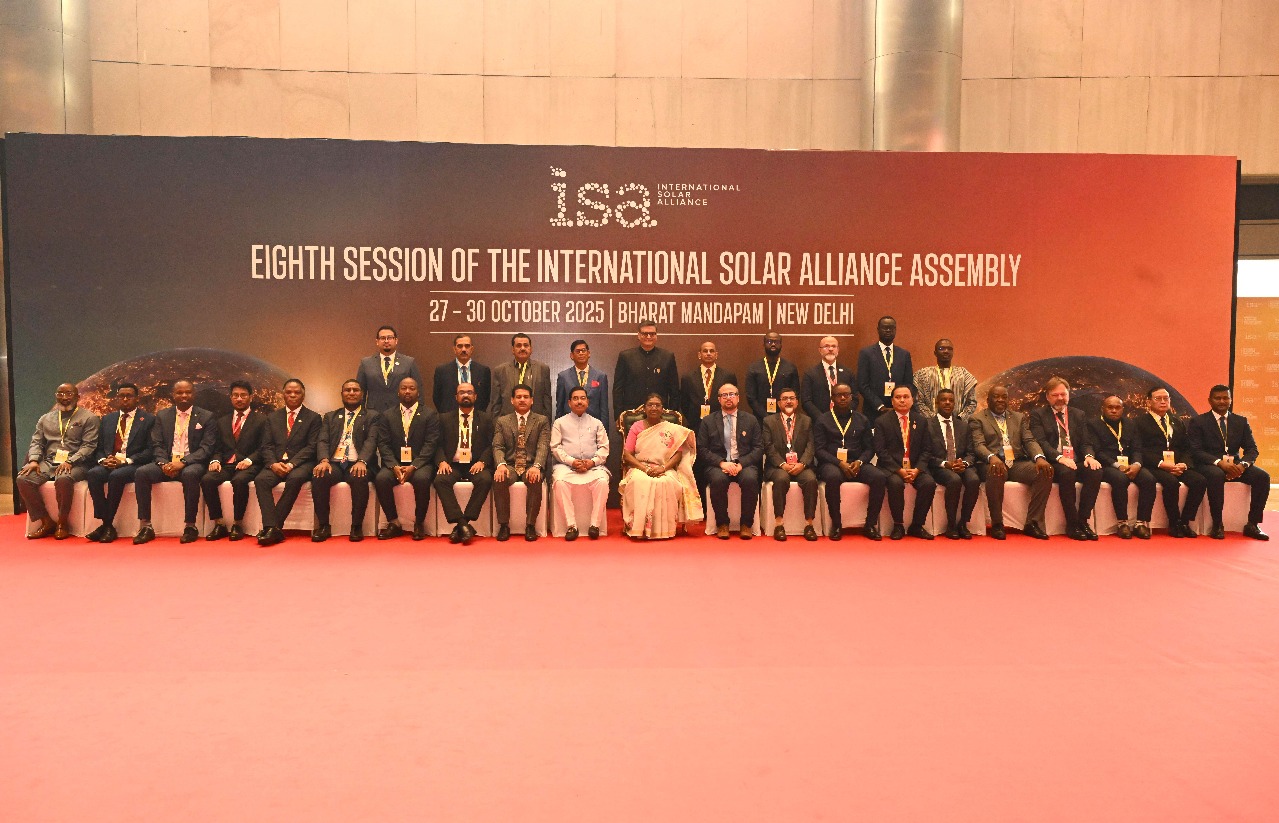
NFAPost, Bengaluru: In a landmark moment for global renewable diplomacy, the Hon’ble President of India, H.E. Smt. Droupadi Murmu, delivered the keynote address at the Eighth Session of the International Solar Alliance (ISA) Assembly held at Bharat Mandapam, New Delhi — marking the first-ever address by an Indian President to the ISA Assembly.
Before an audience of over 550 delegates and 30 ministers and vice-ministers from 125 Member and Signatory Countries, President Murmu urged the Global South to take the lead in shaping an inclusive and sustainable solar future that empowers communities and safeguards ecosystems.
“The next step must be deeper inclusivity, ensuring that no woman, no farmer, no village, and no small island is left behind in this solar revolution,” said President Murmu. “Our progress should not only be measured through megawatts but through the number of lives illuminated, the number of families strengthened, and the number of communities transformed.”
The President underscored India’s steadfast commitment to ISA’s founding vision of “One World, One Sun, One Grid”— a concept advanced by Prime Minister Shri Narendra Modi. She called on the Assembly to focus on technology sharing, job creation, women’s leadership, and ecological preservation as the pillars of a just energy transition.
A Decade of Solar Leadership
Since its announcement at COP21 in Paris, the International Solar Alliance has evolved from an ambitious idea into a results-driven global institution. Guided by four strategic pillars — Catalytic Finance, Global Capability Centre & Digitisation, Regional Engagement, and Technology Roadmap & Policy — ISA has become a cornerstone of global energy transition efforts.
Highlighting ISA’s progress, President Murmu pointed to landmark initiatives such as the Global Solar Facility, the Small Island Developing States (SIDS) Platform, and Africa’s Solar Mini-Grids, which collectively demonstrate how collaborative innovation can reshape energy access across continents.
India: From Ambition to Global Leadership
Delivering the opening address, Shri Pralhad Joshi, Hon’ble Minister for New and Renewable Energy and President of the ISA Assembly, hailed ISA as a “true symbol of global cooperation and shared purpose.”
“India is now the world’s fourth-largest in renewable energy capacity,” said Joshi. “Under the leadership of Hon’ble Prime Minister Shri Narendra Modi, we achieved our Nationally Determined Contribution target of 50% capacity from non-fossil sources five years ahead of schedule. India is the voice of the Global South — and through ISA, we are turning that voice into action.”
India’s renewable energy achievements continue to inspire global action. The nation has already produced over 1,08,000 GWh of solar electricity, averted fossil fuel and pollution-related costs worth ₹4 lakh crore (USD 46 billion), and achieved half its total installed capacity from non-fossil fuel sources years ahead of its 2030 target.
Through ISA, India plans to replicate successful models such as PM Surya Ghar – Muft Bijli Yojana and PM-KUSUMin developing countries, particularly in Africa and small island nations — extending the benefits of people-focused, decentralised solar systems worldwide.
France Reaffirms Partnership and Support
Representing the French Co-Presidency of ISA, H.E. Mrs. Eléonore Caroit, French Minister of State for Francophonie and International Partnerships, reaffirmed France’s deep commitment to the Alliance:
“France attaches the utmost importance to the International Solar Alliance, which plays a pivotal role in advancing solar energy. Since the launch of the Alliance nearly a decade ago, France has had the honour of serving as co-president alongside India.”
Echoing this sentiment, H.E. Mr. Benoit Faraco, Special Envoy for Climate at the French Ministry for Europe and Foreign Affairs, said, “The Alliance’s work directly contributes to implementing COP decisions. We look forward to seeing ISA showcase its success at COP30 in Brazil.”
France also announced new financial support for ISA’s flagship Africa Solar Facility, underscoring its commitment to accelerating clean energy access across the continent.
From Advocacy to Action: ISA’s Expanding Impact
Mr. Ashish Khanna, Director General of the ISA, described the world as standing “at a turning point in the solar revolution.”
“It took 25 years to build the first 1,000 GW of solar capacity — but only two years to add the next 1,000 GW,” Khanna said. “ISA is now moving from advocacy to action, helping nations scale up sustainable and inclusive solar economies.”
Khanna highlighted ISA’s latest initiatives, including the SUNRISE Network for solar waste recycling, the One Sun One World One Grid (OSOWOG) programme to enable inter-regional solar connectivity, and a Global Capability Centreenvisioned as a “Silicon Valley for Solar” in India.
The ISA Academy, another key launch, introduces an AI-driven online learning platform offering personalised training pathways to democratise access to solar knowledge worldwide.
Spotlight on Global Solar Knowledge
The Assembly also unveiled five major knowledge products shaping the next phase of the solar decade:
- Ease of Doing Solar 2025 – Reports USD 861 billion in energy transition investments from ISA countries, with solar power driving USD 521 billion of it.
- Solar PV Skills and Jobs in Africa – Projects solar workforce growth to 4.2 million by 2050, led by technicians and small-scale systems.
- Global Solar Trends & Outlook 2025 – Charts solar’s dominance in global clean energy expansion.
- Solar Compass: Special Issue on Integrated PV – Explores how Building-Integrated Photovoltaics can reshape urban development across the Global South.
- Global Floating Solar Framework – Projects rapid capacity growth led by Asia-Pacific, with generation costs already as low as USD 0.05–0.07/kWh.
Charting the Solar Future
As the Assembly concludes, delegates will visit the BSES Rajdhani Power Limited’s Kilokri Battery Energy Storage System — India’s largest standalone urban BESS — and the Digital Twin of Network Project in Janakpuri, a pioneering initiative creating real-time digital twins for power distribution.
The Eighth ISA Assembly reaffirms the Alliance’s vision: to make solar energy accessible, affordable, and reliable for all — lighting homes, empowering livelihoods, and driving sustainable growth across the Global South.
“This is the moment for Global South leadership in shaping an inclusive, resilient, and solar-powered future,” Khanna said.
About the International Solar Alliance:
Launched in 2015 by India and France at COP21, the International Solar Alliance unites 125 Member and Signatory Countries to promote solar energy as a cornerstone of sustainable development. Headquartered in India, ISA works across four strategic pillars — Catalytic Finance, Capability & Digitisation, Regional Engagement, and Technology & Policy — to mobilise investment, foster innovation, and enhance energy access globally.
For more information: www.isa.int
Media Contact: Aarti Narain | aartinarain@isa.int