Minister Signals Wider Role for Private Sector in Space, Nuclear and Strategic Research Domains
Growing Patent Filings and Tier-2 Innovators Reflect Expanding National Research Base, Says the Minister
New Delhi, NFAPost: Union Minister of State (Independent Charge) for Science and Technology Jitendra Singh called for deeper and sustained collaboration between industry, academia, and government, stating that such partnerships are no longer optional if India intends to establish itself as a global research and innovation centre.
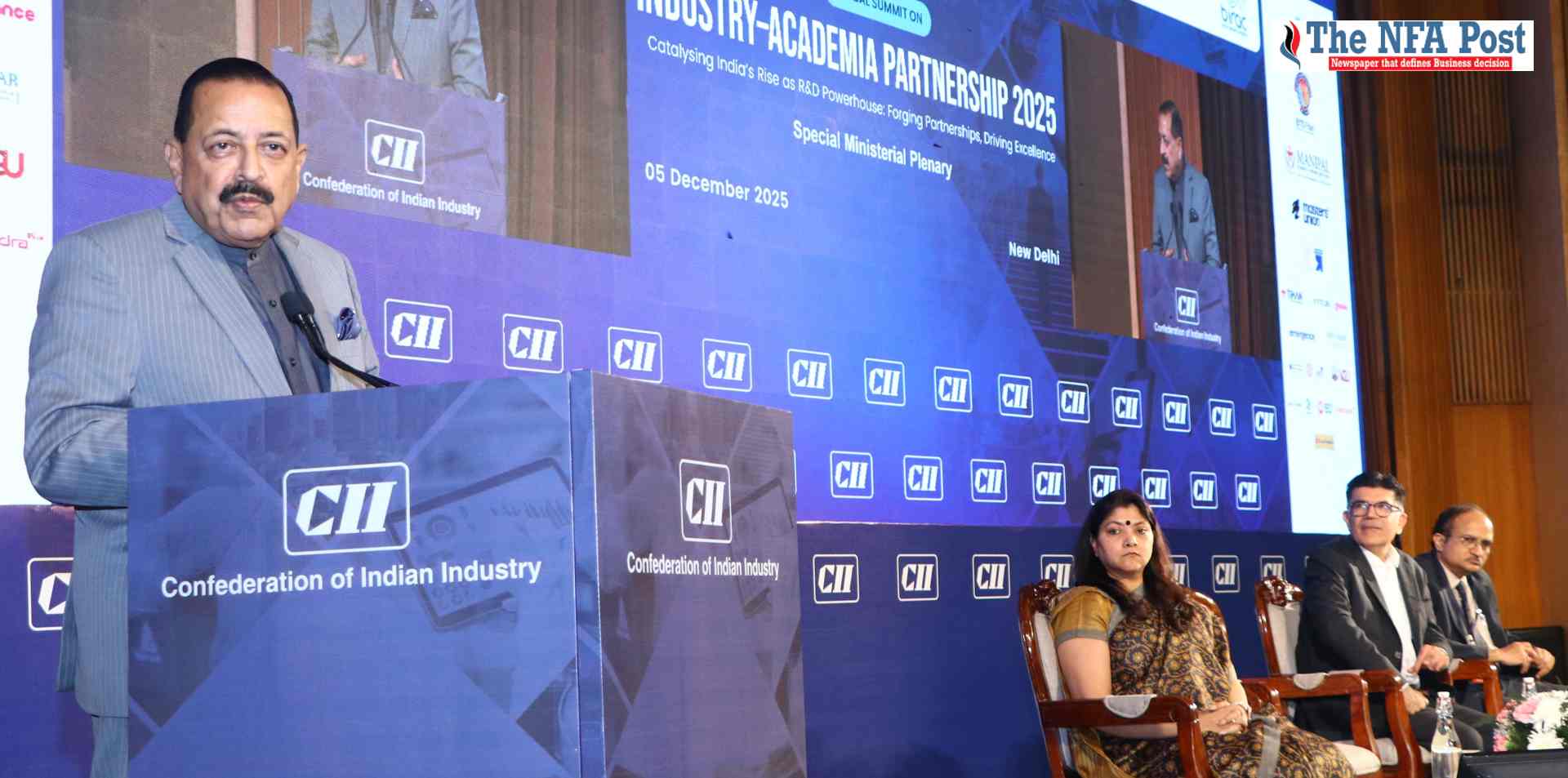
Speaking at the Global Summit on Industry–Academia Partnership 2025, themed “Catalysing India’s Rise as an R&D Powerhouse: Forging Partnerships, Driving Excellence,” the Minister said India’s growth ambitions in science, technology and strategic sectors require an ecosystem built on shared responsibility and participation.
“Here I want to highlight a change in national approach towards research and innovation, noting increased openness to collaboration with industry and greater participation from private players in strategic sectors. It is a motivating fact that patent filings and the growing contribution of young innovators from smaller cities as indicators of this shift,” said Union Minister of State (Independent Charge) for Science and Technology Jitendra Singh.
He said that recent decisions to allow wider non-government involvement in areas such as space and nuclear research reflect evolving confidence in collaborative models. Acknowledging that such sectors were traditionally reserved for the government, he noted that expanding the role of private entities will be central to accelerating innovation-based growth.
Referring to global research structures, Union Minister of State (Independent Charge) for Science and Technology Jitendra Singh said India must increasingly benchmark its strategies with international institutions that draw heavily from non-government sources. In this context, he underscored the importance of government gradually taking on the role of facilitator, enabling industry, academia and startups to work jointly in priority science and technology domains.

“Initiatives such as the National Research Foundation and recently announced research funding mechanisms are attempts to stimulate private investment in innovation and build long-term research linkages. I expect that industry will, over time, emerge as a major contributor to research output and national economic growth,” said Union Minister of State (Independent Charge) for Science and Technology Jitendra Singh.
Jitendra Singh also spoke about the growing aspirations of young people across Tier-2 and Tier-3 cities, noting that access to information and digital platforms has made them active participants in India’s innovation journey. The Minister said that domestic patent filings from young researchers and entrepreneurs reflect this shift and demonstrate the expanding research base within the country.
“Institutional platforms such as InSpace and similar interfaces in biotechnology help ensure that collaborations are structured, transparent and mutually beneficial, while bringing academic research closer to industrial application,” said Union Minister of State (Independent Charge) for Science and Technology Jitendra Singh.
Jitendra Singh released the CII Industry–Academia Partnership Compendium 2025 at the event, and later visited an exhibition that showcased products and technologies developed by startups, research institutions and academic bodies.
Concluding his remarks, Union Minister of State (Independent Charge) for Science and Technology Jitendra Singh said India’s evolving scientific landscape requires long-term partnerships among research institutions, industry, startups and government. Calling such cooperation essential for achieving national goals in emerging technologies and strategic capability, he emphasised that the country’s innovation ecosystem must continue to broaden participation, strengthen linkages, and encourage shared ownership of research outcomes.


******