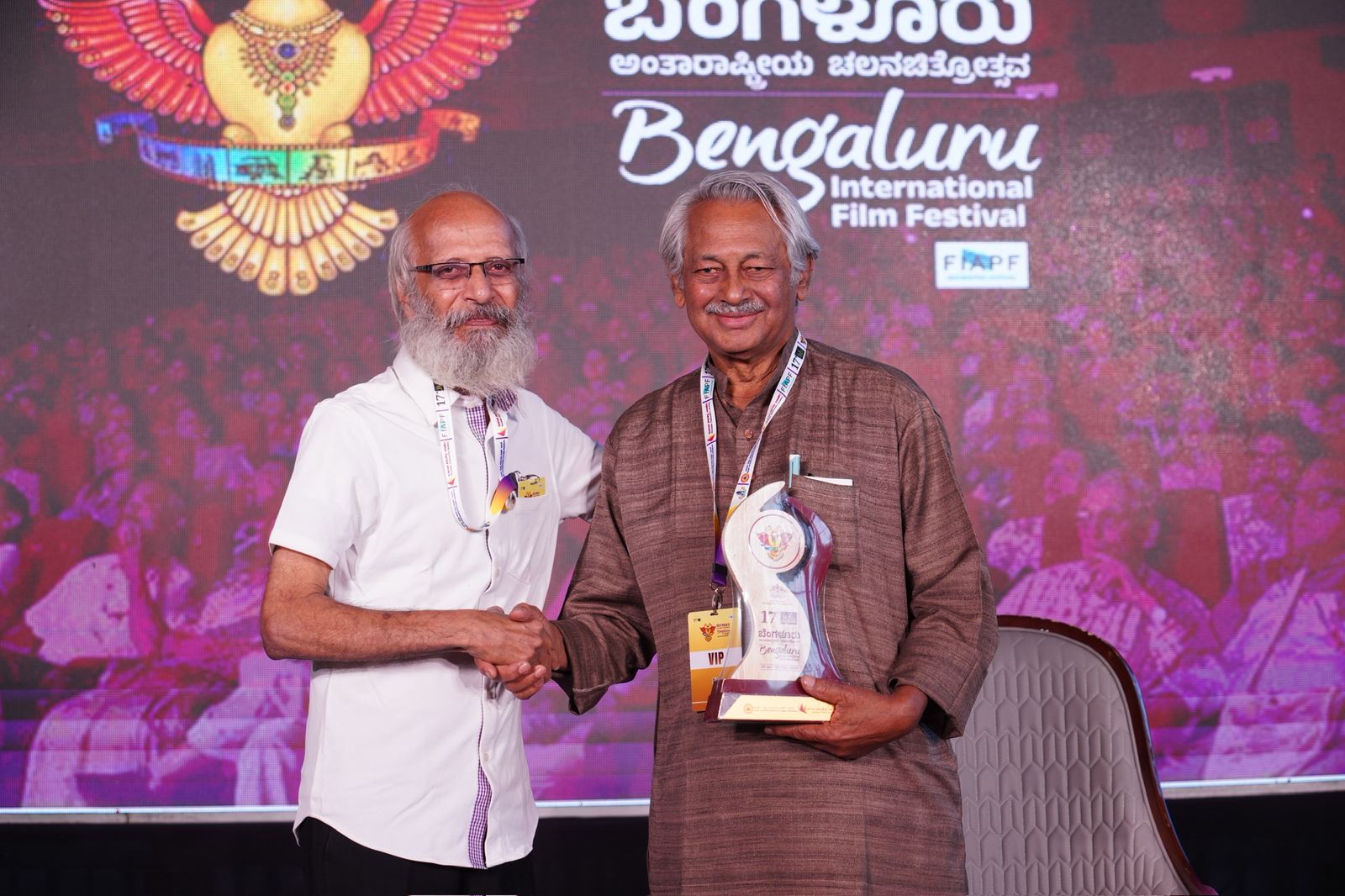
At BIFFes, the Padma Shri–winning filmmaker traces how television and OTT have reshaped cinematic grammar, challenged beauty norms, and brought storytelling closer to lived realities
Bengaluru, NFAPost: OTT platforms have emerged as one of the most significant forces in contemporary storytelling, bringing cinema closer to everyday life and the real problems people face, observed eminent filmmaker and Padma Shri awardee Girish Kasaravalli at the 17th Bengaluru International Film Festival (BIFFes).
Participating in a panel discussion at the festival, Kasaravalli reflected on how successive technological shifts—from television to streaming platforms—have fundamentally altered the way cinema represents people, aesthetics and social realities.
“OTT platforms are portraying issues and lifestyles that are very close to our everyday lives,” he said. “In that sense, they play a very important role today.”
How Television First Broke Old Myths
Looking back nearly three decades, Kasaravalli recalled how the rise of television brought about a quiet but powerful disruption in Indian visual culture.
“One of the biggest positive changes that television brought about 30 years ago was the breaking of certain long-held beliefs,” he said. “Before that, there was a strong notion that for an actress to become a star, she had to be beautiful, regardless of how talented she was. Talent always came second.”
According to him, this mindset reflected a market-driven logic that valued appearance over artistic merit.
“Artists were being understood purely through the lens of market economics,” he noted.
Television, however, changed that equation by opening doors to performers drawn directly from everyday society—people who may not have fit conventional beauty standards, but possessed immense talent.
Anita Kanwar and the Limits of Acceptance
Citing a striking example, Kasaravalli spoke about Anita Kanwar, whose television performances left a lasting impact.
“Anita Kanwar successfully led a television serial for nearly two years,” he said. “Yet, the film industry never fully accepted her.”
For Kasaravalli, this highlighted the subtle contradictions and new forms of exclusion that accompanied these shifts—progressive in some ways, but limited in others.
Web Series as the Next Cultural Shift
Drawing parallels to the present moment, Kasaravalli argued that web series and OTT content are now playing a similar transformative role.
“Many subtle changes and new forms of dissatisfaction are unfolding today,” he observed. “In my view, web series are addressing these realities far more effectively. That is why we must move forward in step with OTT.”
He suggested that streaming platforms are expanding the scope of storytelling by allowing more nuanced characters, slower rhythms and socially grounded narratives—elements often constrained in mainstream cinema.
Cinema Grammar Changes Every Two Decades
Placing these developments in a broader historical context, Kasaravalli spoke about cinema as an evolving art form.
“Cinema is about 130 years old,” he said. “But every 20 years, its grammar changes.”
These shifts, he explained, are never purely technological.
“Behind every such change lies politics. Behind it lies a new way of expression that seeks to emerge.”
From silent films to sound, from television to OTT, each transformation has redefined how stories are told—and whose stories are considered worthy of being told.
Staying in Step with Change
Kasaravalli’s reflections offered both a historical lens and a gentle provocation to filmmakers and audiences alike: resisting change may mean missing out on powerful new voices.
At BIFFes, his words served as a reminder that cinema’s vitality lies in its ability to adapt—embracing new platforms not as threats, but as opportunities to reconnect with society, deepen expression and reflect the truths of changing times.