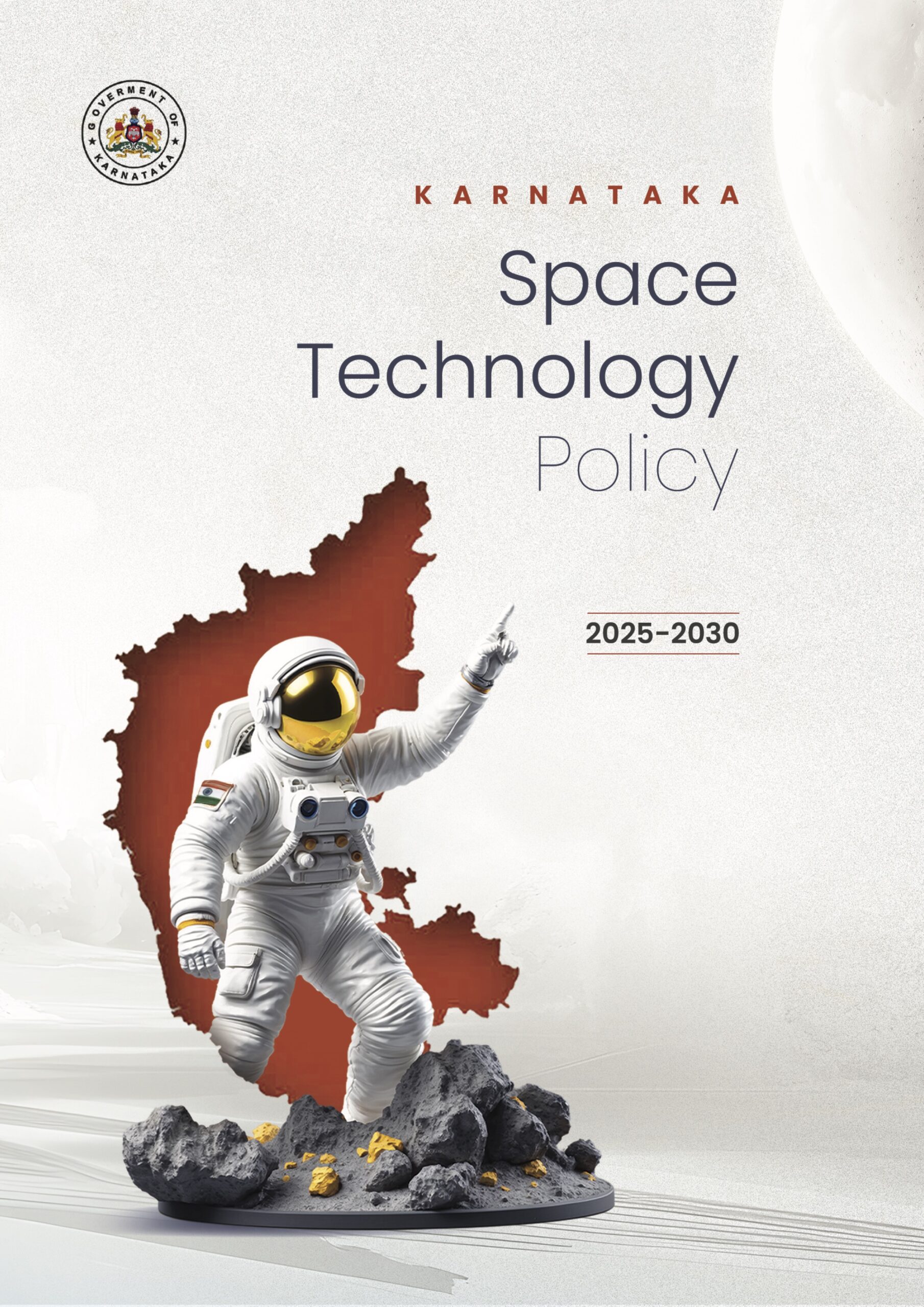
NFAPost, Bengaluru: Karnataka’s Space Technology Policy 2025–2030 marks one of India’s most ambitious state-level interventions in the NewSpace era. Drawing directly from the evolving industrial dynamics of global space commerce, the policy outlines a comprehensive strategy to position the state as the country’s dominant space hub. It targets 50% of India’s space market share by 2033—equivalent to USD 22 billion—and aims to capture 5% of the global space economySpace Technology Policy 2025-30…. This is not merely a sectoral policy; it is an economic and technological agenda that aligns Karnataka’s scientific legacy with the demands of private-led space commercialization.
I. Policy Vision: From Legacy Leadership to Global Ambition
Bengaluru already hosts ISRO’s headquarters and much of India’s space-science talent base. The new policy takes this historic advantage and converts it into a strategic roadmap.
The vision is explicit:
- Sustain Karnataka as the No. 1 destination for space technology in India.
- Hold 50% of India’s space market by 2033.
- Build comprehensive capabilities across the entire space value chain, upstream and downstream.
- Capture 5% of the global space market through end-to-end manufacturing, testing, applications, and services Space Technology Policy 2025-30….
This approach recognizes that India’s private space revolution will be driven by states capable of fostering manufacturing, R&D, and market-ready innovation. Karnataka wants to be that state.
II. Structural Architecture: The Five Strategic Pillars
The policy is built on five pillars, each mapped to core bottlenecks in India’s NewSpace ecosystem:
1. Skill Development
Karnataka plans to train 50,000 students and professionals, including 15,000 women, through ISRO, IN-SPACe, academia and industry partnerships Space Technology Policy 2025-30….
This is significant because today’s space-tech jobs require embedded systems, materials science, advanced optics, AI, avionics, and multi-domain engineering expertise—not only rocket science. The inclusion of ITIs, polytechnics, diploma colleges, and universities widens the recruitment base, addressing a critical talent shortage in the Indian space sector.
2. Investments
The state aims to attract USD 3 billion in space-sector investments across startups, MSMEs, OEMs, and global companies.
Incentives include:
- 20% subsidy on plant and machinery
- 25% subsidy on land (up to 5 acres) outside Bengaluru Urban
- 50% exemption on stamp duty
- Rent reimbursement for five years
- 100% electricity duty exemption for five years
- ETP subsidies up to ₹2.5 crore Space Technology Policy 2025-30…
For large investments (>₹100 crore), a special package can be crafted—giving Karnataka the flexibility to negotiate with global OEMs.
3. Infrastructure and Testing Facilities
The biggest bottleneck in India’s private space industry is access to high-quality testing infrastructure. Karnataka’s policy tackles this head-on.
Key provisions:
- Dedicated Space Manufacturing Parks with plug-and-play facilities
- Integrated AIT (Assembly, Integration, Testing) clusters
- New test centers under PPP
- A statewide catalogue and unified access point for all testing facilities (ISRO, PSUs, academia, private labs) Space Technology Policy 2025-30…
This is critical, because testing queues at national facilities often delay private-sector missions by months.
4. Innovation and Facilitation
The policy introduces one of India’s most detailed innovation-support mechanisms:
- Establishment of a Center of Excellence for Space Technology acting as an ecosystem nerve center.
- Support for technology transfer from ISRO, IN-SPACe, DRDO.
- Financial support up to:
- ₹1 crore for testing
- ₹75 lakh for R&D
- ₹75 lakh for standards/certifications
- ₹75 lakh for technology acquisition
- ₹1.5 crore for global market access
- IP support: ₹5 lakh for domestic patents and ₹10 lakh for international patents Space Technology Policy 2025-30….
The policy even commits to facilitating 50+ satellites designed, built, and launched by Karnataka-based companies by 2030—a rare measurable milestone in Indian policy frameworks.
5. Adoption & Awareness
This pillar is unique because it connects space tech to socioeconomic sectors.
Key mechanisms:
- An inter-departmental committee to identify and deploy EO, SatCom, and PNT applications in agriculture, mining, forest management, urban governance, and disaster response.
- Preferential Market Access (PMA) for Karnataka startups developing space-based solutions.
- Development of Geospatial Digital Public Infrastructure (DPI) to democratize satellite data access across academia, startups, and government entities.
- Special research grants for foundational EO models powered by AI Space Technology Policy 2025-30….
This ensures that Karnataka’s space-policy is not isolated—but interlinked with governance and economic transformation.
III. Upstream + Downstream Coverage: A Full Value-Chain Approach
Unlike many policies that focus heavily on downstream analytics or manufacturing alone, Karnataka takes a value-chain complete approach:
Upstream (Hardware & Missions)
Support for:
- Satellite design and manufacturing
- Launch vehicle components
- Payloads, propulsion, TT&C, GNC systems
- Space robotics, debris removal, refueling, in-orbit manufacturing
- Space tourism and space stations in the long-term horizon
- SSA/SDA ground stations and orbital services Space Technology Policy 2025-30…
Downstream (Applications & Services)
Support for:
- Earth observation data analytics
- Satellite broadband & IoT connectivity
- Satcom user terminals and ground systems
- PNT-based precision systems
- Digital Public Infrastructure for space data Space Technology Policy 2025-30…
This is one of the most expansive policy definitions of space-sector coverage in India.
IV. Startups & MSMEs: The Detailed Incentive Framework
Space startups face long gestation cycles, capital-intensive prototyping, and high testing costs. Karnataka directly addresses this through an unusually generous incentive package:
Financial Interventions
- Subsidized testing, technology acquisition, and quality certification
- Grants for internships, enabling student integration into the NewSpace workforce
- Provident Fund reimbursement for newly hired employees
- Global market access funding—a critical factor for startups seeking international customers
- Research and biotech-space R&D grants Space Technology Policy 2025-30…
This positions Karnataka as one of the most startup-friendly space ecosystems globally.
V. Governance Mechanisms: From Policy Paper to Execution
To prevent policy stagnation, Karnataka has established a multi-layer implementation model:
- A Space Technology Cell under KITS for single-window implementation
- A Vision Group of ISRO, IN-SPACe, NSIL, DRDO, academia, and private industry experts
- Clear eligibility criteria aligned with the Indian Space Policy 2023 and IN-SPACe NGPs
- A 5-year timeline with operational guidelines to follow Space Technology Policy 2025-30…
This governance architecture ensures policy durability and technical clarity—often missing in state-level tech policies.
VI. Strategic Assessment: Strengths & Challenges
Strengths
- Comprehensive value-chain coverage (rare in state policies)
- Heavy incentives that reduce early-stage risk
- Dedicated infrastructure parks + testing clusters
- Strong public-private innovation frameworks
- Concrete numerical goals (50 satellites, 50k skilled workers, USD 3B investments)
Potential Challenges
- Execution bottlenecks if testing facilities don’t scale fast enough
- Overlap with Aerospace & Defence Policy—requires careful synergy
- Global OEM attraction will depend on ease of land acquisition and turnaround timelines
- Need for sustained political and bureaucratic continuity beyond 2030
Nevertheless, the policy is forward-looking, technically sound, and clearly crafted with deep stakeholder input.
Conclusion: Karnataka’s Bid to Lead India’s NewSpace Race
Karnataka’s Space Technology Policy 2025–2030 is one of India’s most detailed, ambitious, and execution-ready space policy frameworks. It signals the state’s determination to not just participate in India’s space surge, but to shape and dominate it.
By integrating manufacturing, testing, R&D, talent, investment, and downstream societal applications, Karnataka has positioned itself as the gravitational center of India’s NewSpace industry. If executed with precision, the state could indeed achieve its target of becoming the launchpad of India’s space decade.