Deviation during third stage halts India’s first space mission of 2026; ISRO initiates detailed failure analysis
Bengaluru, NFAPost: India’s workhorse launch vehicle, the Polar Satellite Launch Vehicle (PSLV), suffered a rare setback on Monday as the PSLV-C62 mission encountered an anomaly during its third stage, preventing the successful placement of the primary earth observation satellite into orbit.
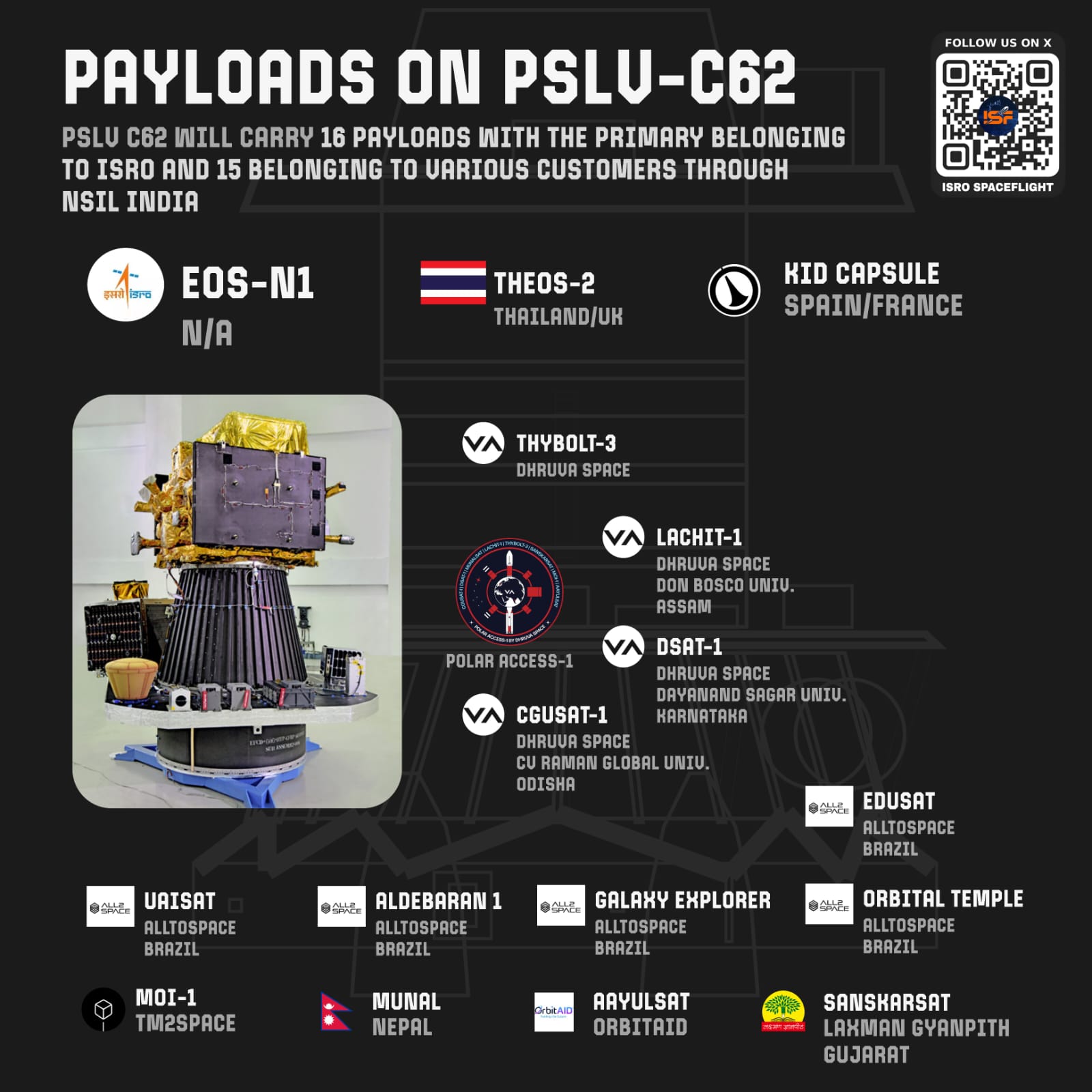
The mission, which marked the Indian Space Research Organisation’s first launch of 2026, lifted off from the First Launch Pad at the Satish Dhawan Space Centre in the early hours, carrying the EOS-N1 satellite along with 14 co-passenger payloads and a re-entry capsule.
However, minutes into the flight, ISRO confirmed that a deviation was observed during the PS3 phase of the mission.
“The performance of the vehicle close to the end of the third stage was as expected. But close to the end, we are seeing more disturbance in the vehicle. Subsequently, a deviation in the flight path was observed,” ISRO Chairman V. Narayanan said in a post-launch briefing.
“We are analysing the data and will come back at the earliest.”
A High-Stakes Commercial and Technology Mission
The 44.4-metre-tall PSLV-C62 was flying a commercial mission for NewSpace India Limited, marking the 64th flight of PSLV and the fifth mission of the PSLV-DL configuration.
The launch carried a diverse mix of Indian and international payloads, making it one of ISRO’s most complex multi-satellite missions in recent years. Applications spanned on-orbit AI processing, IoT services, store-and-forward communication systems, radiation measurement, and agricultural data collection.
At the heart of the mission was EOS-N1 (Anvesha), a hyperspectral earth observation satellite designed for advanced surveillance, environmental monitoring, and strategic applications.
Key Payloads Aboard PSLV-C62
Among the most closely watched secondary payloads was AayulSAT, developed by Bengaluru-based startup OrbitAID Aerospace. The satellite is India’s first on-orbit refuelling demonstrator, aimed at validating propellant transfer and satellite servicing technologies in low Earth orbit—capabilities seen as critical for sustainable space operations and life-extension of satellites.
Another notable payload was the KID re-entry capsule, a European technology demonstrator developed in collaboration with a Spanish startup. The capsule was intended to separate from the PSLV’s fourth stage and splash down in the South Pacific Ocean, validating controlled atmospheric re-entry technologies.
The mission also included CubeSats and small satellites from universities and startups, including Dhruva Space’s CGUSAT, along with international partner missions supporting research and commercial use cases.
A Second Consecutive Third-Stage Setback
The anomaly comes months after a rare failure of PSLV-C61, launched on May 18, 2025, which was unable to place the EOS-09 satellite into its intended orbit—also due to a third-stage issue.
Following that mission, ISRO had constituted a failure analysis committee, carried out extensive reviews, and implemented corrective measures before returning PSLV to flight with C62. The latest incident underscores the technical sensitivity of the solid-propellant PS3 stage, even for a launcher with a reliability record built over three decades.
ISRO’s Road Ahead
Despite the setback, ISRO officials stressed that a detailed post-flight analysis is already underway, with telemetry and flight data being examined to identify the precise cause of the deviation.
Historically, ISRO has used such anomalies to strengthen its launch systems, often returning to flight with enhanced robustness. The outcome of the PSLV-C62 investigation will be critical not only for upcoming PSLV missions but also for maintaining confidence among international customers as India scales up its commercial launch ambitions.
As India’s space programme enters 2026 with ambitious civil, commercial, and strategic goals, the PSLV-C62 mission serves as a reminder that spaceflight remains unforgiving—and that even proven launch vehicles demand constant vigilance, refinement, and engineering discipline.