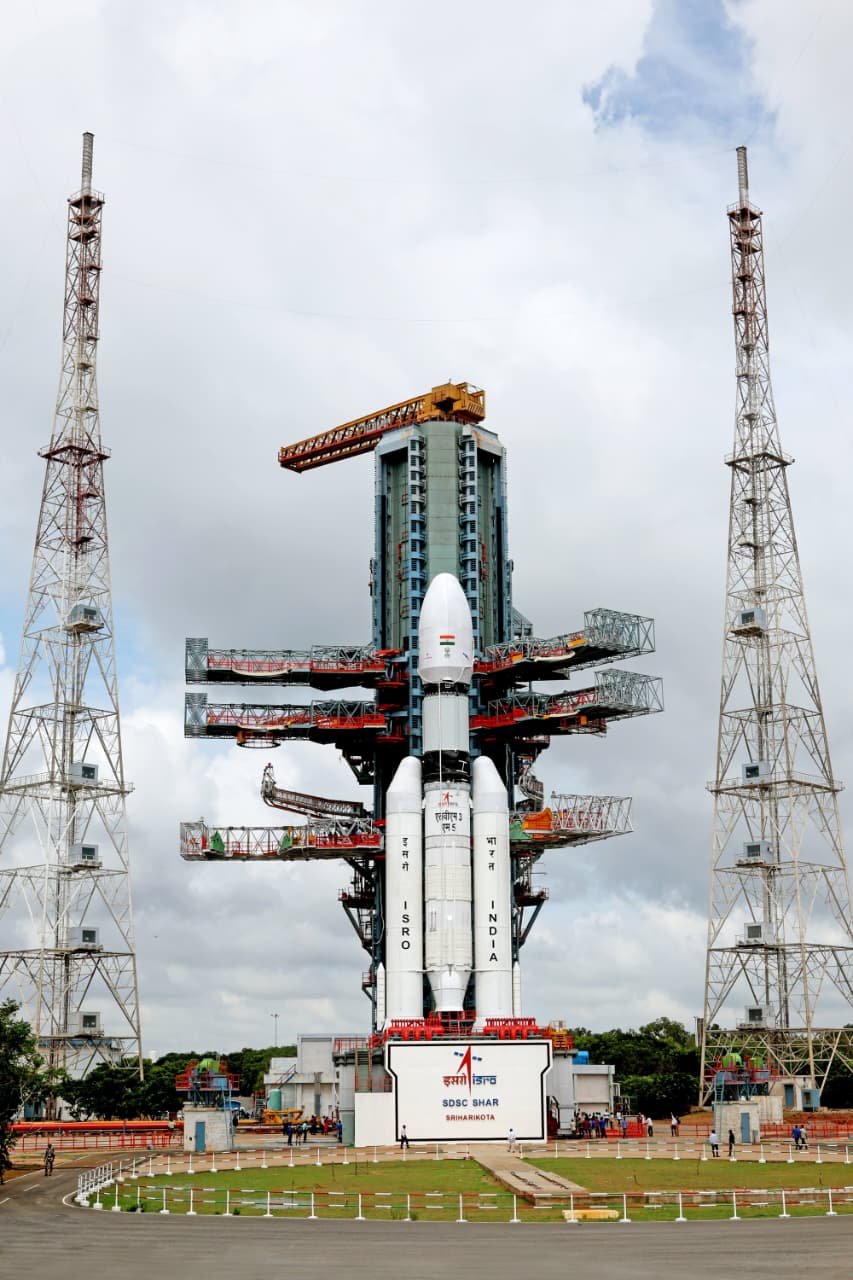
Marking a historic milestone, the LVM3-M5 rocket successfully launched the 4,410-kg CMS-03 satellite—India’s heaviest communication payload to date—enhancing the Navy’s secure network and reaffirming ISRO’s self-reliant space capabilities.
NFAPost, Bengaluru: India’s heaviest satellite launch to date took to the skies on Sunday evening as the Indian Space Research Organisation (ISRO) successfully lifted off the LVM3-M5 ‘Bahubali’ rocket at 5:26 PM IST from the Satish Dhawan Space Centre, Sriharikota. The mission marked another proud chapter in India’s space odyssey as it placed the CMS-03 (GSAT-7R)communication satellite into Geosynchronous Transfer Orbit (GTO) — a monumental step in strengthening the Indian Navy’s communication network.
“The 4,410-kg satellite was precisely injected into orbit,” announced ISRO Chairman Dr. V. Narayananfrom the Mission Control Centre. “This mission not only showcases the reliability of our launch vehicle but also reinforces our capability to indigenously place heavy communication satellites in orbit. It is yet another shining example of Atmanirbhar Bharat.”
India’s Heaviest Satellite Launched From Indian Soil
The CMS-03 satellite, developed entirely by ISRO, is designed to provide secure, multi-band communication coverageacross the Indian subcontinent and the surrounding oceanic region. The mission also represents a key milestone — it’s the first time ISRO has launched a satellite exceeding 4,000 kg to GTO from Indian soil, eliminating dependence on overseas launch services such as Arianespace from Kourou, French Guiana.
The successful deployment of CMS-03 comes after ISRO’s earlier reliance on the European Ariane-5 rockets for heavy payloads. For instance, the GSAT-11 satellite, weighing 5,854 kg, was launched in December 2018 from French Guiana. Sunday’s success underscores how far India has come in building a robust heavy-lift capability of its own.
CMS-03: A Strategic Asset for the Indian Navy
The CMS-03 (GSAT-7R) satellite is the next-generation successor to GSAT-7 ‘Rukmini’, launched in 2013, and forms part of India’s strategic communication satellite series. Exclusively developed for the Indian Navy, it promises real-time, encrypted communication between warships, submarines, aircraft, and coastal command centers—critical for network-centric warfare and maritime domain awareness.
“The successful launch of CMS-03 is a monumental achievement for India,” said Lt. Gen. A.K. Bhatt (Retd.), Director General, Indian Space Association (ISpA). “It powerfully demonstrates our sovereign capability in launching heavy-payload satellites for strategic applications. This satellite will be a game-changer for maritime and national security, ensuring advanced, secure communication channels across the Indian Ocean Region.”
With enhanced coverage, improved bandwidth, and support across UHF, S, C, and Ku bands, CMS-03 is designed to ensure seamless connectivity even in remote or contested ocean zones—a key enabler of India’s blue-water naval ambitions.
‘Bahubali’ Rocket Proves Its Might Once Again
Nicknamed ‘Bahubali’ for its sheer lifting strength, the LVM3 (Launch Vehicle Mark-3) is ISRO’s most powerful rocket yet. It is a three-stage heavy-lift launcher featuring:
- S200 Solid Boosters (developed at VSSC, Thiruvananthapuram) for initial lift-off thrust
- L110 Liquid Stage, powered by twin Vikas engines (from LPSC, Bengaluru)
- C25 Cryogenic Stage, using liquid hydrogen and oxygen for high-efficiency propulsion
This indigenously developed cryogenic stage — C25 — underwent an in-orbit ignition test during the mission, which Dr. Narayanan described as a “major milestone” that will enhance future missions’ flexibility and precision.
The LVM3-M5 marks the fifth operational flight of the LVM3 series, maintaining an unblemished 100% success record since its first experimental flight in 2014. The rocket previously launched the Chandrayaan-3 mission, which made history in 2023 when India became the first nation to land near the lunar South Pole.
From the Moon to the Sea: Expanding India’s Space Footprint
Dr. Narayanan, recalling the Chandrayaan-3 triumph, said,
“Our previous mission brought pride to the nation by reaching the Moon’s South Pole. Today’s mission brings pride again — this time for our ability to serve our defence forces and maritime community with advanced indigenous capability.”
He also acknowledged the challenging weather conditions at Sriharikota during the launch campaign and lauded ISRO’s teams for ensuring mission success against all odds.
Next on the Launch Pad: LVM3-M6 and Gaganyaan
ISRO’s schedule remains packed for the remainder of the financial year, with seven launches planned, including the much-anticipated uncrewed Gaganyaan mission.
The next LVM3 mission (M6) is already in preparation, slated for the second week of December, to carry a commercial communication satellite into orbit. “The integration of the next payload is underway at Sriharikota,” confirmed Dr. Narayanan.
A Step Closer to Self-Reliance in Space
The LVM3-CMS-03 mission symbolizes India’s steady progression toward complete independence in heavy satellite launches, reducing reliance on foreign launchers while building indigenous expertise across propulsion, cryogenics, and orbital mechanics.
For India’s Navy, CMS-03 is more than a satellite—it’s a strategic force multiplier that ensures the nation’s defence assets remain securely connected across vast maritime domains.
As ISRO continues to scale new heights, the successful launch of CMS-03 stands as a testament to India’s growing stature in the global space community — a blend of innovation, precision, and national pride.