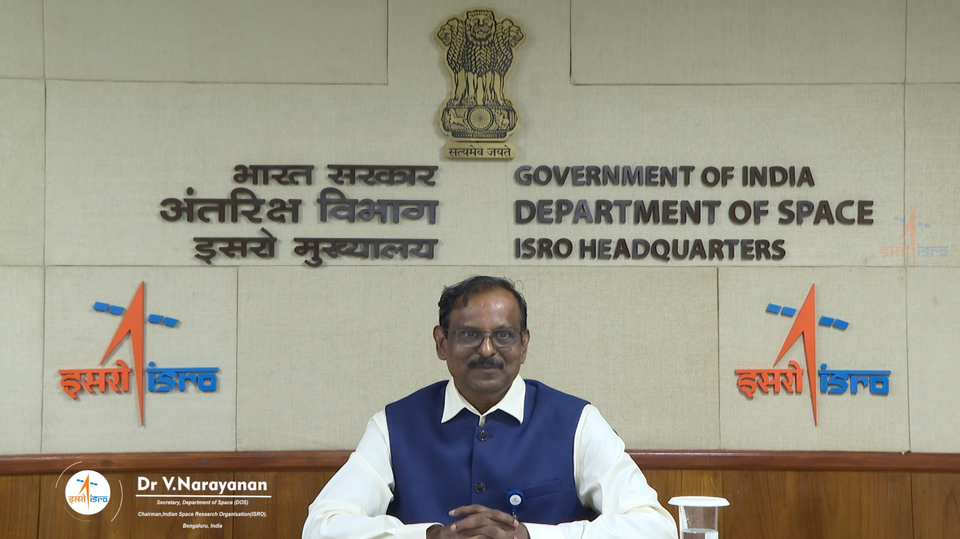
At the India Manufacturing Show 2025, ISRO Chairman V. Narayanan announced a historic move to hand over half of the PSLV development to an industry consortium, marking a decisive step toward India’s goal of becoming a globally competitive, self-reliant space power.
NFAPost, Bengaluru: India’s space program is entering a new era of industrial participation. ISRO Chairman V. Narayanan has revealed that the agency plans to transfer 50 per cent of the Polar Satellite Launch Vehicle (PSLV) development to the Indian industry consortium, led by HAL and L&T, following successful validation launches.
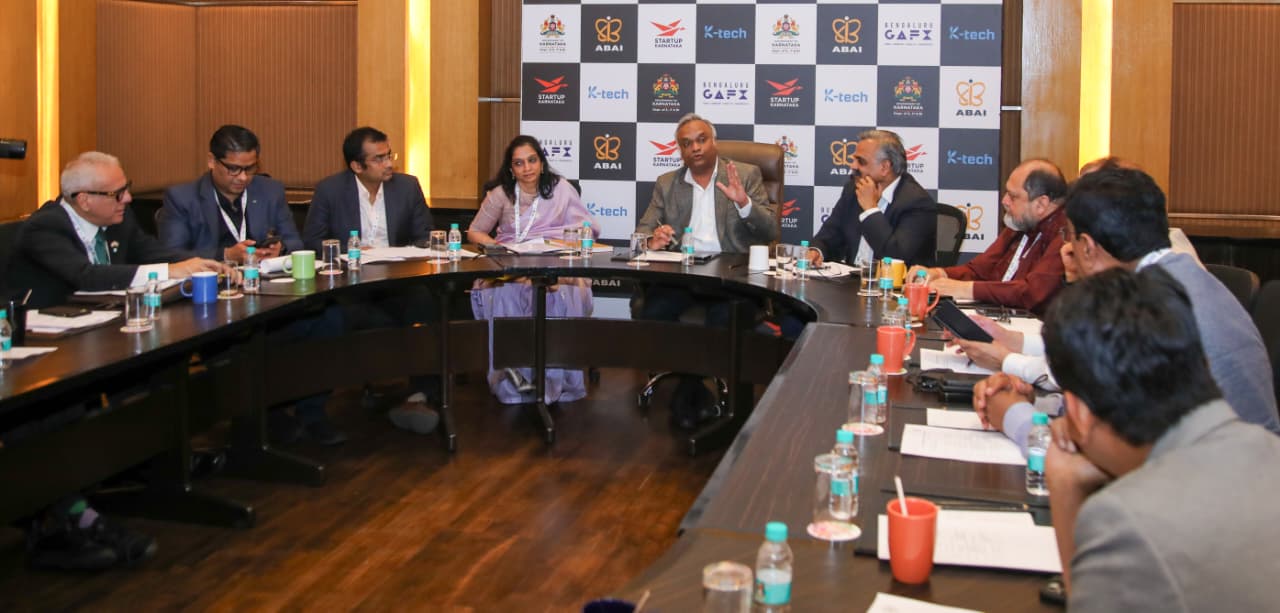
Speaking at the 7th India Manufacturing Show (IMS 2025) at the Bangalore International Exhibition Centre, Narayanan hailed the growing capability of India’s aerospace, defence, and engineering sectors, noting that “80 to 85 per cent of the systems for ISRO missions are already delivered by Indian industries.”
“Today, when you look at the PSLV — the workhorse of India — the Indian consortium headed by HAL and L&T has produced the first rocket. We are going to launch it before the end of this financial year, mostly by February,” Narayanan said.
“Once we succeed in two launches, our plan is to give at least 50 per cent of the PSLV development directly to the Indian industry consortium.”
Industry at the Heart of India’s Space Story
Narayanan emphasized that the domestic ecosystem’s contributions extend far beyond launch vehicles. Citing the CMS-03 mission, India’s heaviest communication satellite launched using the “Bahubali” LVM3-M5 rocket, he said industry partners contributed nearly 85 per cent of its systems.
“This mission was launched by ISRO, no doubt about it, but the real strength lies in the fact that 80 to 85 per cent of the systems were delivered by Indian industries. That’s the magnitude of their role in our space journey,” he added.
According to Narayanan, about 450 Indian industries now supply systems and subsystems for ISRO missions, a sharp contrast to a decade ago. The space reforms introduced by the Union Government, he noted, have catalyzed an explosion in private participation.
“When space reforms were announced, we had barely three or four startups in the country. Today, I am happy to inform you that over 330 startups are actively working in the Indian space ecosystem,” he said.
Transferring SSLV and Building Indigenous Capability
ISRO has already transferred the technology for the Small Satellite Launch Vehicle (SSLV) to Hindustan Aeronautics Limited (HAL) through a ₹511 crore agreement. The plan, Narayanan revealed, is to shift the production of 16 SSLVs to private industries — a move expected to deepen commercial participation and accelerate India’s launch cadence.
From Bicycles to Cryogenics: The Journey of Indian Spaceflight
Reflecting on ISRO’s six-decade-long journey, Narayanan traced its roots back to the modest beginnings of November 21, 1963, when India launched a small U.S.-made rocket from Thumba, Kerala.
“From that humble beginning, July this year was another important milestone — the NISAR mission,” he said. “The entire NASA–ISRO Synthetic Aperture Radar satellite was built and assembled in India, launched by an Indian rocket, with Indian industry providing most of the systems.”
He also celebrated India’s landmark achievements — from Chandrayaan-3’s soft landing near the lunar South Pole to the Mars Orbiter Mission (Mangalyaan), which flawlessly reignited its engine after 295 days in deep space.
“The spacecraft traveled 600 million kilometers and restarted its engine after 295 days — a feat no other nation has achieved in its first attempt,” Narayanan said, calling it a “marvel of precision.”
Technological Self-Reliance Takes Center Stage
Narayanan highlighted how India overcame international technology denials in the 1990s to emerge as a global leader in cryogenic propulsion.
“A country that once carried rocket parts on bicycles now builds world-class engines. Today, we have developed three indigenous cryogenic propulsion systems,” he said.
He also announced the development of a 32-bit indigenous computer processor, jointly built by HCL and ISRO, as a major stride toward electronics independence for future missions.
Scaling Up: India’s Next Leap
With 56 operational satellites currently serving communication, navigation, and Earth observation needs, Narayanan said ISRO plans to triple or quadruple this number in the coming years.
Prime Minister Narendra Modi, he added, has set an ambitious goal — to raise India’s annual launches from 10–12 to around 50 within five years.
“We completed our 100th rocket launch on January 29, 2024 — a golden chapter in India’s space history. The next century of launches will be built not just by ISRO, but by the entire Indian industry,” Narayanan concluded.