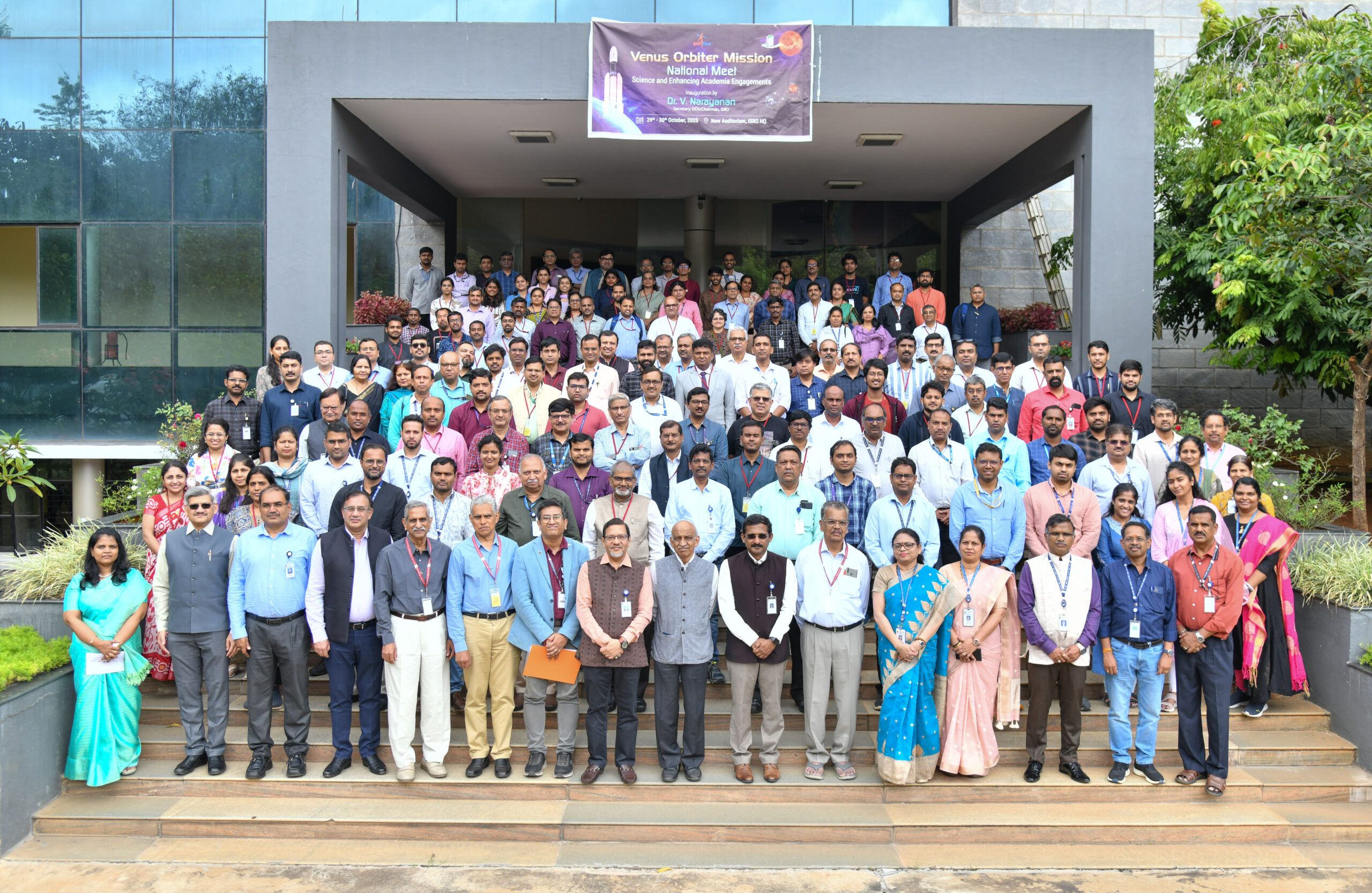
The two-day gathering brought together over 150 scientists and researchers from across India to refine the scientific roadmap for ISRO’s upcoming Venus Orbiter Mission (VOM), slated for launch in 2028.
NFAPost, Bengaluru: The Indian Space Research Organisation (ISRO) organised a National Science Meet on the Venus Orbiter Mission (VOM) at its headquarters in Bengaluru on October 29–30, 2025, marking a significant step forward in India’s planetary exploration ambitions. The two-day event brought together more than 150 scientists, engineers, faculty members, and Ph.D. scholars from across the country, including participants from 40 research and academic institutions beyond the Department of Space.
The meet aimed to build national-level scientific collaboration and define the mission’s research priorities — from Venus’ dense atmosphere and surface dynamics to its complex solar interactions — as India prepares to join the select group of nations exploring Earth’s enigmatic twin planet.
Engaging India’s Scientific Community
In his inaugural address, Dr. V. Narayanan, Chairman, ISRO and Secretary, Department of Space (DOS), emphasized the importance of communicating India’s space science endeavours to the wider public.
“It is essential that we convey the essence of India’s scientific missions to our citizens — especially non-experts — inspiring them to appreciate the potential of space exploration and India’s growing role in the global scientific community,” said Dr. Narayanan.
Former ISRO Chairman and Space Commission Member Shri A.S. Kiran Kumar highlighted how VOM represents a natural progression for India’s interplanetary journey.
“Having successfully explored the Moon and Mars, India’s next step towards Venus is a logical extension of our pursuit of understanding the Solar System,” he said, underscoring India’s capability to undertake complex deep-space missions.
Shri M. Ganesh Pillai, Scientific Secretary, ISRO, stressed the vital role of national collaboration in shaping the mission’s objectives.
“The engagement of India’s scientific community at this preparatory phase will ensure the integrity and global competitiveness of our mission goals,” he noted.
Preparing for Venus Science
Dr. Tirtha Pratim Das, Director, Science Programme Office, ISRO Headquarters, presented ISRO’s recent initiatives to build scientific preparedness for the mission. He discussed the Announcement of Opportunity (AO) released by ISRO, inviting researchers to analyse archival data from global Venus missions, thereby enabling India’s scientific community to gain early familiarity with Venusian datasets and methodologies.
The meet included in-depth sessions on the scientific and technological aspects of the Venus Orbiter Mission — from atmospheric and ionospheric studies to surface and subsurface investigations, cloud dynamics, aerosols, lightning phenomena, and solar wind interactions. Researchers also explored instrumentation techniques, data modelling, and simulation approaches for upcoming Venus studies.
VOM: India’s Next Leap Beyond Mars
The Venus Orbiter Mission (VOM), slated for launch in 2028, will be a purely scientific mission aimed at advancing global understanding of Venus’ atmosphere, ionosphere, and geology. The mission will probe how solar radiation interacts with Venus’ thick cloud layers, and will seek insights into the planet’s climatic evolution — a subject of great relevance to comparative planetology and Earth science.
Panel discussions during the meet focused on how VOM can complement existing international efforts and contribute new data on Venus’ dynamic environment through Indian innovation in instrumentation and mission design.
Towards a Collaborative Future
The National Science Meet on VOM reflected ISRO’s growing emphasis on inclusive scientific participation — drawing upon India’s diverse network of universities, national laboratories, and research institutes. The event underscored ISRO’s commitment to maximizing the mission’s scientific yield through early engagement and collaboration with the academic community.
“The Venus Orbiter Mission is not only India’s next deep-space milestone but also a symbol of our collective scientific resolve,” remarked an ISRO spokesperson. “By uniting our scientific talent early in the process, we ensure that India’s contribution to Venus exploration is both innovative and globally impactful.”