Six trailblazing researchers under 40 recognized for breakthroughs spanning absurdly fast algorithms, genome repair, Prakrit poetics, sustainable chemistry, and more — as Narayana Murthy calls for a renewed national commitment to research excellence.
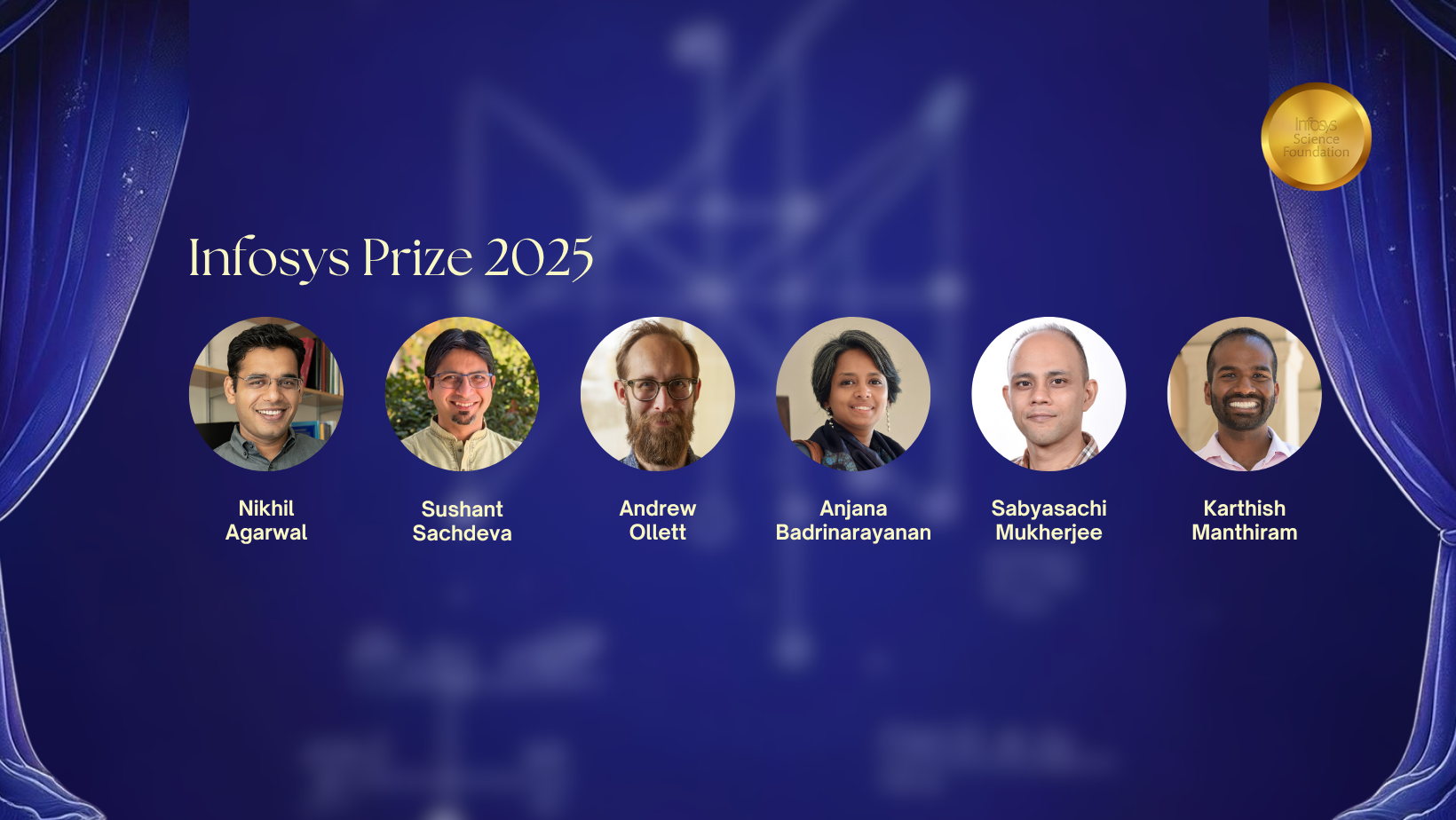
NFAPost, Bengaluru: In a celebration of India’s rapidly rising scientific talent, the Infosys Science Foundation (ISF) on November 12 announced the winners of the Infosys Prize 2025 across six disciplines — Economics, Engineering and Computer Science, Humanities and Social Sciences, Life Sciences, Mathematical Sciences, and Physical Sciences.
Awarded annually and widely regarded as India’s most prestigious recognition for research excellence, the Infosys Prize this year honors exceptional scholars under the age of 40, marking the second year of the Foundation’s renewed focus on early-career researchers. Each laureate receives a gold medal, citation, and a prize purse of USD 100,000.
Announcing the winners were ISF trustees K. Dinesh, Narayana Murthy, Srinath Batni, Kris Gopalakrishnan, Dr. Pratima Murthy, and S. D. Shibulal, with other trustees including Mohandas Pai, Nandan Nilekani, and Salil Parekhsending their congratulations.
“The achievements of the Infosys Prize 2025 winners reflect the vital connection between research, science, and society,” said K. Dinesh, President of the ISF Board of Trustees. “Their work inspires the next generation of innovators and strengthens our belief that research is the cornerstone of human progress.”
Meet the Infosys Prize 2025 Laureates
Economics: Nikhil Agarwal, MIT
Awarded for pioneering contributions to market design, Agarwal’s work has transformed empirical studies of matching systems — from school choice and medical residencies to kidney exchanges. The jury noted that while “markets balance demand and supply for apples and oranges,” Agarwal’s work tackles more complex allocation problems that fundamentally shape human welfare.
Engineering & Computer Science: Sushant Sachdeva, University of Toronto
Recognized for deep insights into mathematical optimization and algorithmic theory, Sachdeva cracked several longstanding computational challenges. His breakthroughs have redefined performance limits in systems shaping modern life — including internet traffic, transport networks, and communications.
Humanities & Social Sciences: Andrew Ollett, University of Chicago
One of the world’s leading scholars of Prakrit languages, Ollett’s acclaimed work Language of the Snakes explores the interplay of Prakrit, Sanskrit, and regional languages over two millennia. His linguistic expertise spans an impressive array — Kannada, Tamil, Old Javanese, Chinese, Greek, Latin, and more — shedding light on India’s far-reaching cultural cosmopolitanism.
Life Sciences: Anjana Badrinarayanan, NCBS Bangalore
Honored for groundbreaking discoveries in genome maintenance and repair, Badrinarayanan’s research uses sophisticated live-cell imaging to reveal how cells repair DNA damage — even in non-dividing cells. Her work uncovers mechanisms central to evolution, genome stability, and cellular resilience.
Mathematical Sciences: Sabyasachi Mukherjee, TIFR Mumbai
Mukherjee’s influential work bridges Kleinian group dynamics and complex dynamical systems, reshaping understanding of conformal dynamics. His contributions have implications across physics, fluid mechanics, and emerging fields such as data science.
Physical Sciences: Karthish Manthiram, Caltech
Awarded for pioneering electrochemical routes to essential chemicals, Manthiram’s innovations in lithium-mediated ammonia synthesis and oxygen-atom transfer catalysis offer transformative pathways toward electrified, sustainable chemical manufacturing.
“Research Is Humanity’s Noblest Collective Enterprise”
Narayana Murthy’s Call to Action
Delivering a keynote lecture titled “On the Importance of Research for India and the World”, Infosys founder Narayana Murthy placed the laureates’ achievements in historical and philosophical context.
Drawing from thinkers as varied as Marcus Aurelius, Alan Turing, Richard Feynman, Jennifer Doudna, and Amartya Sen, Murthy argued that research has always been the engine of human progress.
“Nothing has such power to broaden the mind as the ability to investigate systematically,” he quoted Marcus Aurelius.
“Basic research provides scientific capital,” he added, echoing Vannevar Bush’s seminal 1945 report Science – The Endless Frontier, which catalyzed the rise of American research leadership.
Murthy urged India to embrace a similar national awakening.
“Research is not a luxury but a necessity for human survival, dignity, and progress,” he said.
“Our duty is to build an aspirational, meritocratic, competitive environment that reveres ideas over titles and encourages our brightest minds to dream the unimaginable.”
In an emotional closing, he invoked mathematician David Hilbert’s famous declaration:
“We must know. We will know.”
Strengthening India’s Research Ecosystem
Beyond recognizing individual brilliance, the Infosys Prize has historically spotlighted research with global impact. Several past laureates have gone on to win the Nobel Prize, Fields Medal, Dan David Prize, MacArthur Fellowship, and Breakthrough Prize, among others — a testament to the award’s alignment with global standards of scientific excellence.
This year’s cohort reflects a new generation of Indian and India-connected scholars breaking boundaries in fields central to the 21st century — algorithms, genome science, sustainable chemistry, language preservation, and market design.
With India seeking to strengthen its role in global research and innovation, the Infosys Prize continues to serve as both a marker of excellence and a call to action.
As Murthy emphasized:
“Creating a thriving ecosystem for research is the only way to fulfil the dreams of our founding fathers — to build an India where every child has the opportunity to lead a life of dignity and possibility.”