India is poised to become a semiconductor powerhouse, with its market projected to grow from $22 billion in 2019 to $64 billion by 2026, at a 16% CAGR, and reach $110 billion by 2030, capturing 10% of global consumption. The country hosts 20% of the world’s VLSI design engineers around 120,000 professionals driving chip design innovation. India manufactures 4.7% of global electronic devices and 22% of mobile phones, underscoring its manufacturing prowess.
The India Semiconductor Mission (ISM), backed by the Ministry of Electronics & IT, has catalysed six semiconductor facilities with $18 billion in investments over the past 32 months, including major projects like Micron’s ATMP in Gujarat and Tata’s fab in Dholera. These initiatives, supported by the Production-Linked Incentive scheme, are reducing India’s 90% chip import dependency and enhancing supply chain resilience.
Ajit Manocha, SEMI President and CEO, emphasised India’s potential, noting that 150 new fabs are needed globally to meet the $1 trillion semiconductor target by 2030. India’s exponential growth is critical to securing a significant market share, with SEMICON India playing a pivotal role in fostering this ecosystem. However, a workforce shortage of 250,000–300,000 professionals by 2027 looms large. SEMI, in collaboration with Indian institutions, aims to bridge this gap through upskilling programs to equip talent for the evolving industry.
With a robust talent pipeline and strong government support, India is on track to become a trusted partner in the global semiconductor value chain. By 2030, these efforts could position India as a leader in the $500 billion domestic semiconductor market, driving innovation, job creation, and economic growth while meeting global demand in AI, automotive, and consumer electronics sectors.
Below listed are six projects which are under construction with speedy progress:
Micron Technology ATMP Facility (Sanand, Gujarat)
Micron Technology’s USD 2.75 billion (Rs. 22,516 crore) Assembly, Test, Marking, and Packaging (ATMP) facility in Sanand, Gujarat, is a cornerstone of India’s semiconductor ambitions. Approved in June 2023, construction began in September 2023, with the first DRAM and NAND flash module expected by mid-2025. This facility will cater to the booming global memory chip market, valued at USD 160 billion in 2024, and is crucial for India’s role in the semiconductor supply chain. Within its 32-month timeline, the project is on track, leveraging Gujarat’s industrial ecosystem.
Tata Electronics Fab Facility (Dholera, Gujarat)
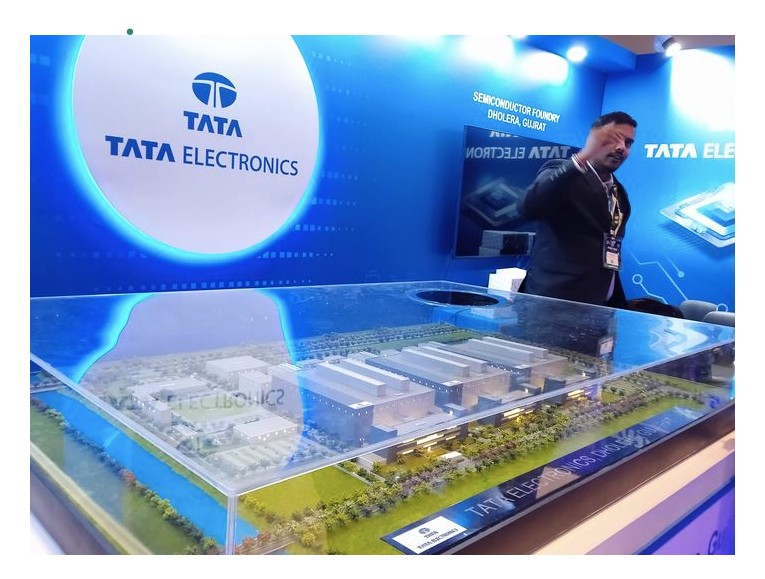
India’s first major semiconductor fabrication plant, a USD 10.44 billion (Rs. 91,000 crore) venture by Tata Electronics and Taiwan’s Powerchip Semiconductor Manufacturing Corporation (PSMC), is under construction in Dholera, Gujarat. Approved in February 2024, this facility will produce 50,000 wafers per month, focusing on 28nm chips for automotive, computing, and AI sectors—industries driving USD 300 billion of the global chip market. Within its 32-month timeline, the project is advancing rapidly, positioning India to compete in advanced chip manufacturing.
Tata Semiconductor Assembly and Test (TSAT) Facility (Morigaon, Assam)
Tata Electronics’ USD 3.26 billion (Rs. 27,000 crore) OSAT facility in Morigaon, Assam, approved in February 2024, is set to produce 48 million chips per day. Specializing in advanced packaging technologies like flip-chip and system-in-package, it targets the USD 50 billion global advanced packaging market, serving automotive and consumer electronics. Within its 32-month timeline, this facility is poised to make Assam a key player in India’s semiconductor landscape.
CG Power OSAT Facility (Sanand, Gujarat)
CG Power’s USD 0.916 billion (Rs. 7,600 crore) OSAT facility in Sanand, Gujarat, approved in February 2024, is a joint venture with Japan’s Renesas Electronics and Thailand’s Stars Microelectronics. Producing 15 million specialized chips daily for defense, space, and electric vehicles, it taps into the USD 80 billion niche chip market. Progressing within its 32-month timeline, this project strengthens India’s expertise in high-value sectors.
Vama Sundari Investments OSAT Facility (Noida, Uttar Pradesh)
The USD 0.425 billion (Rs. 3,706 crore) OSAT facility in Noida, Uttar Pradesh, a joint venture between HCL Group and Foxconn, received a revised letter of intent on March 6, 2025. Expected to create 4,000 jobs, this facility will contribute to the USD 40 billion OSAT market, focusing on assembly and testing. Within its 32-month timeline, it is set to enhance India’s semiconductor presence in the northern region.
Kaynes Semicon ATMP Facility (Sanand, Gujarat)
Kaynes Semicon’s USD 0.395 billion (Rs. 3,307 crore) ATMP facility in Sanand, Gujarat, approved on September 2, 2024, will produce 6.3 million chips daily for automotive, electric vehicles, consumer electronics, telecom, and mobile phones. With partnerships from Malaysia’s Globetronics, Taiwan’s Aptos Technology, and Japan’s AOI, it targets the USD 200 billion consumer electronics chip market. The project is advancing within its 32-month timeline, reinforcing Gujarat’s status as a semiconductor hub.

Srinivasa Reddy N
Editor, EEHerald