


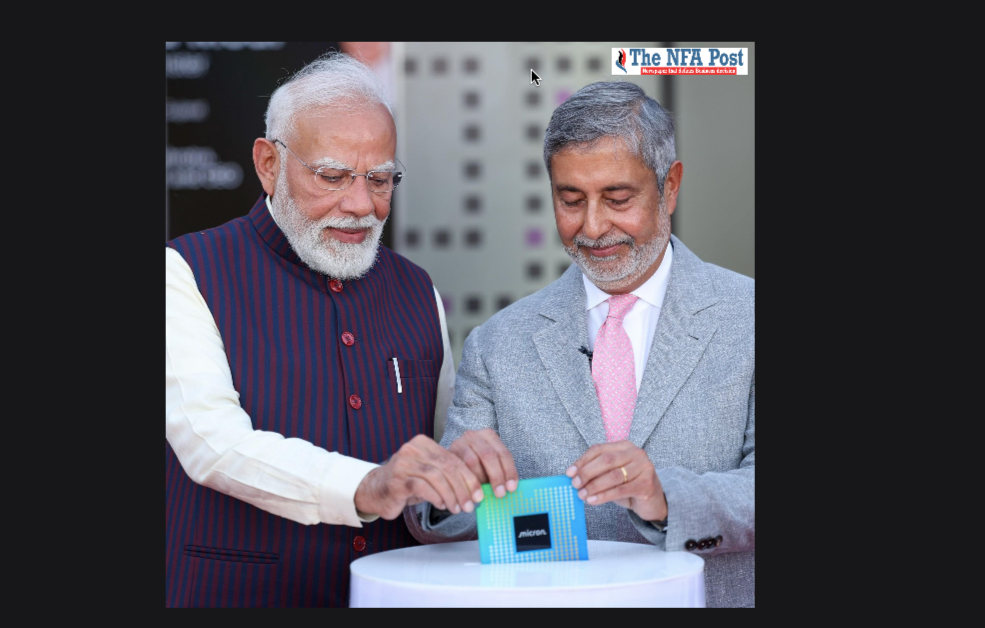
With the first Made-in-India memory modules rolling out of Gujarat, New Delhi signals a decisive shift from technology importer to semiconductor stakeholder in the global value chain
“India is ready. India is reliable. India delivers. India is Capable. India is Competitive. India is Committed,” states Prime Minister
He also noted that while India was once primarily known for software and IT services, it is now rapidly strengthening its identity in the hardware sector.
“This facility is a testament to the robust partnership between the world’s largest democracies India & USA, particularly in AI & chip tech and working to secure global supply chain,” said Modi
While 10 projects have been approved under the Semicon India programme, 3 more are set to begin production soon across various states, including UP, Assam, Odisha and Punjab.
Bengaluru / Ahmedabad, NFAPost: In what government officials described as a defining inflection point in India’s technology trajectory, Prime Minister Narendra Modi inaugurated Micron Technology’s semiconductor Assembly, Testing, Marking and Packaging (ATMP) facility in Sanand, formally launching commercial production of India’s first domestically assembled memory modules.
The moment was heavy with symbolism. For decades, India has been one of the world’s largest consumers of semiconductors while remaining heavily import-dependent. With the commissioning of Micron’s advanced facility, that narrative begins to shift.
The Prime Minister noted that after the world’s largest and most successful AI Summit, today the country is witnessing another historic milestone. “While the AI Summit introduced the world to India’s AI prowess, today is a testament to India’s commitment to technology leadership”, said Prime Minister Narendra Modi.

He also noted that while India was once primarily known for software and IT services, it is now rapidly strengthening its identity in the hardware sector. “Today, in Sanand, we see the dawn of a new future. The commencement of commercial production at Micron’s ATMP Facility is set to bolster India’s role in the global technology value chain”, Narendra Modi emphasised.
The Prime Minister highlighted the “New India” mindset, where the transition from policy to production is happening at unprecedented speed. The Prime Minister emphasised the project’s rapid progression under the national semiconductor push, noting that the Memorandum of Understanding was signed in June 2023, followed by the groundbreaking in Sanand in September 2023. “By February 2024, machine installation in the pilot facility had begun, leading to the commencement of commercial production in February 2026”, Shri Modi added.
Narendra Modi stated that India has significantly streamlined complex regulatory processes, successfully clearing Advanced Pricing Agreements (APAs) in just a few months. He noted that this same procedure typically takes between three and five years to complete, even in developed nations.
“When the intent is clear and the dedication is toward the nation’s rapid development, policies become transparent and decisions gain momentum. This facility is a testament to the robust partnership between India and the USA, particularly in AI and chip technology. Two of the world’s largest democracies, India and the USA are working continuously to secure the global supply chain, citing the Pax Silica agreement signed during the AI Summit as a key effort to make the supply chain for critical minerals more reliable,” said Prime Minister Narendra Modi.
Noting this century as the century of the AI Revolution, the Prime Minister called semiconductors a bridge to this change. Comparing historical shifts, Narendra Modi stated that if oil was the regulator of the 20th century, the micro-chip is the regulator of the 21st century. A tiny chip is the medium connecting the Industrial Revolution to the AI Revolution.

“With this vision, India decided to move forward aggressively in the semiconductor sector. Recall that when the world was struggling with the havoc of Covid, India announced its Semiconductor Mission. During the pandemic, when everything felt like it was falling apart, the seeds we planted with conviction are now growing and bearing fruit,” Narendra Modi highlighted.
The Prime Minister reiterated India’s commitment to the semiconductor sector, noting that while 10 projects have been approved under the Semicon India programme, three more are set to begin production soon across various states, including Uttar Pradesh, Assam, Odisha, and Punjab. “This ecosystem we are building is not limited to one region; it is Pan-India. New tech hubs for a ‘Viksit Bharat’ are being developed in every corner of the country,” said Narendra Modi stated.
The Prime Minister noted that a semiconductor ecosystem is far more than just a factory; it is a multi-layered system comprising machine manufacturers, design engineers, research institutions, logistics networks, and skilled technicians. A chip is produced through the seamless coordination of all these elements.
“India is focusing on the entire value chain. In this year’s budget, we announced the ‘India Semiconductor Mission 2.0’ for this very purpose. As production increases, the demand for materials, components, and services within India will also grow. This is the greatest opportunity,” said Narendra Modi.

Narendra Modi also highlighted that a massive portion of India’s population is becoming first-time gadget users.
“Whether it is electronics, automobiles, or other technologies, demand is constantly rising. “Make in India” is now in full swing. There is a manifold growth in the production and exports of the electronics sector in the last 11 year. For investors, both the domestic market and global opportunities stand ready,” said Narendra Modi.
Drawing parallels to Sanand’s transformation into an automobile hub, the Prime Minister expressed confidence that the Micron facility would anchor a new semiconductor ecosystem. The plant will produce D-RAM and NAND solutions to power global data centers, AI applications, and mobile devices. He also lauded the facility for housing one of the world’s largest ATMP cleanrooms and its focus on environmental sustainability through minimised water consumption.
Praising the policies of the Gujarat government, Narendra Modi noted that the policies created for the semiconductor sector are now yielding results on the ground. The Prime Minister highlighted that Gujarat is advancing rapidly in technology.
“Simplifying processes like approvals, land allotment, and utilities has strengthened investor confidence. Dholera and Sanand are developing as the semiconductor clusters of Western India. Industries related to the inputs required for the semiconductor sector, such as chemicals and petrochemicals, along with skill centers and training initiatives, are being developed simultaneously,” said Prime Minister Narendra Modi.
The Prime Minister concluded with a powerful message to global investors, asserting that “India is ready. India is reliable. India delivers.” He assured global partners and investors of unwavering support from both the Central and State governments, marking this decade as a historic turning point for India’s technological trajectory. His address resonated globally with a clear, firm commitment, “India is Capable. India is Competitive. India is Committed.”
Ahead of the Prime Minister’s visit, Micron President and CEO Sanjay Mehrotra described the inauguration as a watershed moment.
“This is a historic moment for India, for Micron Technology. Micron is a global leader in memory and storage semiconductor technology, and that is today at the heart of AI. Micron here is now bringing that leading-edge memory production to India,” said Micron President and CEO Sanjay Mehrotra.
A Facility Built for the AI Era
The Sanand ATMP plant represents more than a manufacturing expansion—it is a strategic anchor in the global memory supply chain.
Spread across approximately 500,000 square feet of cleanroom space once fully scaled, the facility ranks among the largest semiconductor assembly and testing plants globally. Here, advanced DRAM and NAND wafers fabricated at Micron’s international fabs will be assembled, tested, packaged, and prepared for worldwide distribution.
The total project outlay exceeds ₹22,500 crore, backed by a combination of Micron’s capital investment and government incentives under the India Semiconductor Mission.
Industry observers note that while fabrication remains the most capital-intensive segment of chipmaking, ATMP facilities are critical nodes in the value chain—particularly in an era when advanced packaging is increasingly central to performance gains.
Catalyzing a Domestic Ecosystem
The Sanand facility’s impact extends well beyond its cleanroom walls.
Currently employing around 1,300 professionals, the plant complements Micron’s established presence in Hyderabad and Bengaluru, where over 4,000 engineers work in design and R&D roles. Over time, the Sanand unit is expected to scale significantly.
“This will grow to a facility that will be over time 5,000 manufacturing workers here, and another nearly 5,000 that will be enabled in the ecosystem as well,” Mehrotra said. “So this is just the beginning.”
For Gujarat—already a rising manufacturing hub—the project reinforces Sanand’s transformation from an automotive cluster into a high-technology corridor.
For India, it represents something more structural: the early formation of a semiconductor manufacturing ecosystem that includes suppliers, logistics players, testing services, materials providers, and skilled workforce pipelines.
From Import Dependence to Strategic Capability
The launch aligns with the government’s broader semiconductor roadmap under the India Semiconductor Mission and its recently expanded second phase. New Delhi has been explicit about its objective: reduce import vulnerability, strengthen supply chain resilience, and position India as a trusted global partner in advanced electronics manufacturing.
The timing is also significant. With artificial intelligence, high-performance computing, and edge devices driving unprecedented demand for memory and storage solutions, global supply chains are undergoing recalibration. Nations are competing not only for fabs but for packaging, testing, and advanced integration capabilities.
Micron’s Sanand facility places India directly into that conversation. As Micron President and CEO Sanjay Mehrotra confirmed, the company is preparing to ramp production aggressively:
“We are ready to ramp up volume production and put into production multiple hundreds of millions of advanced memory chips into assembly and test here and be able to ship it globally worldwide,” said Micron President and CEO Sanjay Mehrotra.
A Strategic Signal to the World
For policymakers, the inauguration serves as tangible proof that India’s semiconductor ambitions are moving from policy documents to production lines. For global investors, it signals execution credibility. And for the domestic technology ecosystem, it marks the beginning of a deeper integration into the semiconductor value chain.
The Sanand launch may not yet represent full-spectrum semiconductor sovereignty—fabrication at scale remains a longer-term ambition—but it establishes a foundational capability that was absent just a few years ago.
More than the opening of a factory, the event signals a strategic pivot. India, long positioned as a design powerhouse and end-market consumer, is now asserting itself as a manufacturing stakeholder in one of the most critical industries of the 21st century.
If semiconductors define the architecture of the digital age, Sanand may well be remembered as the site where India began building its own.















Leave a Reply