


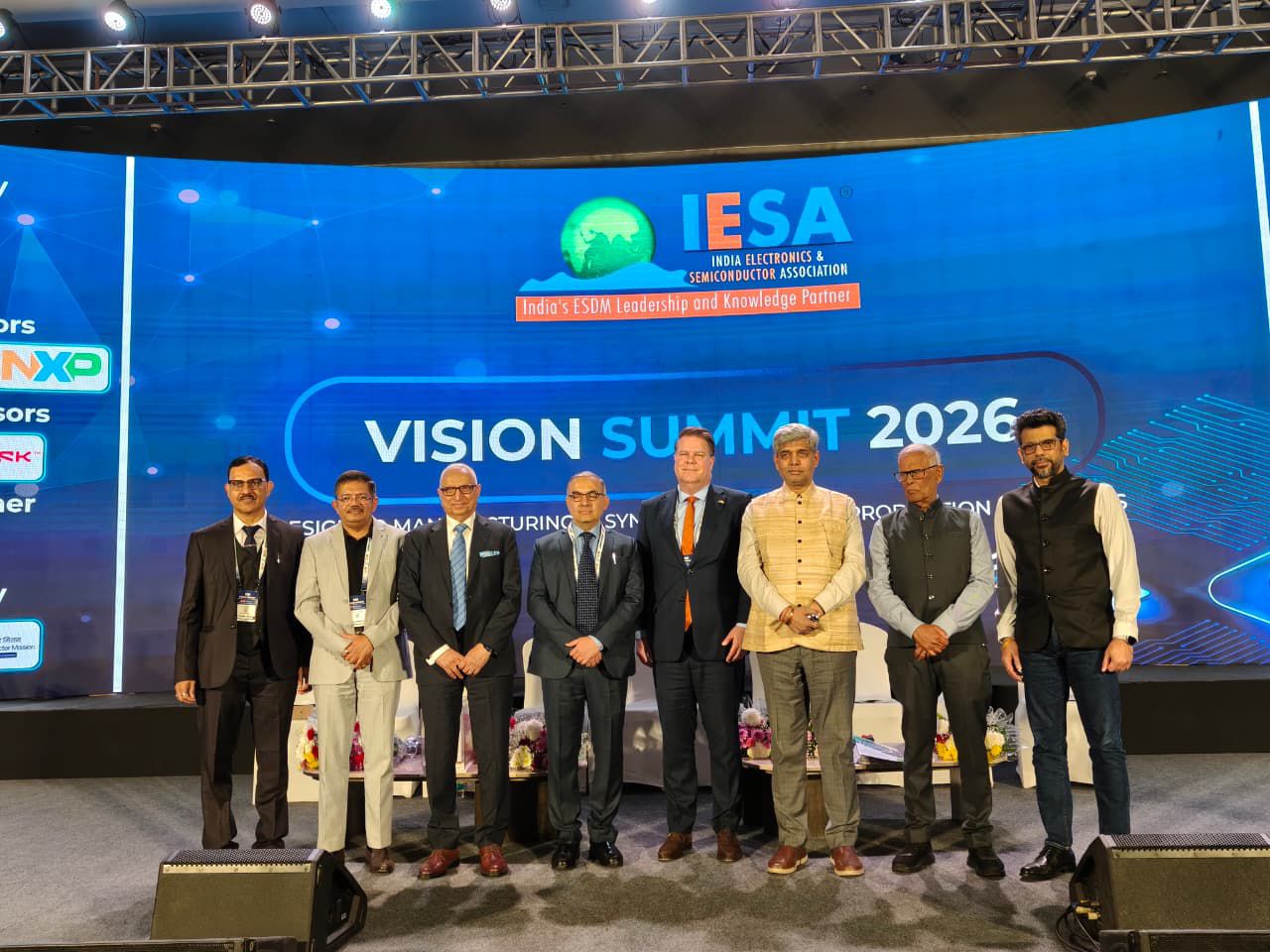
At IESA Vision Summit 2026 in Bengaluru, global chip leaders and policymakers signal a decisive shift—India is no longer chasing the semiconductor future; it is designing it
Bengaluru, NFAPost: There was no incrementalism in the air at the 19th edition of the IESA Vision Summit. No hedging. No cautious optimism. Instead, what unfolded was a confident assertion that India’s semiconductor journey has crossed a psychological threshold—from aspiration to execution, from participation to authorship.
Ashok Chandak, President of the India Electronics and Semiconductor Association (IESA), set the tone early.
“Today, we are at the consequential juncture where the global landscape is getting redefined. And India is not just a participant, but India is playing a key role by becoming architect of the future.”
It was not rhetoric for effect. Across keynotes delivered by senior leaders from Applied Materials, Lam Research, and NXP Semiconductors, the message was consistent: the semiconductor industry is undergoing structural realignment, and India has found itself at the center of that tectonic shift.
A Rewired World: Chips as Geopolitical Currency
If the past few years proved anything, it is that semiconductors are no longer just components—they are strategic assets.
Radhika Vishwanathan, COO of Applied Materials India, framed the transformation bluntly. The global semiconductor ecosystem, she said, is undergoing “deep structural changes”—seven tectonic shifts that are reshaping production, design, and geopolitical alignments.
Among the most consequential is the reconfiguration of global supply chains.
The era of hyper-globalized, efficiency-driven manufacturing is giving way to regionalized, resilient ecosystems. National security and supply sovereignty now sit alongside cost optimization as primary drivers.
“Compute is replacing oil as strategic infrastructure,” Vishwanathan said. “Chips are geopolitical assets. That is the reality of today’s world.”
As Moore’s Law slows, the industry’s innovation vector is shifting—from simple node scaling to architectural innovation, heterogeneous integration, and advanced packaging. Here, India holds a structural advantage. The country’s deep bench of design talent has long powered global semiconductor firms.
But Vishwanathan acknowledged a structural gap. India has been strong in design and applications—but “missing the middle.” The equipment, fabrication, and materials ecosystem remained underdeveloped.
Closing that gap is now a national priority.

Policy to Production: The Semiconductor Mission 2.0 Moment
If Vision Summit 2026 had a subtext, it was this: policy clarity has translated into industrial momentum.
Rangesh Raghavan, Corporate VP of Lam Research India, traced the journey from ambition to activation.
“With ISM 1.0, we saw ambition turn to reality with these investments,” he said, pointing to nearly ten fabrication facilities now in development. “Now, the government has just announced ISM 2.0, which is squarely aimed at the entire ecosystem. This is absolutely the right kind of mindset.”
For Raghavan—who returned to India five years ago after three decades overseas—the shift has been personal as well as professional. He sees a $50 billion-plus growth opportunity emerging for India’s supply chain, particularly as global equipment manufacturers cultivate local vendors to serve international markets.
Lam Research is not merely observing the shift. It is investing in capacity building. In collaboration with ecosystem partners, the company is helping train 60,000 engineers in semiconductor manufacturing using its virtual “Semiverse” platform—an immersive digital environment designed to accelerate industry readiness.
Raghavan summed up the current moment by invoking Prime Minister Narendra Modi’s often-repeated phrase:
“Yahi samay hai, sahi samay hai—this is the time, it is the right time.”
For an industry where cycles often stretch over decades, such alignment of policy, capital, and talent is rare.
Beyond Data Centers: The Edge Intelligence Revolution
If geopolitics defined the macro narrative, technology defined the horizon.
Dr. Tobias Helbig, VP of Innovation at NXP Semiconductors, offered a provocation. He drew a parallel to a 1942 prediction that the global market would need only five computers—an assessment that proved technically correct for room-sized mainframes, yet catastrophically wrong about the future of billions of embedded devices.
“I look at this and I wonder—Is this our ‘five computers’ moment?” Helbig asked, referring to the current industry obsession with centralized, energy-intensive AI in massive data centers.
The next frontier, he argued, lies at the edge.
AI embedded in watches, drones, factory systems, vehicles, and smart infrastructure—running securely and efficiently, often disconnected from cloud dependence. He called it the moment when “the robots are waking up.”
The real innovation challenge is not raw compute scale, but energy efficiency.
The human brain operates at roughly 20 watts. A fly functions at under a milliwatt. Today’s data centers consume megawatts.
NXP, Helbig noted, is already building systems capable of running generative AI workloads at around 10 watts—proof that distributed intelligence is not a distant dream but an emerging reality.
For India, this edge-AI revolution aligns naturally with its strengths in embedded systems, automotive electronics, telecom, and industrial automation.
From Talent Nation to Technology Powerhouse
The Summit’s central theme—India as a Product Nation, Production Nation, and Skilling Nation—was not aspirational branding. It reflected a deliberate, layered strategy:
- Design depth built over decades.
- Manufacturing capacity now under construction.
- Policy alignment via ISM 1.0 and 2.0.
- Supply chain localization tied to global demand.
- Mass-scale skilling initiatives preparing tens of thousands of engineers.
The industry’s message was clear: India is no longer satisfied with being the world’s back office for chip design. It seeks to command the full stack—from materials and equipment to fabrication and advanced packaging.
The convergence of geopolitical necessity, domestic ambition, and technological inflection has created what many at the summit described as a once-in-a-generation window.
If the past defined India as a participant in the semiconductor value chain, the present signals a transition toward strategic authorship.
As one walked out of the packed Bengaluru convention halls, the takeaway was unmistakable: the semiconductor story is being rewritten—and India intends to draft the next chapter.













Leave a Reply