From emerging economy to pivotal geoeconomic force, India’s bold bets on chips, artificial intelligence, and sustainability are reshaping global trade, technology governance, and resilient growth
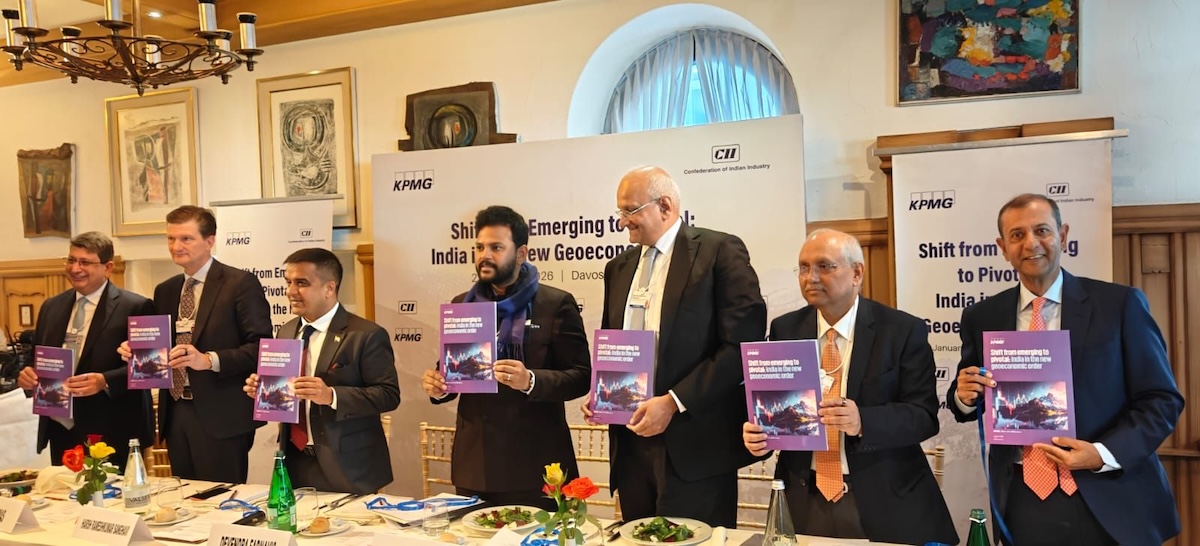
Bengaluru, NFAPost: India’s rapid ascent as a decisive force in the global economic and technological order is being driven by unprecedented investments in semiconductor manufacturing and the accelerated adoption of artificial intelligence (AI), according to a new report released by KPMG International at the World Economic Forum 2026 in Davos.
Titled “Shift from Emerging to Pivotal: India in the New Geoeconomic Order,” the report positions India not merely as a high-growth market, but as a country increasingly shaping global standards, supply chains, and technology governance—at a time when the world is recalibrating amid geopolitical uncertainty and fragmented trade regimes.
“India’s transformation is remarkable,” said Bill Thomas, Global Chairman & CEO, KPMG International.
“What we’re witnessing is more than economic growth—it’s about building trust and shaping the future of global collaboration. From advanced manufacturing and digital infrastructure to clean energy and AI, India is building an ecosystem that drives resilience and innovation at scale.”
Semiconductors: From Policy Vision to Execution Reality
At the heart of India’s strategic pivot is its determined push into semiconductor manufacturing—an area long dominated by a handful of global hubs. According to the KPMG report, India has now approved six semiconductor fabrication plants (fabs) with a cumulative outlay of $1.3 billion, marking a decisive shift from intent-driven policy announcements to execution-led capacity building.
Complementing this, the Indian government has earmarked $2.2 billion for deep-tech research and development, reinforcing the country’s position among the top five global nations in critical technologies. Flagship initiatives such as the India Semiconductor Mission and Semicon India are accelerating the creation of a comprehensive domestic ecosystem—spanning fabrication, testing, validation, and advanced packaging.
Crucially, the report highlights India’s ability to leverage its domestic strengths in chemicals, minerals, and industrial gases, strengthening upstream inputs that are essential for reliable and integrated chip production. This vertical integration, combined with sustained investments in R&D and talent development, is laying the groundwork for India to emerge as a trusted node in global semiconductor supply chains.
With these moves, KPMG projects that India is on track to join the world’s top five semiconductor hubs by 2030, supporting critical infrastructure needs, advanced computing, defence electronics, and secure communications.
AI at Scale: Rewriting the Economic Equation
Alongside semiconductors, artificial intelligence is rapidly becoming a cornerstone of India’s economic transformation. The report estimates that AI adoption in India could generate $1.7 trillion in economic value by 2035, reshaping productivity, business models, and public service delivery across sectors.
Under the IndiaAI Mission, more than 38,000 GPUs have already been deployed to support AI research, startups, and large-scale applications. India’s technology and AI ecosystem now employs over six million people, while a striking 89% of new startups in 2024 integrated AI into their products or services—underscoring how deeply the technology is embedded in entrepreneurial innovation.
KPMG notes that India’s approach to AI is distinguished not just by scale, but by responsible governance. Robust data frameworks, sector-specific adoption in healthcare, agriculture, education, and defence, and the establishment of the IndiaAI Safety Institute are positioning the country as a proponent of trust-based, inclusive AI deployment.
From Standards Taker to Standards Shaper
Reflecting on the broader implications, Yezdi Nagporewalla, Chief Executive Officer of KPMG in India, said India is no longer content with incremental progress.
“India’s systemic transformation is redefining the industry landscape,” he said.
“By moving from incremental change to actively shaping global standards, India’s leadership in digital infrastructure, sustainability, and advanced technologies like semiconductors and AI is setting new benchmarks.”
For global businesses, this shift means adapting to evolving standards, tapping into India’s integrated ecosystem, and aligning with a market that is increasingly influencing how technology and sustainability frameworks are designed worldwide.
Trade, Manufacturing, and Energy: The Supporting Pillars
The report situates India’s tech surge within a broader matrix of policy and economic momentum. On the trade front, new agreements with the UK, Oman, and New Zealand are expanding India’s global commercial footprint and diversifying export markets.
Manufacturing remains another strong pillar. India’s Production Linked Incentive (PLI) schemes have attracted $22.2 billion in investments across 14 sectors, generating $207.9 billion in incremental production and creating 1.26 million jobs—a scale that reinforces India’s role as a manufacturing alternative in a de-risking global economy.
In energy, India achieved a landmark by reaching 50% non-fossil fuel share in total installed electricity capacity by June 2025, five years ahead of schedule. This early achievement strengthens India’s credibility as a partner in the global energy transition, aligning economic growth with climate commitments.
A New Era of Global Collaboration
Taken together, KPMG’s findings portray an India that is no longer on the periphery of global decision-making, but firmly at its centre. By anchoring resilient supply chains, advancing AI-led innovation, and aligning growth with sustainability, India is redefining what leadership looks like in a multipolar world.
As global supply chains diversify and technology governance becomes more distributed, India’s strategic investments in semiconductors and AI signal a new era of collaboration and competitiveness—one in which the country is not just participating in the global economy, but actively shaping its future trajectory.