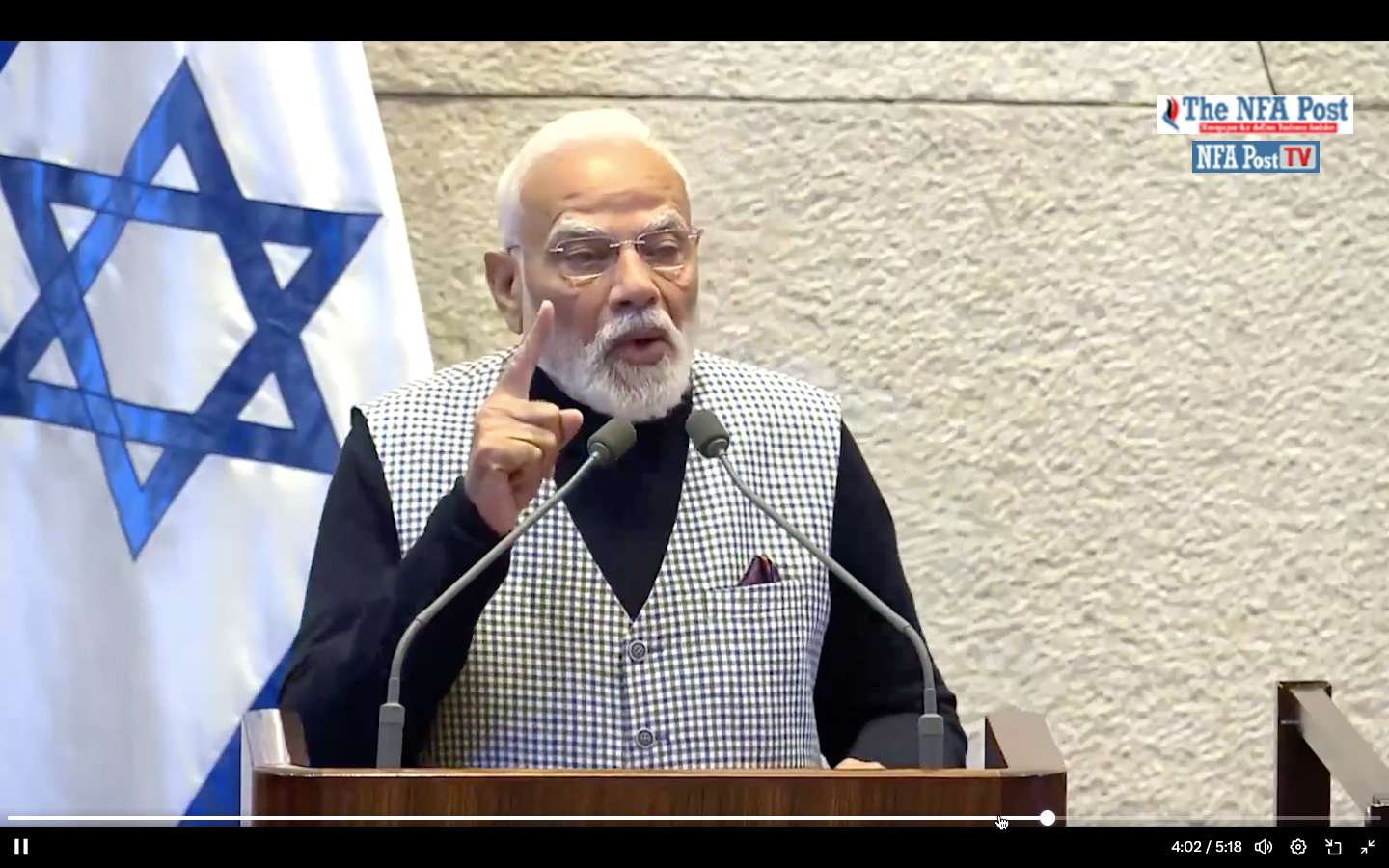
CREDAI SOUTHCON 2026 Keynote | Brigade Group Chairman M.R. Jaishankar outlines India’s growth trajectory, lessons from China, and a strategic roadmap for developers across South India
Bengaluru, NFAPost: Addressing real estate developers from across South India on the first day of the two-day CREDAI SOUTHCON 2026, hosted by CREDAI Karnataka in Bengaluru, M.R. Jaishankar, Executive Chairman of Brigade Group, delivered a keynote that set the tone for the conference. His address placed Tier-2 and Tier-3 cities at the centre of India’s next real estate expansion, urging developers to balance ambition with discipline as the country enters a decisive phase of urbanisation.
Drawing on over four decades of experience, Jaishankar blended macroeconomic data, global comparisons, and hard-earned market lessons to offer what many delegates described as a strategic compass for navigating India’s rapidly evolving property landscape.
India’s Economic Ascent and the Real Estate Multiplier
Jaishankar opened with a confident assessment of India’s macroeconomic momentum.
“Year after year, we are seeing 8–8.2% GDP growth, and today we are proud to say that India is the fourth largest economy in the world,” he said.
With India currently a $4-trillion economy, real estate already contributes 7–9% of GDP, translating into a sector size of $300–400 billion. The projections ahead are striking. By 2030, when India is expected to touch $7 trillion, real estate could expand to $850 billion, accounting for 11–12% of GDP. Looking further ahead to 2047, Jaishankar projected a $10-trillion economy, with the real estate sector alone potentially reaching $1.5 trillion.
The structural drivers behind this growth are unmistakable. India’s urbanisation rate, currently around 35%, is expected to rise to 42% by 2030 and 50% by 2047. This demographic shift, combined with the rise of nuclear families and increasing aspirations for quality housing, is creating sustained end-user demand, particularly beyond the saturated Tier-1 markets.
Lessons from China: Growth Without the Ghost Cities
To contextualise India’s trajectory, Jaishankar drew a measured comparison with China—one that carried a clear warning.
“What China was in 2008, we are in 2025,” he observed.
China in 2008 had a $4-trillion GDP and a per capita income of $3,500, compared with India’s current $2,800 per capita income. By Jaishankar’s estimate, India trails China’s growth curve by 18–25 years. But he stressed that the comparison should not lead to imitation.
China’s urbanisation, he noted, was state-directed and forced, resulting in large-scale developments that often ran ahead of demand—creating the now-infamous ghost cities. India, by contrast, must pursue incremental, demand-driven growth.
To underline the scale of China’s market, Jaishankar cited a striking example: in 2018, Vanke Developers reportedly sold 50,000 housing units in a single quarter, a figure equivalent to Bengaluru’s entire annual residential sales.
“That kind of potential exists in India as well,” he said, “but whether it materialises in 2035 or 2047 depends on how responsibly we grow.”
South India’s Tier-2 Cities Step Into the Spotlight
Turning to regional dynamics, Jaishankar highlighted South India as a key engine of the Tier-2 and Tier-3 growth story. Of the roughly 150,000 units sold annually across Tier-2/3 cities nationwide, South India currently accounts for around 22,000 units.
Cities such as Coimbatore, Kochi, Thiruvananthapuram, along with fast-developing Andhra Pradesh hubs like Visakhapatnam and Vijayawada, are emerging as credible alternatives to overstretched metros.
Jaishankar projected that South India’s Tier-2/3 residential market could reach 40,000 units by 2030 and 60,000 units by 2035, representing nearly 100% growth and a 10–12% compounded annual growth rate.
Infrastructure: The Silent Catalyst
A major accelerant for this shift is infrastructure. National programmes such as Bharatmala, the Golden Quadrilateral, and the planned expansion of airports from 65 to 170 are dramatically improving regional connectivity.
These investments are not just reducing travel times; they are redistributing economic opportunity. As jobs and enterprises move outward, pressure on Tier-1 cities eases. Jaishankar pointed to Bengaluru’s ranking as the world’s second most congested city as a cautionary example of what unchecked urban concentration can lead to.
Economic Cycles and the Shadow of Disruption
Despite his optimism, Jaishankar urged developers to remain grounded in historical reality. Over a career spanning nearly four decades, he has witnessed multiple downturns—the 1991 balance-of-payments crisis, the 2008 global financial meltdown, and domestic disruptions ranging from demonetisation and RERA to GST and the COVID-19 pandemic.
Today, new uncertainties loom.
He described the “scary part” of recent reports suggesting that Bengaluru’s IT sector added just 17 new hires over six months, raising questions about AI-led disruption and its potential spillover into housing demand.
Beyond Homes: The Expanding Commercial Canvas
Jaishankar was emphatic that Tier-2 cities are not just about housing. Office real estate, particularly driven by Global Capability Centres (GCCs), could see demand of 2–4 million sq ft in select Tier-2 markets as companies seek cost efficiency outside Tier-1 cities.
Organised retail is also expanding, though he warned against over-supply.
“One mall is less. Two malls can already be too many,” he said, stressing the importance of market sizing.
Hospitality emerged as one of the strongest post-COVID themes, fuelled by a surge in leisure travel. Jaishankar described the growth as “tremendous—almost unbelievable.”
Perhaps most striking was his assessment of warehousing, which he called the dark horse of Indian real estate. With demand projected to outstrip even residential and office segments, warehousing thrives in locations where land costs remain below ₹2 crore per acre—a sweet spot typically found in Tier-2 and Tier-3 corridors.
He also flagged data centres as an emerging opportunity. While currently concentrated in Mumbai and Chennai, coastal cities like Visakhapatnam are gaining attention following large global investments, including from Google.
A Playbook for the Next Generation of Developers
Jaishankar concluded with a clear set of strategic imperatives:
- Cautious optimism: Assess geopolitical and macroeconomic risks carefully. “For heaven’s sake, don’t over-borrow and create excess land banks.”
- Brand building: A strong brand commands a premium and provides resilience during downturns.
- Cluster development: Mixed-use, integrated developments outperform stand-alone projects. He cited Brigade Gateway, which commands a 25% price premium due to its live-work-play model.
- Transparency and trust: Robust processes and transparent operations ensure customer confidence—even when markets soften.
The Road Ahead
In sum, Jaishankar’s address was less a speech and more a masterclass in strategic foresight. It balanced the promise of India’s economic ascent with hard-won lessons from global and domestic cycles.
For developers, the takeaway was unambiguous: India’s real estate future will be written not in overbuilt metros, but in carefully planned, demand-led Tier-2 and Tier-3 cities. Those who combine patience with prudence, and ambition with discipline, stand to shape the next chapter of India’s urban story.