At the IEEE Future Networks World Forum 2025 in Bengaluru, India positions itself as a global leader in science, technology, and innovation — setting the stage for deep-tech dominance and next-generation connectivity.
NFAPost, Bengaluru: India’s scientific and technological ambitions reached a defining moment this week with the announcement of a ₹1 trillion National R&D and Innovation Fund, designed to turbocharge private-sector research in frontier technologies. Speaking at the inaugural session of the IEEE Future Networks World Forum (FNWF) 2025 in Bengaluru, Dr. Abhay Karandikar, Secretary, Department of Science & Technology (DST), Government of India, said the initiative marks a turning point in India’s innovation journey.
“India is entering a decisive phase in its science and technology journey. Our goal is not just to expand research output, but to build an innovation ecosystem that is globally competitive, economically impactful, and aligned to national priorities,” said Dr. Karandikar.
“We are building a science and innovation ecosystem that is future-ready, self-reliant, and globally influential as we move towards the vision of a developed India by 2047.”
A New Chapter in India’s Innovation Story
Dr. Karandikar emphasized that India’s science and innovation ecosystem has reached an inflection point. The country now ranks third globally in science and engineering publications and PhD output, while patent filings have doubledin the past year. India’s startup ecosystem, he noted, has also surged to become the third largest in the world, boasting over 170,000 startups and more than 100 unicorns.
At the heart of this transformation are national missions such as the Anusandhan National Research Foundation (ANRF), National Quantum Mission, and the National Mission on Cyber-Physical Systems (NM-ICPS). Together, these initiatives are shaping India’s technological frontiers in AI, quantum computing, robotics, semiconductors, and space technologies.
The newly announced ₹1 trillion Innovation Fund is set to supercharge private-sector participation in strategic deep-tech sectors, including 6G and future networks, semiconductors, AI-driven healthcare, quantum systems, space communications, and green energy solutions.
Global Voices on the Future of Connectivity
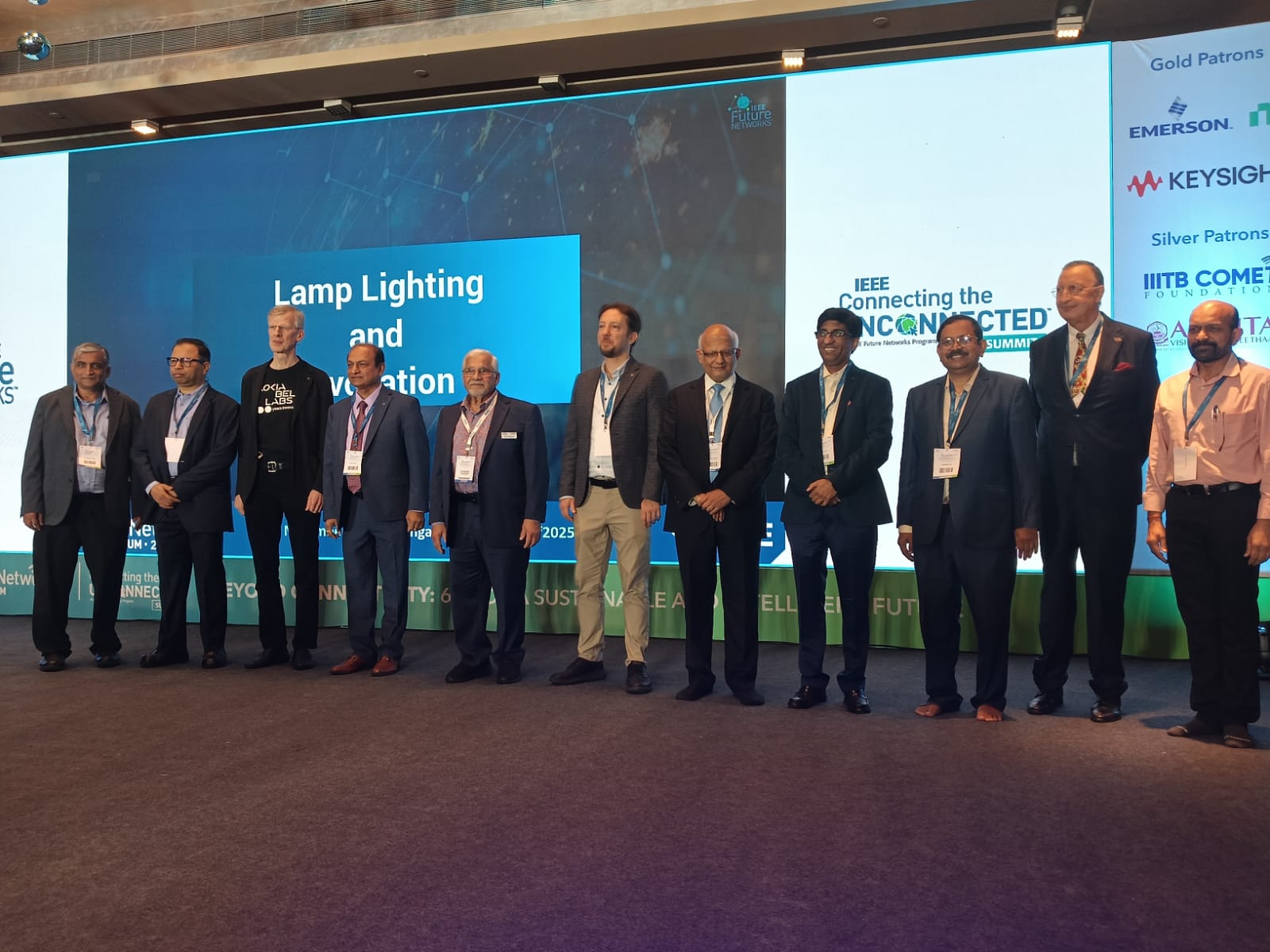
The three-day IEEE Future Networks World Forum brought together a distinguished global panel of researchers, policymakers, and technology leaders to discuss the next evolution of connectivity—from 5G expansion to 6G, AI-native networks, and quantum communications.
Joining the conference virtually, Vinton Gray Cerf, widely recognized as the Father of the Internet, offered a cautionary yet visionary perspective on the resilience of tomorrow’s networks.
“The future of networking is already unfolding through subsea fiber systems and low-Earth-orbit satellite networks,” Cerf said. “But as our dependence on connectivity grows, so does our vulnerability. The next phase of networking will be defined not just by reach, but by resilience — the ability to withstand failure and recover swiftly.”
Industry Leaders Chart the 6G Frontier
Ashutosh Dutta, Founding Co-Chair of the IEEE Future Networks World Forum and researcher at Johns Hopkins University, underscored India’s pivotal role in shaping the global telecom future.
“The 8th IEEE Future Networks World Forum in Bengaluru not only accelerates the deployment of 5G but also paves the way for 6G research and development. This forum provides a platform for industry, academia, government, and startups to co-create technology for humanity,” he said.
From the industry front, Peter Vetter, President of Bell Labs Core Research and Bell Labs Fellow, highlighted the convergence of AI, quantum technologies, and next-generation communications as part of a holistic vision.
“Our work spans AI, software systems, next-generation networks, quantum technologies, and even communication in space — not as isolated breakthroughs, but as part of one continuous effort to solve real-world problems with science and engineering,” Vetter noted. “The goal is not novelty for its own sake, but technology that is intelligent, resilient, and meaningful.”
India’s 6G Vision: Innovation with Inclusion
India’s leadership in connectivity innovation was a recurring theme. Dr. Latif Ladid, Chair of the 5G World Allianceand President of the IPv6 Forum, pointed out that India is now the second-largest deployer of 5G over IPv6 globally, supported by a vibrant 6G research ecosystem.
Anindya Saha, representing Tejas Networks, added that India’s ‘Bharat 6G Vision’ aims to democratize access to advanced connectivity.
“India is no longer just adopting the future—it is co-creating it. Our Bharat 6G Vision is a blueprint for an AI-native network built on affordability, sustainability, and ubiquitous intelligence,” Saha said. “We are here not just to showcase innovation, but to drive international standards and bridge the global digital divide.”
Beyond Technology: Networks that Empower Society
Adding a broader academic perspective, Prof. Debabrata Das, Project Director of NM-ICPS and Director of IIIT-Bangalore, emphasized that the conference sought to reimagine the very purpose of connectivity.
“This forum is not just about moving from one generation of communication technology to the next,” he said. “It is about reimagining how networks can enable societies — on the ground and in space. The ideas shared here will shape research directions, innovation pathways, and global collaboration in the years ahead.”
A Decisive Decade for Indian Innovation
The IEEE Future Networks World Forum 2025 has made it clear that India’s innovation ecosystem is entering its decisive decade. With government-backed mega-missions, private-sector engagement, and global collaboration, India is positioning itself not just as a participant in the next technological revolution — but as one of its principal architects.
As Dr. Karandikar aptly put it, India’s vision for 2047 is not only about achieving self-reliance but defining global standards of excellence and innovation.
“The technologies being developed today — from quantum to 6G — are not just tools of progress,” he said, “they are the foundations upon which the future of a developed, self-reliant India will be built.”