


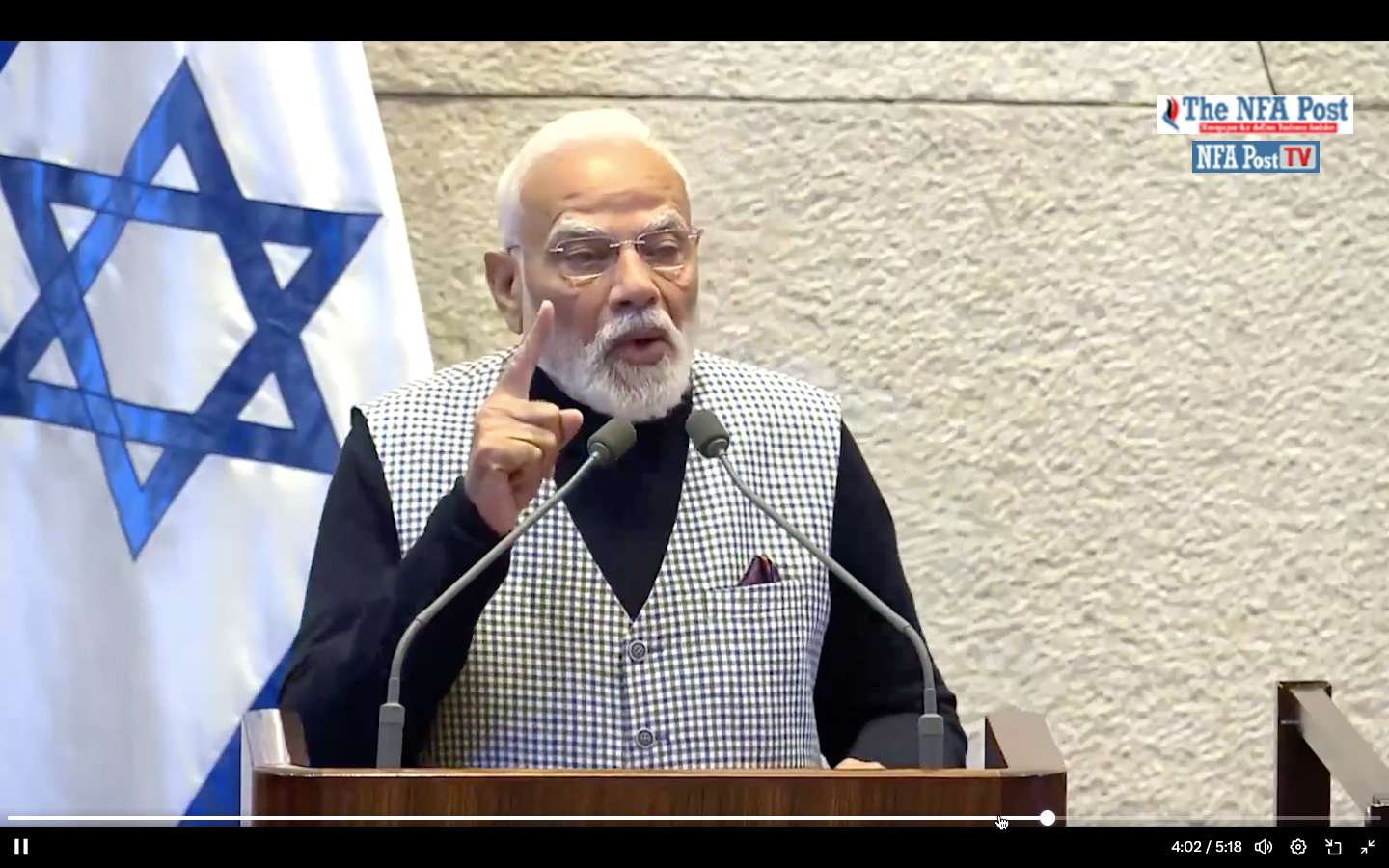
I see a lot of synergies in areas such as quantum technologies, semiconductors, and artificial intelligence. We are also working with Israel on creating cross-border financial linkages using our Digital Public Infrastructure, says Prime Minister Narendra Modi
Tel Aviv, NFAPost: Prime Minister Narendra Modi arrived in Israel on Wednesday for a two-day state visit, and he became the first Indian politician to address the Israeli parliament, Knesset, stating that India’s aspirational spirit aligns naturally with Israel’s innovation ecosystem.
“Our aspirational spirit aligns naturally with Israel’s innovation ecosystem. I see a lot of synergies in areas such as quantum technologies, semiconductors, and artificial intelligence. We are also working with Israel on creating cross-border financial linkages using our Digital Public Infrastructure,” said Prime Minister Narendra Modi.
In a special gesture, on arrival at the airport in Tel Aviv, he was received by Israeli Prime Minister Benjamin Netanyahu and his spouse, Sara Netanyahu and accorded a ceremonial welcome.
Following the arrival ceremony, the two Prime Ministers held a brief one-on-one meeting. At the hotel, the Prime Minister was accorded a warm and enthusiastic welcome by the members of the Indian community and the representatives of the Jewish Indian diaspora. The reception was marked by vibrant cultural performances by Indian and Israeli artistes, symbolising the enduring friendship between the two nations.
The Prime Minister Narendra Modi shared a Sanskrit Subhashitam, emphasising the critical importance of protecting the fundamental roots of wisdom and daily discipline .The Subhashitam shared by the Prime Minister reads:
विप्रो वृक्षस्तस्य मूलं च सन्ध्या वेदाः शाखा धर्मकर्माणि पत्रम्।
तस्मान्मूलं यत्नतो रक्षणीयं छिन्ने मूले नैव शाखा न पत्रम्॥
“A wise person is like a tree. The root of that tree of knowledge is daily worship. The Vedas are its branches, and good deeds are its leaves. Therefore, the root must be carefully protected, because if the root is destroyed, neither the branches nor the leaves will survive.”
The Prime Minister wrote on X;
विप्रो वृक्षस्तस्य मूलं च सन्ध्या वेदाः शाखा धर्मकर्माणि पत्रम्।
तस्मान्मूलं यत्नतो रक्षणीयं छिन्ने मूले नैव शाखा न पत्रम्॥
Before leaving India to Tel Aviv for a two day Israeli state visit, Prime Minister Narendra Modi made it clear that India and Israel share a robust and multifaceted Strategic Partnership that has witnessed remarkable growth and dynamism in recent years.
“I look forward to my discussions with Prime Minister Netanyahu aimed at further strengthening our cooperation across various domains, including science and technology, innovation, agriculture, water management, technology, defence and security, trade and investment, as well as people-to-people ties. We will also exchange views on regional and global issues of mutual interest,” said Prime Minister Narendra Modi.
During the visit which is on the invitation of Israel Prime Minister Benjamin Netanyahu, Prime Miniter Narendra Modi also said he will meet Israel President Isaac Herzog. “I will also have the honour of becoming the first Indian Prime Minister to address the Israeli Parliament, Knesset, an occasion that would be a tribute to the strong parliamentary and democratic ties that bind our two nations,” said Prime Minister Narendra Modi.
He also made it clear that he is eagerly look forward to interacting with the members of the Indian diaspora who have for long been nurturing the India-Israel special friendship.
“I am confident that my state visit will further consolidate the enduring bonds between the two countries, set new goals for the Strategic Partnership, and advance our shared vision for a resilient, innovative and prosperous future,” said Prime Minister Narendra Modi.
Upon his arrival at the Knesset, the Prime Minister was received by Knesset Speaker Amir Ohana and accorded a ceremonial welcome. The Prime Minister of Israel, Benjamin Netanyahu; Leader of Opposition Yair Lapid; and Speaker Ohana spoke in the Plenary ahead of Prime Minister’s address, expressing strong bipartisan support for India-Israel ties.
The
Prime Minister began his address by thanking the Speaker for the special honour. He expressed gratitude for being bestowed with the “Speaker of the Knesset” medal, which he dedicated to the enduring friendship and shared democratic traditions of the two countries.
Highlighting the strong bonds of friendship between India and Israel, the Prime Minister noted that the two peoples share both ancient civilisational ties and a robust contemporary partnership based on technology, innovation, defence, security and strategic convergences.
“Long before we related to each other as modern States, we were linked by ties that go back more than two thousand years. The Book of Esther refers to India as Hodu. The Talmud records trade with India in ancient times. Jewish merchants travelled across sea routes that connected the Mediterranean with the Indian Ocean. They came seeking opportunity and dignity. And, in India, they became one of us,” said Prime Minister Narendra Modi.
He also pointed out that Jewish communities have lived in India without fear of persecution or discrimination. “They have preserved their faith and participated fully in society. That record is a source of pride for us. The Bene Israel of Maharashtra, the Cochini Jews of Kerala, the Baghdadi Jews of Kolkata and Mumbai, and the Bnei Menashe of the North East have enriched India. In my home state Gujarat, there is a school set up by a Bene Israeli family – Mister and Missus Best. It is an excellent school, and of course, it is called the Best School,” said Prime Minister Narendra Modi.
He stated that the vibrant people-to-people ties based on cooperation in agriculture, rural development, water management, sustainability and enterprise have imparted a dynamic outlook to the relationship. Underlining the historical connections and two-way movement of people between the two countries, the Prime Minister stated that the Indian community in Israel and the Jewish diaspora in India have made a significant contribution to progress in both countries.
Recalling the uncompromising policy of zero tolerance for terrorism of the two countries, the Prime Minister offered condolences for the October 7 terror attack and noted that there can be no justification for such brutality.
“I carry with me deepest condolences of the people of India for every life lost and for every family whose world was shattered in the barbaric terrorist attack by Hamas on “October 7”. We feel your pain. We share your grief. India stands with Israel, firmly, with full conviction, in this moment, and beyond. No cause can justify the murder of civilians. Nothing can justify terrorism,” said Prime Minister Naredra Modi.
He also pointed out that India has endured the pain of terrorism for a long time. “We remember the 26/11 Mumbai attacks and the innocent lives lost, including Israeli citizens. Like you, we have a consistent and uncompromising policy of zero tolerance for terrorism, with no double standards,” said the Prime Minister.
Terrorism aims to destabilise societies, to block development, and to erode trust. “Countering terrorism requires sustained and coordinated global action, because terror anywhere threatens peace everywhere. That is why, India supports all efforts that contribute to durable peace and regional stability,” said Narendra Modi.
He also recalled that some years ago, when Israel concluded the Abraham Accords, India applauded Israel’s courage and vision. “It was a moment of new hope for a long-troubled region. Since then, the situation has changed significantly. The path is even more challenging. Yet it is important to sustain that hope,” said Prime Minister Narendra Modi.
He offered India’s support to all efforts that contribute to durable peace and stability in the region. In this context, he highlighted India’s firm support for the Gaza Peace Initiative endorsed by the UN Security Council.
Noting the ongoing collaboration between India and Israel in the plurilateral arena, he called for deeper interaction between the two countries in the India-Middle East-Europe Economic Corridor [IMEC] and the I2U2 frameworks.
Prime Minister highlighted India’s growth story and sought greater bilateral collaboration in the fields of trade, investment, infrastructure development, green growth, startups, digital solutions and emerging technologies, unlocking the innovation and creativity of the youth. Expressing satisfaction at the conclusion of the Bilateral Investment Treaty, he called for early finalisation of an ambitious Free Trade Agreement to realise the untapped trade potential.
“For the last few years, India has been the fastest-growing major economy in the world. Soon, we will be among the top three economies globally. At the same time, Israel is a powerhouse of innovation and technological leadership. This creates a natural foundation for a forward-looking partnership,” said Narendra Modi.
He also said India is committed to expanding trade, strengthening investment flows, and promoting joint infrastructure development.
“The Bilateral Investment Treaty signed last year will provide confidence and predictability to our businesses. In the last few years, India has concluded a number of important trade agreements with other nations. To your West, the European Union, and the UK. To your East, the UAE and Oman,” said the Prime Minister
He also pointed out that bilateral goods trade has grown manifold in recent years. “But, it does not reflect the full scope of opportunity. That is why our teams are working hard to negotiate an ambitious Free Trade Agreement. It will unlock the vast untapped potential in our trade relationship,” he said.
Indian Prime Minister also pointed out that Israel is often called the “startup nation” and in recent years, both countries have also been working to unlock the innovation and creativity of youth.
“I recall that in 2018, Prime Minister Netanyahu and I inaugurated the iCreate Technology Business Incubator in India. Since then, it has supported nearly 900 such startups. Last week, we hosted the world’s largest and most democratised AI Impact Summit, with representatives from over 100 countries. Our aspirational spirit aligns naturally with Israel’s innovation ecosystem. I see a lot of synergies in areas such as quantum technologies, semiconductors, and artificial intelligence. We are also working with Israel on creating cross-border financial linkages using our Digital Public Infrastructure,” said Prime Minister Narendra Modi.
He also mentioned how Israel’s agricultural miracle in the desert inspires Indian farmers. “Israeli expertise in precision irrigation and water management has already transformed agricultural practices in India. Together, we have established 43 Centres of Excellence across India that have provided training to more than half a million farmers. We should now set an ambitious goal of expanding to 100 Centres to benefit millions of farmers and fishermen,” said Prime Minister Narendra Modi.
The Prime Minister called for greater parliamentary interaction between the two vibrant democracies, taking advantage of the recently formed Parliamentary Friendship Group for Israel in India. Drawing parallels between the ethos of the two civilisations, the Prime Minister noted that India’s philosophy of Vasudhaiva Kutumbakam [the world is one family] and the Israeli principle of Tikkum Olam [healing the world] speak of shared approaches towards a harmonious society.
“We are both ancient civilisations. And it is perhaps no surprise that our civilisational traditions also reveal philosophical parallels. In Israel, the principle of Tikkun Olam speaks of healing the world. In India, Vasudhaiva Kutumbakam affirms that the world is one family. Both ideas extend responsibility beyond immediate boundaries. They ask societies to act with compassion and moral courage,” said Prime Minister Narendra Modi.
He pointed out that Judaism emphasises Halakha, guiding everyday conduct through law and practice. “Hindu philosophy speaks of Dharma, the moral order that shapes duty and right action. In both traditions, ethical life is lived through action, and faith is expressed through conduct,” said the Prime Minister.
There is an endearing similarity in festivals as well in both countries. “You celebrate Hanukkah with the warm glow of candles. Around the same time, we celebrate Diwali, the festival of lights, with the gentle radiance of lamps. Soon, India will celebrate the festival of Holi, filled with happiness and colour. And around the same time, Israel will also celebrate Purim with enthusiasm and joy,” said Prime Minister Narendra Modi.
Prime Minister thanked the members of the Knesset for their contribution to India-Israel ties and conveyed good wishes for the upcoming festival of Purim. The full address of the Prime Minister may be seen here [link]










Leave a Reply