


SBaaS Programme Aims to Build Indigenous Hosted Payload Platforms and Position India as a Global Small Satellite Hub
Bengaluru, NFAPost: In a significant push to deepen India’s private-sector participation in space manufacturing, the Indian National Space Promotion and Authorisation Centre (IN-SPACe) has announced the results of its much-anticipated Announcement of Opportunity (AO) for the development of indigenous small satellite bus platforms under its Satellite Bus as a Service (SBaaS) initiative.
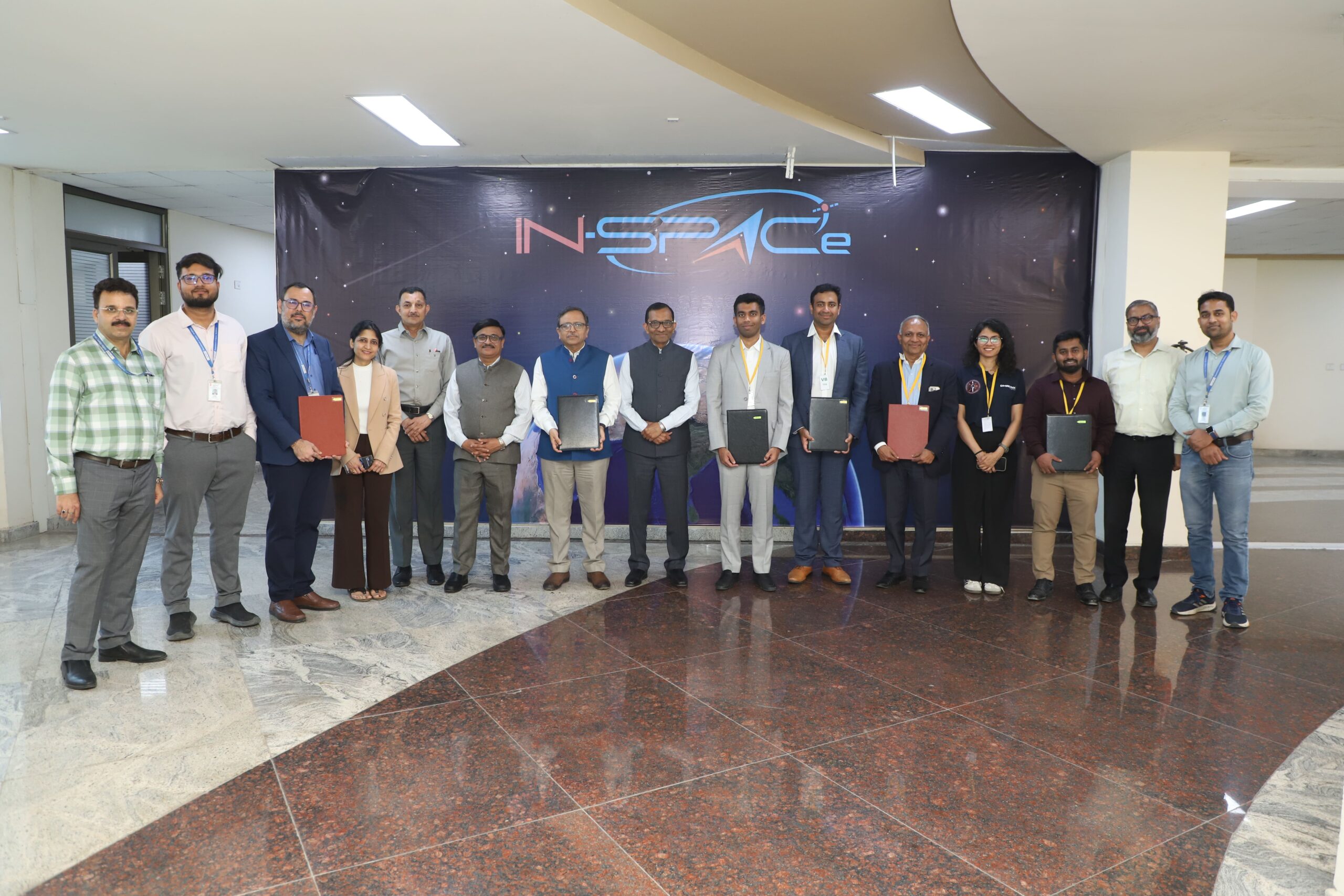
After receiving 15 proposals by July 2025 and conducting what officials described as a rigorous, transparent, multi-stage evaluation process, IN-SPACe has selected three Non-Governmental Entities (NGEs):
- Astrome Technologies Pvt. Ltd., Bengaluru
- Azista Industries Pvt. Ltd., Hyderabad
- Dhruva Space Pvt. Ltd., Hyderabad
Each of the selected companies will receive a grant of ₹5 crore to support the development and demonstration of modular, scalable small satellite bus platforms designed specifically for hosted payload services. Formal contract agreements were signed on 11 February 2026, marking the operational launch of the SBaaS scheme.
Building India’s Satellite Manufacturing Backbone
At its core, the SBaaS initiative seeks to create standardized, flight-ready satellite bus platforms capable of accommodating multiple hosted payloads—ranging from Earth observation instruments to communication modules—on a shared spacecraft architecture.
Dr. Pawan Goenka, Chairman of IN-SPACe, framed the initiative as a structural shift in India’s space manufacturing strategy.
“The Satellite Bus as a Service initiative marks an important step in building a robust, sustainable, and globally competitive small satellite manufacturing ecosystem in India. By enabling indigenous satellite bus platforms and integrating them with India’s emerging small satellite launch capabilities, we are laying the foundation for India to become a preferred global destination for end-to-end small satellite manufacturing, launch, and hosted payload services.”
The emphasis on integration is critical. India has already demonstrated cost-effective launch capability through Indian Space Research Organisation (ISRO), and with private launch vehicle startups gaining traction, the missing piece has been scalable, standardized spacecraft platforms that lower barriers for payload developers.
SBaaS attempts to bridge that gap.
Lowering Entry Barriers for Payload Developers
Shri Rajeev Jyoti, Director – Technical Directorate at IN-SPACe, highlighted how the programme addresses structural inefficiencies in the small satellite market.
“The SBaaS initiative is a key enabler for the development and manufacturing of indigenous small satellite bus platforms in India. By providing standardized and flight-proven satellite bus platforms for hosted payload missions, IN-SPACe aims to reduce entry barriers for payload developers while strengthening domestic manufacturing capabilities and reinforcing India’s position in the rapidly growing global hosted payload services market.”
Hosted payload models are increasingly attractive globally because they allow payload developers to avoid the high costs and long timelines associated with building and launching an entire dedicated satellite. Instead, multiple customers can share a bus platform, reducing risk and cost per mission.
For India’s emerging space-tech startups—particularly those building sensors, communication payloads, or climate-monitoring instruments—this could significantly compress go-to-market cycles.
Structured Public-Private Collaboration
Under the AO guidelines, IN-SPACe will provide milestone-linked grant disbursement and facilitate access to ISRO/DOS infrastructure, testing facilities, and technical expertise as required. This hybrid support mechanism reflects a broader public–private partnership (PPP) model that India’s space sector has steadily embraced since its liberalisation in 2020.
In subsequent phases, IN-SPACe plans to enable actual hosted payload missions on these platforms, moving the selected companies from development into operational deployment—an important shift from prototype-building to revenue-generating missions.
The announcement follows another strategic move by IN-SPACe: the signing of a concession agreement with PixxelSpace India and Allied Orbits Pvt Ltd (an SPV formed by a Pixxel-led consortium) to establish an Earth Observation constellation under a PPP framework. That initiative aims to build indigenous EO capabilities and foster a commercially viable satellite data ecosystem.
Taken together, these steps signal a coordinated strategy: build platforms, enable payload developers, integrate launch services, and create downstream data markets.
Why Satellite Buses Matter
A satellite bus is essentially the core spacecraft platform that provides power, propulsion, communications, and attitude control—while the payload performs the mission-specific function. Globally, companies such as Airbus, Northrop Grumman, and smaller space startups have demonstrated how standardized bus architectures can drastically reduce mission costs.
India’s entry into this domain is strategically timed. The global small satellite market—driven by Earth observation constellations, IoT connectivity, climate monitoring, and defence applications—is expanding rapidly. Hosted payload services, in particular, offer governments and commercial players flexible mission options without requiring standalone satellites.
By nurturing indigenous bus platforms, IN-SPACe is attempting to ensure that Indian companies do not remain limited to subsystems or downstream analytics, but instead move up the value chain into spacecraft manufacturing and mission integration.
The Institutional Context
Indian National Space Promotion and Authorisation Centre was constituted in June 2020 following the Government of India’s landmark decision to open the space sector to private participation. Functioning as an autonomous agency under the Department of Space, it serves as a single-window nodal body responsible for the promotion, authorisation, and supervision of private space activities.
Its mandate spans the building of launch vehicles and satellites, sharing of ISRO infrastructure, and enabling new space infrastructure development. The organisation operates through its Promotion Directorate, Technical Directorate, and Programme Management & Authorisation Directorate, supported by administration, finance, and legal wings.
In essence, IN-SPACe acts as both facilitator and regulator—ensuring compliance while accelerating capability-building.
Strategic Implications
The SBaaS initiative is not merely a grant programme; it is an ecosystem-building intervention.
For Bengaluru-based Astrome Technologies, known for its satellite communication innovations, and Hyderabad-based Azista Industries and Dhruva Space—both active in spacecraft subsystems and integration—the grants provide capital as well as regulatory confidence. The association with IN-SPACe and access to ISRO-grade testing facilities reduce technological and credibility risks, especially when competing in international markets.
More importantly, SBaaS aligns platform development with India’s emerging private launch capabilities, creating the possibility of fully Indian-designed, manufactured, integrated, and launched small satellite missions.
If executed effectively, the initiative could:
- Shorten satellite development timelines
- Reduce mission costs for payload developers
- Attract international hosted payload customers
- Strengthen India’s export potential in small satellite manufacturing
- Deepen PPP-led innovation in space infrastructure
The Road Ahead
India’s space liberalisation journey is still in its formative phase, but programmes like SBaaS indicate increasing maturity. Rather than sporadic startup support, the focus is shifting toward structured capability clusters—launch, platform, payload, and downstream services—operating in a coordinated framework.
The selection of Astrome, Azista, and Dhruva Space marks the beginning of that platform-building journey.
As India positions itself in the intensifying global competition for small satellite manufacturing and hosted payload services, the SBaaS initiative may well prove to be a foundational building block—quietly but decisively shaping the architecture of India’s commercial space future.











Leave a Reply