


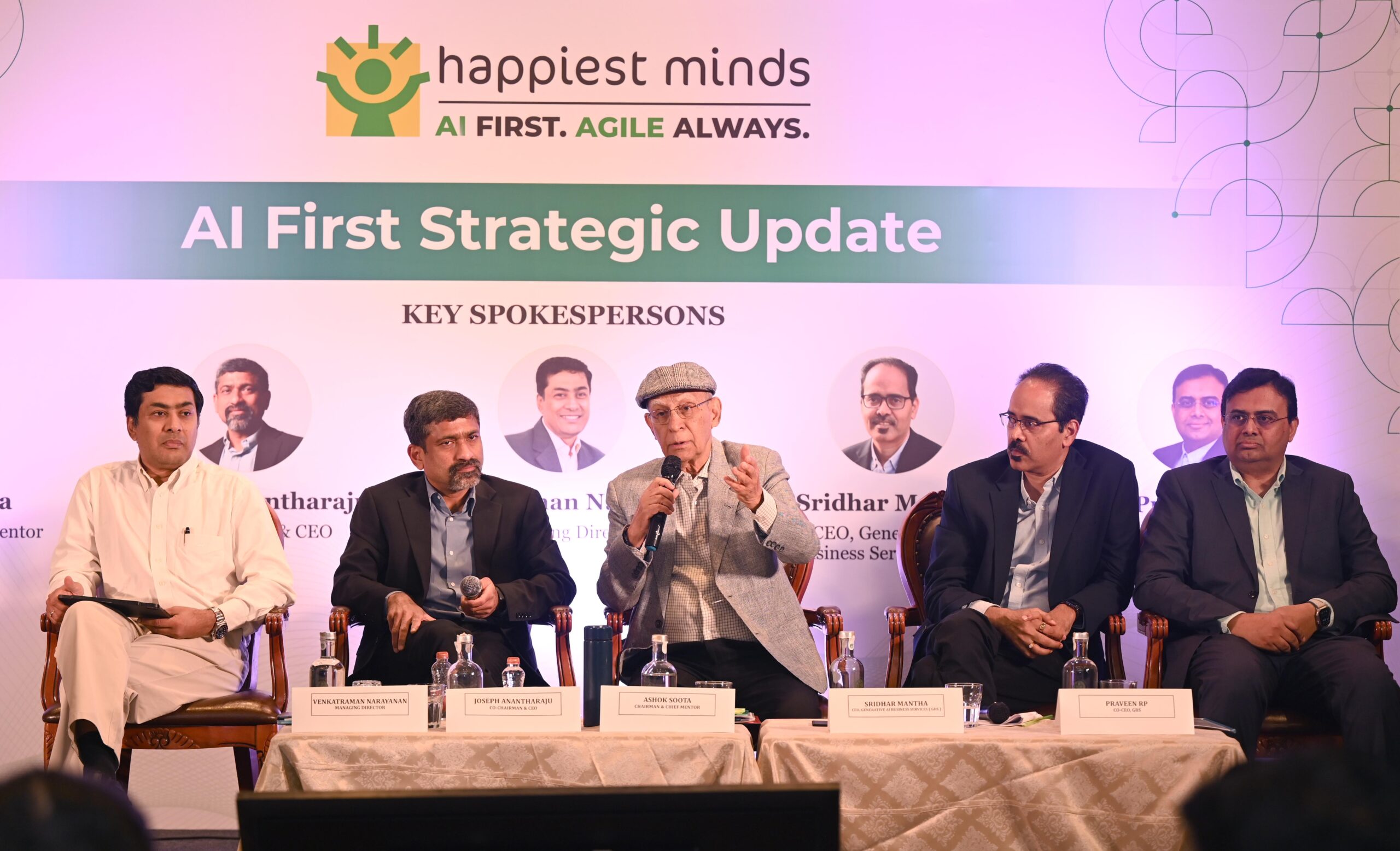
Chairman Ashok Soota dismisses AI disruption fears, unveils 11-point blueprint to embed artificial intelligence across operations and accelerate revenue momentum
Bengaluru, NAFPost: In a bold recalibration of its long-term growth playbook, Happiest Minds Technologies has formally declared an “AI First” future, marking what Chairman Ashok Soota described as a decisive shift in the company’s strategic identity.
Replacing its long-standing positioning of “Born Digital, Born Agile,” the Bengaluru-headquartered IT services firm is now committing to embed artificial intelligence at the heart of its service delivery, revenue model, and client engagement strategy—while confidently dismissing concerns that AI could erode traditional IT services businesses.
Addressing the media alongside his senior leadership team, Soota framed the pivot not as a defensive maneuver but as an aggressive growth strategy.
“This is not a threat,” he asserted. “It is an opportunity for us. Maybe also for other people in the IT services space. Certainly, we’re not seeing any problems whatsoever, and we will continue to grow at an accelerated rate.”
Upward Revision of Growth Guidance
The announcement comes at a time when global IT services firms are grappling with macroeconomic caution, delayed decision-making cycles, and industry anxiety over automation-driven revenue cannibalisation.
Happiest Minds, which had earlier committed to sustaining 10% annual growth for four years, is now signaling a significant upward revision in guidance.
“When we announce our Q4 results, we will give you these numbers and expect to show a significant increase in the guidance,” Soota said, hinting at stronger-than-anticipated momentum.
While he acknowledged that broader industry slowdowns may require recalibrating the company’s long-term $1 billion revenue aspiration timeline, he emphasized that the “AI First” framework is designed to compress that journey, not delay it.
11 Strategic Programs: Beyond Branding
Unlike many corporate AI declarations that remain aspirational, Happiest Minds outlined 11 structured programs aimed at embedding artificial intelligence deeply across its delivery architecture and market strategy.
CEO Joseph Anantharaju noted that the shift reflects a change in client expectations.
“Enterprises are moving beyond experimentation,” he said. “They are increasingly focused on embedding AI into core workflows and platforms where the business impact is clear and scalable.”
Among the key pillars of the strategy:
1. AI Service Delivery Platform
A unified AI-enabled framework integrating tools and intelligent agents to accelerate service delivery across business units.
2. Industry-Specific AI Solutions
A sharpened focus on high-adoption sectors such as Healthcare, EdTech, and Retail/CPG, including initiatives like:
- “University in a Box” digital transformation models
- Specialized Small Language Models (SLMs) tailored for healthcare workflows
3. AI-Native Software Development
A reimagined operating model in which human engineers define intent and governance frameworks while AI agents execute tasks across the Software Development Lifecycle (SDLC).
4. Outcome-Based Pricing
Scaling non-linear revenue models tied directly to measurable business outcomes—such as productivity gains or revenue uplift—rather than traditional time-and-material billing.
Collectively, these initiatives signal a fundamental redesign of how value is created and monetized.
From Proof of Concept to Production
One of the strongest signals of maturity in Happiest Minds’ AI journey is the commercial performance of its Generative AI Business Services (GBS) unit.
The unit has grown nearly 50% quarter-on-quarter and has already turned profitable—an inflection point many competitors are still striving toward.
Sridhar Mantha, CEO of GBS, underscored the company’s progress:
“We are able to move beyond pilots and POCs. We have already moved 30 use cases into production, which are actually delivering ROI to our customers.”
This transition—from experimentation to enterprise-scale implementation—forms the backbone of the company’s AI monetization strategy.
Mantha described a collaborative partnership model in which clients often possess strategic ambition but require execution clarity.
“They are really appreciative of partnering with us and helping them throughout the journey, based on the broader understanding we bring and the proactive work that we do.”
Humans and AI: A Governance Model, Not Replacement
In a climate where job displacement remains a recurring fear, Happiest Minds’ leadership emphasized augmentation over automation.
Praveen RP, Co-CEO of GBS, articulated what he described as a structural shift in how work will evolve:
“The fundamental shift from doing work to directing agents is the change we will see. In this new model, humans define intent and constraints, AI executes continuously, and humans govern the outcomes.”
Rather than reducing headcount, executives argued that AI will:
- Modernize legacy code faster
- Automate repetitive development cycles
- Increase productivity margins
- Free human talent for higher-value, strategic problem-solving
Financially, the company reported improved gross margins and stated that clients have not sought rate reductions tied to AI-driven efficiency gains—contrary to industry speculation.
Beginning next fiscal year, Happiest Minds will formally disclose:
- AI Revenue (direct AI-led projects)
- AI-Influenced Revenue (traditional services enhanced by AI capabilities)
This transparency is expected to offer investors clearer visibility into the commercial traction of its AI initiatives.
Framing AI as a Market Expansion Tool
Industry observers note that many IT firms remain cautious about openly repositioning around AI for fear of short-term disruption narratives. Happiest Minds’ approach, however, appears intentionally assertive.
Soota repeatedly described fears of revenue erosion as “noise,” arguing that AI adoption is expanding addressable markets rather than shrinking them.
“We are not seeing any slowdown attributable to AI,” he reiterated. “On the contrary, we are seeing accelerated engagement.”
A Strategic Inflection Point
The timing of the announcement is significant. As enterprises globally shift from exploratory AI projects to embedded, workflow-integrated solutions, service providers face a narrowing window to redefine their value propositions.
Happiest Minds’ “AI First” declaration positions the company not merely as an implementer of AI tools, but as a strategic transformation partner.
From Bengaluru, the message was unequivocal:
The company is not adapting cautiously to artificial intelligence—it is restructuring itself around it.
Whether this bold recalibration delivers the accelerated growth Soota predicts will become clearer when Q4 results are announced. But for now, Happiest Minds has made its stance unmistakable: in the next phase of digital transformation, AI is not an add-on—it is the operating system.
















Leave a Reply