At BIFFes, the filmmaker speaks candidly on political sensitivities, cultural hypocrisy, technology-driven viewing habits, and his upcoming Kannada adaptation of Ghachar Ghochar
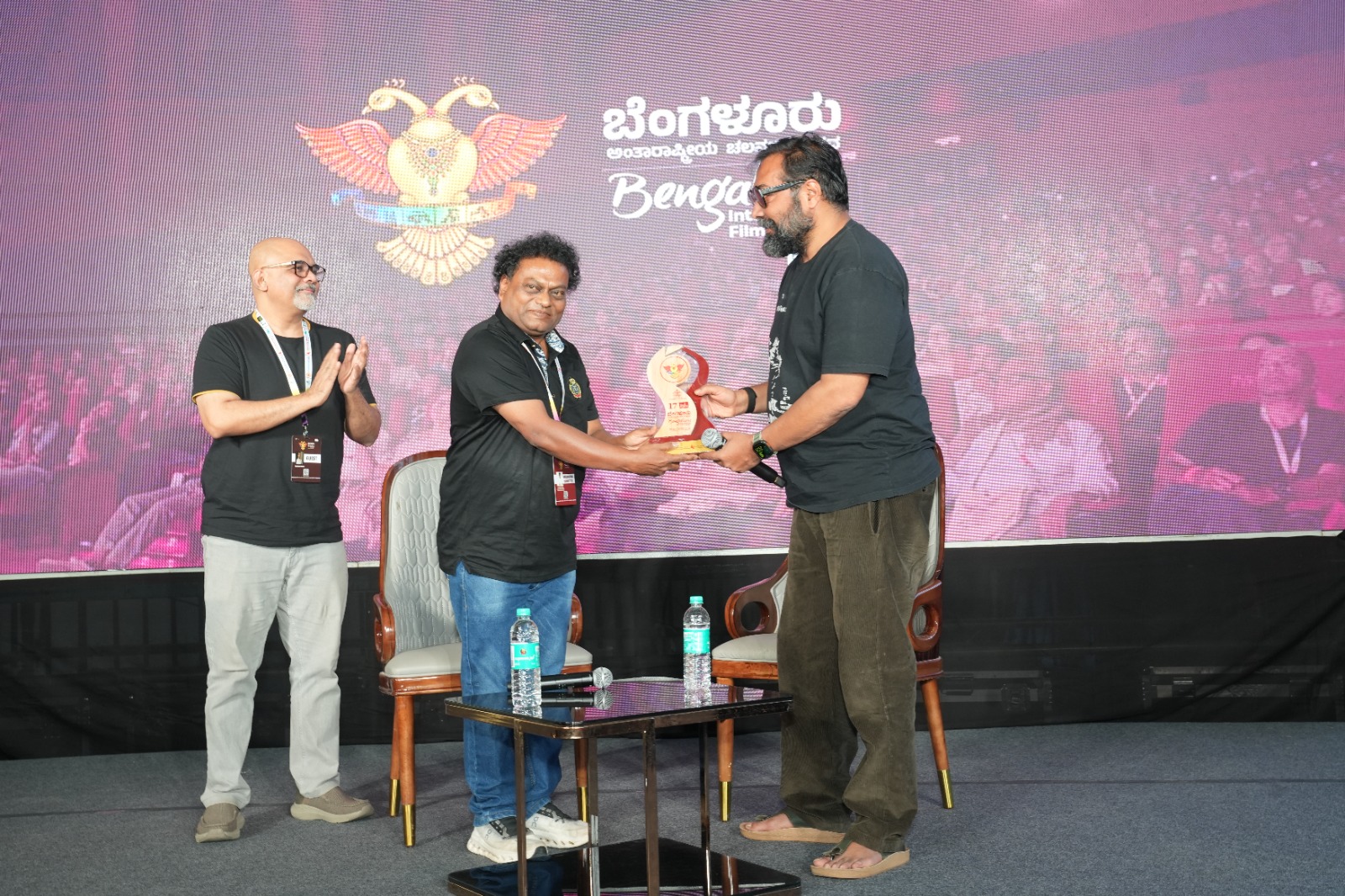
Bengaluru, NFAPost: Indian cinema is operating in an era where fear, caution and compromise increasingly shape creative decisions. This was the stark assessment offered by filmmaker Anurag Kashyap during an intense and wide-ranging discussion titled “Fearless Film Making” at the 17th Bengaluru International Film Festival (BIFFes). The session was moderated by noted film critic Baradwaj Rangan, and drew a packed audience of filmmakers, students and cinephiles.
Kashyap, known for his uncompromising voice, reflected on how the space for independent and politically charged cinema has narrowed over the years.
“In today’s times, making films like Gangs of Wasseypur or Black Friday is impossible,” he said. “Some subjects have become politically sensitive, and the moment you touch them, controversies begin.”
Learning from Global Resistance Cinema
Despite the challenges, Kashyap urged Indian filmmakers not to retreat into self-censorship.
“Directors from countries like Iran or Russia are making films under far greater restrictions than we face,” he pointed out. “Indian directors should draw inspiration from them.”
For Kashyap, courage in cinema is not about provocation for its own sake, but about persistence—finding ways to speak truth even within constrained systems.
Mainstream Courage and Unnecessary Messaging
Turning to contemporary cinema, Kashyap spoke about the recent film Dhurandhar, calling it an example of a bold mainstream attempt.
“It is a courageous mainstream film. I liked the film overall,” he said, adding a note of critique.
“But I didn’t like some of the ideologies. The dialogue about ‘This is the new India’ and one long political monologue—among three such scenes—were unnecessary. Even without them, the impact of the film would not have reduced.”
His comment reflected a recurring theme in the discussion: that overt messaging often weakens cinema that is otherwise confident in its storytelling.
The Politics of ‘Propaganda’
Kashyap also challenged the selective use of terms like propaganda in film criticism.
“Calling films propaganda or promotion is itself a form of propaganda,” he argued.
Drawing a global parallel, he added:
“Hollywood’s Marvel films openly propagate American supremacy, but no one criticizes them from that perspective.”
The remark sparked laughter and reflection alike, underlining how cultural power often escapes scrutiny when it aligns with dominant narratives.
Cultural Hypocrisy and Gendered Outrage
One of the most pointed moments of the session came when Kashyap addressed the reaction to the teaser of the Kannada film Toxic.
“The teaser is an extremely courageous attempt,” he said. “The outrage against it exposes our cultural hypocrisy.”
He elaborated on the gendered double standards prevalent in Indian cinema.
“When male actors appear shirtless or display exaggerated machismo, no one questions it. But when a woman celebrates her sexuality, suddenly it becomes unacceptable.”
Kashyap admitted that such reactions disappoint him deeply, as they reveal entrenched discomfort with female agency on screen.
A Kannada Literary Classic on Screen
In a revelation that drew enthusiastic applause, Kashyap spoke about his deep admiration for Kannada literature and announced an upcoming project.
“I am making a Kannada film based on Ghachar Ghochar by Vivek Shanbhag,” he revealed.
The film is currently in the scripting stage and will later be adapted into Hindi as well. Kashyap said details regarding the director and cast will be announced in due course.
Technology, Attention Spans and New Viewing Habits
Reflecting on changing audience behaviour, Kashyap observed that today’s viewers increasingly consume cinema on mobile phones.
“It has become very difficult to hold attention for slow-paced films,” he said. “But this is not the audience’s fault—it is the result of changes in technology.”
According to him, filmmakers must acknowledge this shift without diluting the integrity of their work.
Political Cinema and the Weight of Time
Responding to questions on why overtly political films are scarce in certain periods, Kashyap offered a sobering historical perspective.
“In Germany, films against Hitler were made only after Hitler died,” he said. “Everything has its own time.”
The comment underscored his belief that cinema, like history, often speaks most freely in retrospect.
A Conversation That Reflected the Times
As the session concluded, it was clear that Kashyap’s remarks struck a chord—not because they offered easy answers, but because they articulated the anxieties, contradictions and moral negotiations facing filmmakers today.
At BIFFes, “Fearless Film Making” lived up to its title—not as a manifesto, but as an honest reckoning with what it means to create cinema in an age where independence is increasingly contested, yet more necessary than ever.