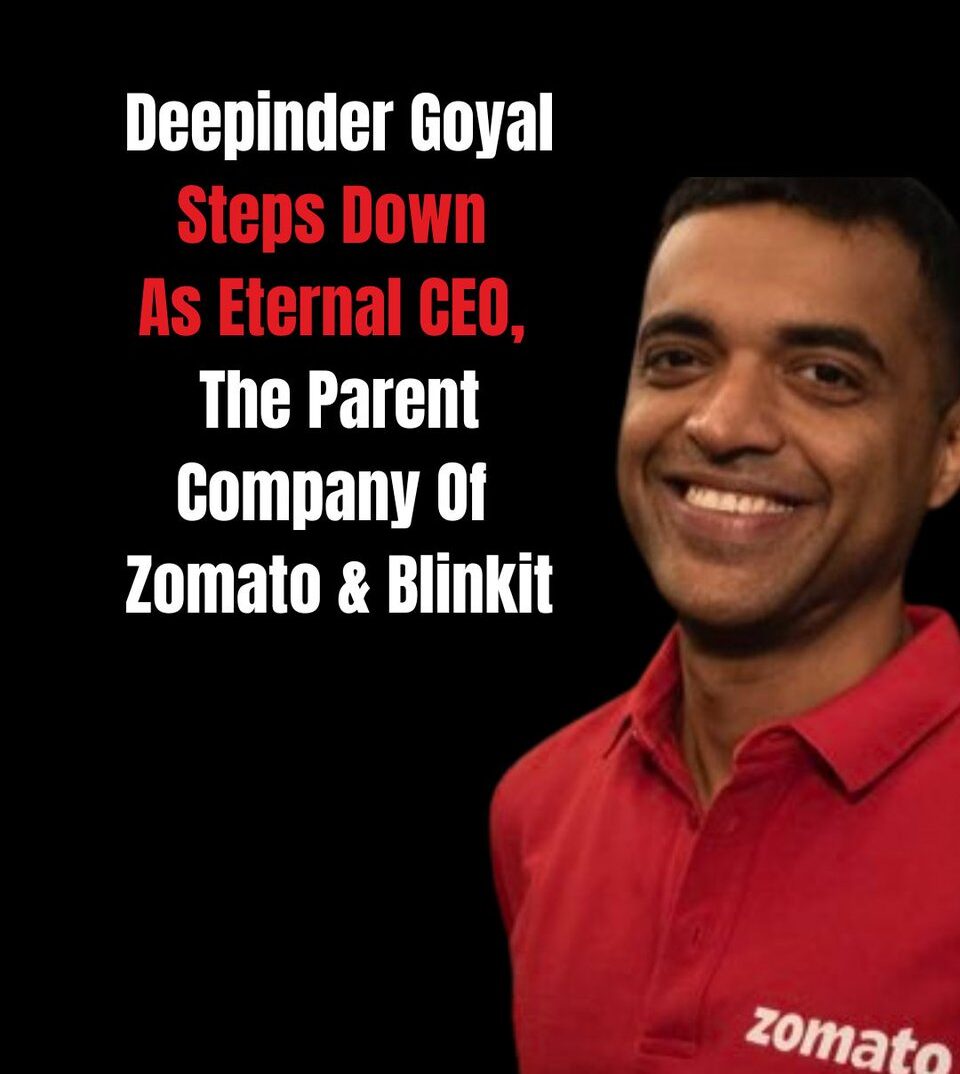
Zomato founder exits the CEO role to pursue high-risk innovation, signalling a strategic leadership transition at one of India’s most influential consumer-tech companies
Bengaluru, NFAPost: In a move that marks the end of an era in India’s consumer internet story, Deepinder Goyal, founder and Chief Executive Officer of Eternal, has announced his decision to step down from the top executive role. Effective February 1, leadership of the group will pass to Albinder Dhindsa, the CEO of Blinkit, while Goyal will continue to serve on Eternal’s board as Vice Chairman.
The announcement, made following Eternal’s board meeting on January 21, comes at a moment of strong financial performance for the company—underscoring that the transition is driven less by operational pressure and more by a strategic rethinking of leadership focus.
A Founder Chooses Exploration Over Execution
In a candid post on X, Goyal explained the personal and professional reasoning behind his decision.
“Of late, I have found myself drawn to a set of new ideas that involve significantly higher risk exploration and experimentation,” he wrote. “If these ideas belonged inside Eternal’s strategic scope, I would have pursued them within the company. They do not.”
The statement reflects a rare founder moment in India’s startup ecosystem—one where a visionary entrepreneur consciously steps back from day-to-day control to create space for experimentation beyond the boundaries of a scaled public company. Goyal was careful to emphasise that this was not a retreat, but a recalibration.
“I want Eternal to become India’s most valuable company,” he added, asserting that the leadership change would not dilute the company’s momentum, even as it gives him the freedom to explore ideas that sit outside Eternal’s remit.
Strong Numbers, Stable Succession
The transition follows the approval of Eternal’s unaudited financial results for the quarter and nine months ended December 31. The company reported a 73% year-on-year surge in net profit in Q3 FY26 to ₹102 crore, while revenue from operations jumped threefold, reinforcing investor confidence and providing a stable backdrop for the leadership change.
Goyal underlined continuity as a central theme of the transition, noting that he, Dhindsa, and senior leader Akshant would continue to work closely, and that business CEOs across the group would retain operational autonomy.
As Group CEO, Dhindsa will be responsible for day-to-day operations, strategic prioritisation, and key business decisions.
Goyal described him as “more than equipped to lead Eternal,” pointing to his role in steering Blinkit from a challenging acquisition to a profitable, high-growth quick-commerce business.
ESOPs, Governance, and Long-Term Thinking
In a move that signals long-term governance discipline, Goyal also announced that all his unvested ESOPs will revert to the ESOP pool.
“This ensures meaningful wealth creation opportunities for the next generation of leaders, while strengthening long-term retention without incremental shareholder dilution,” he said.
For market watchers, this gesture reinforces the message that Eternal’s founder is prioritising institutional strength over personal gain—a narrative still relatively uncommon in India’s founder-led public companies.
From Foodiebay to a Tech Conglomerate
Goyal’s journey is inseparable from the rise of India’s digital consumption economy. He co-founded Zomato—then called Foodiebay—in 2008 with Pankaj Chaddah, starting as a simple platform for restaurant menus and reviews. Over the years, Zomato evolved into a food delivery powerhouse and, later, into a diversified consumer-tech group spanning dining, logistics, and quick commerce under the Eternal umbrella.
His decision to step aside as CEO is thus both symbolic and substantive: the founder of one of India’s most recognisable startups choosing to decouple personal ambition from corporate structure.
A Turn Toward Deep Tech and Longevity
Over the past year, Goyal has increasingly signalled his interest in ventures beyond food and commerce. In March, The Economic Times reported that he invested $20 million in LAT Aerospace, a deep-tech startup co-founded by former Zomato COO Surobhi Das, where Goyal serves as a non-executive co-founder.
He has also launched Continue, a health and wellness initiative focused on extending lifespan, which evolved from what he described as a “personal wellness team” into a structured research effort. More recently, he unveiled Temple, a device designed to monitor brain blood flow—an idea he showcased publicly on social media, hinting at a growing fascination with neuroscience and human longevity.
These projects, while far removed from Eternal’s core businesses, offer insight into the founder’s evolving intellectual pursuits—and perhaps into the next phase of India’s startup innovation landscape.
Continuity Amid Change
Despite the symbolism of the transition, Goyal was unequivocal that Eternal’s strategic direction remains intact.
The change, he said, would allow him to “explore ideas outside Eternal’s scope, without compromising the company’s priorities.”
For Eternal, the appointment of Albinder Dhindsa—a leader with a proven execution track record—signals a shift from founder-driven vision to professionalised scale. For Goyal, it marks a rare and deliberate step into uncertainty, experimentation, and high-risk innovation.
As one chapter closes and another begins, Eternal’s leadership transition stands out not as a rupture, but as a carefully choreographed handover—one that reflects both the maturity of the company and the restless curiosity of its founder.