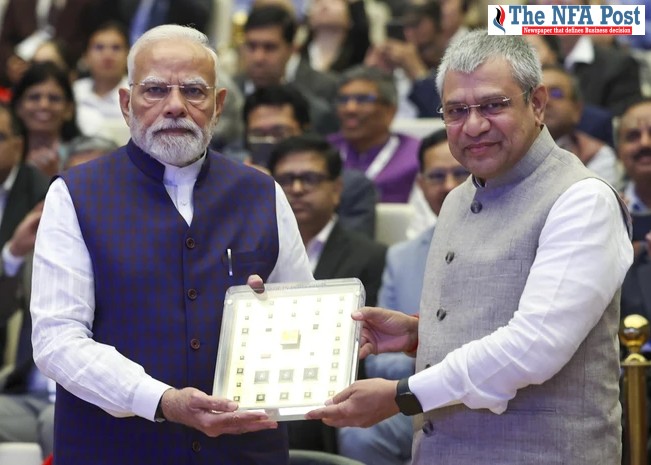
New Delhi, NFAPost: Electronics and IT Minister Ashwini Vaishnaw presented India’s first indigenously built Vikram-32 bit processor chip to Prime Minister Narendra Modi at Semicon India 2025. The semiconductor industry celebrated the event as it marked a milestone in the nation’s semiconductor self-reliance journey.
Developed by the Indian Space Research Organisation (ISRO) in partnership with the Semiconductor Laboratory (SCL), Chandigarh, the Vikram 3201 is built to withstand the extreme conditions of space missions, including temperatures from –55 degrees Celsius to +125 degrees Celsius.
The initial lot of Vikram 3201 device was successfully validated in space during the PSLV-C60 mission, demonstrating its reliability for future space missions. It is an upgrade to Vikram 1601, a 16-bit processor that has powered Isro’s launch vehicles since 2009.
The Vikram chip developed by Isro was first introduced in March and shows rapid advances in India’s chip-making capabilities, following the launch of the India Semiconductor Mission in 2021.
Within just three and a half years, India transitioned from being a major consumer to emerging as a creator of advanced chips, driven by government-backed R&D, stable policies, and robust economic growth. Vikram’s fabrication and packaging took place at SCL’s 180nm CMOS facility in Mohali, Punjab.
Space-grade processors are not off-the-shelf commercial products; they must withstand radiation, extreme temperatures, and the vibrations of launch. Until now, India depended on foreign processors for many critical missions.
With Vikram 3201, India achieves autonomy in this domain, reducing reliance on exports and supply chain disruptions. It is also a step towards Atmanirbhar Bharat (self-reliant India).
Technical Features and Applications
The Vikram-32 is a computer chip that can handle many different tasks. It works with numbers that have decimals (like 3.14) and is built using a 32-bit design, which means it processes data in chunks of 32 bits at a time, and is designed to withstand extreme temperatures and environments found in spaceflight.
According to ISRO, it can handle substantial memory and execute complex instructions needed for launching satellites and space vehicles. Its robust reliability and versatility also signal its potential for defence, aerospace, automotive, and energy sectors, making it instrumental in strategic applications.
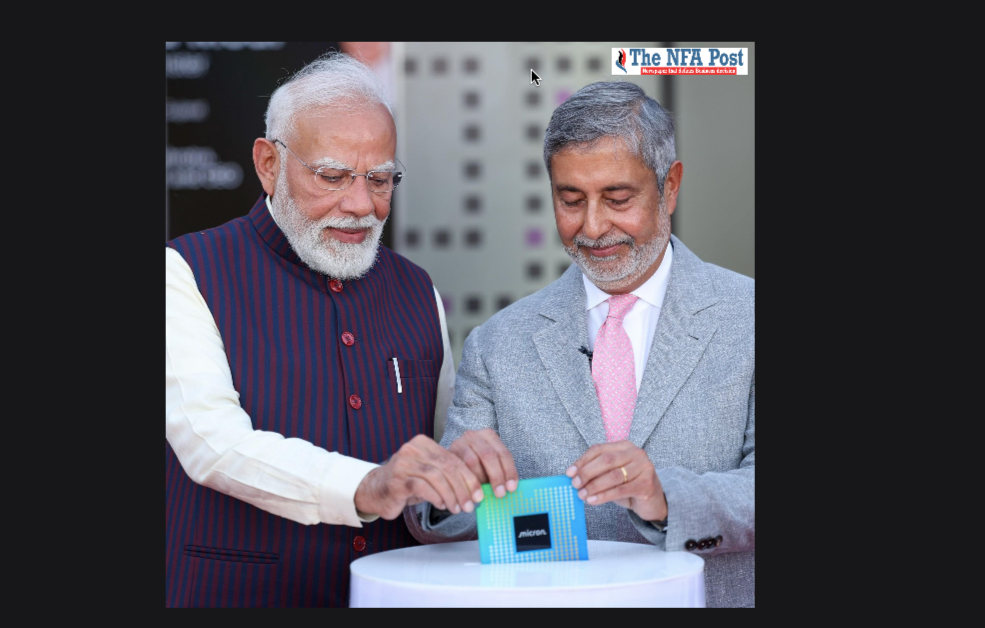
Handing over the first “Made-in-India” chip to the Prime Minister at Semicon India 2025, Minister Ashwini Vaishnaw highlighted India’s progress: construction of five new semiconductor units is underway, and 10 major projects have been approved with over Rs 1.60 lakh crore investments across six states.
With more than 23 design startups supported under the Design Linked Incentive scheme, the event illustrated India’s emergence as a bright spot in the global semiconductor value chain and a “beacon of stability and growth”.
Presenting Vikram-32 to PM Modi was both a technological and symbolic milestone, heralding India’s new era of indigenous semiconductor innovation and global competitiveness.
The three-day Semicon India conference is focussing on advancing a robust, resilient and sustainable semiconductor ecosystem in India.
Earlier this year, on March 5, 2025, the first production lots of Vikram 3201 and another processor, Kalpana 3201, were formally handed over by MeitY Secretary S Krishnan to Isro Chairman Dr V Narayanan.
Kalpana is a 32-bit SPARC V8 RISC microprocessor designed for compatibility with open-source toolchains, offering a different design approach but serving the same goal of indigenous capability.