At SMOPS-2026 in Bengaluru, experts from ISRO, JAXA, and CelesTrak deliver a sobering message: ambition in space is outpacing safety, demanding urgent transparency, smarter systems, and global cooperation.
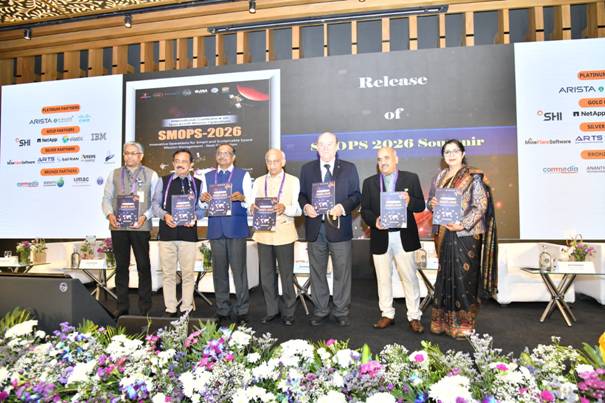
Bengaluru, NFAPost: Beneath the optimism that often defines global space discourse, a more sobering narrative took centre stage at the Spacecraft Mission Operations (SMOPS) 2026 conference, jointly organized by Indian Space Research Organization (ISRO), Astronautical Society of India (ASI) and International Academy of Astronautics (IAA).
The event covered a wide range of topics related to mission operations management, advanced mission design, automation, large constellations management, human spaceflight mission, space robotics, space policy, lunar and interplanetary exploration, cybersecurity in space system, Artificial Intelligence, present and future trends in ground station operations etc., while addressing the futuristic techniques in both upstream and downstream segments.
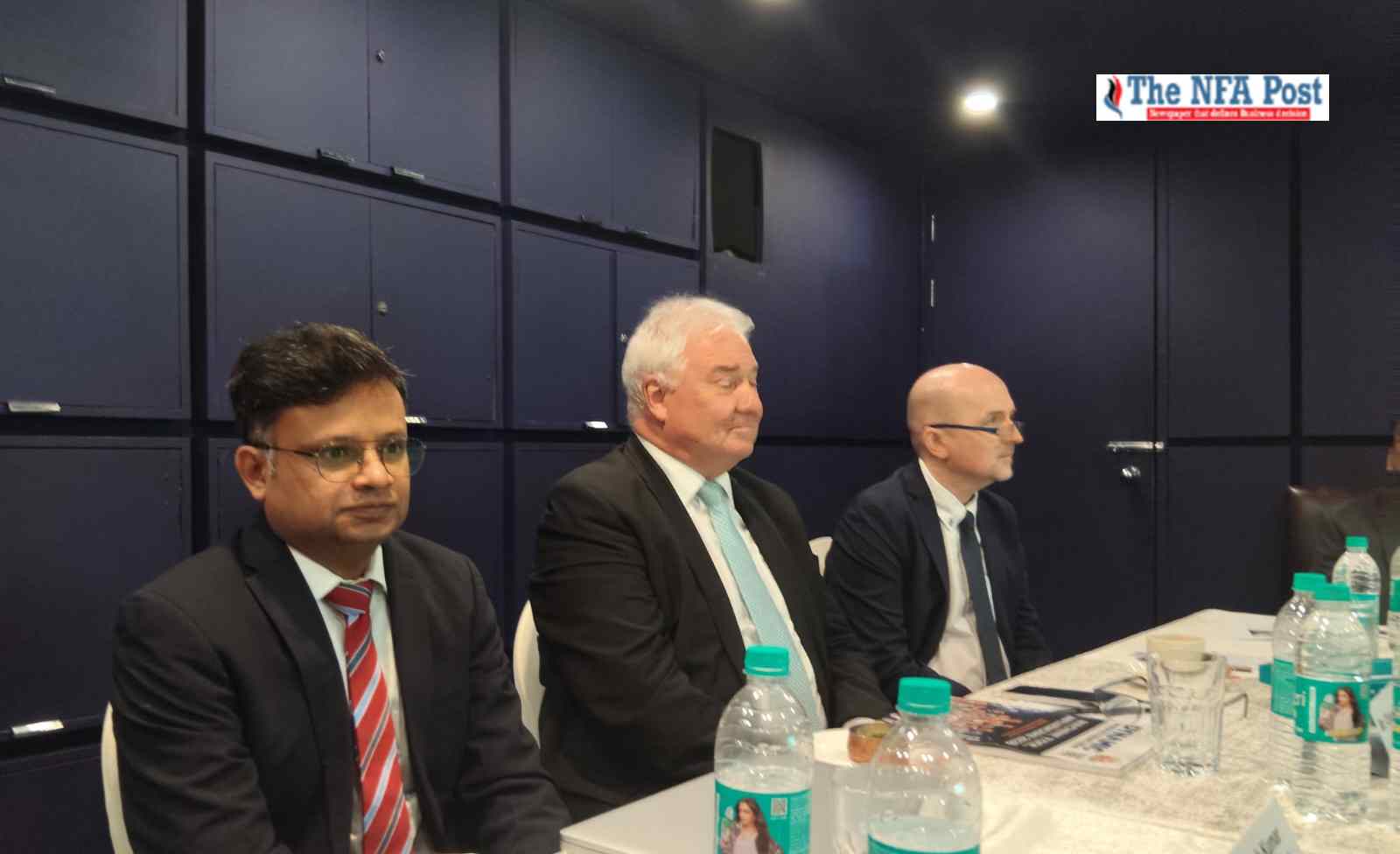
In a series of deeply candid keynote addresses, leading figures from the Indian Space Research Organisation (ISRO), Japan Aerospace Exploration Agency, and CelesTrak warned that the rapid expansion of space activity is exposing dangerous gaps in how missions are managed, monitored, and safeguarded.
The message was unequivocal during the 3-day conference: humanity’s ambitions in orbit are accelerating, but the systems designed to protect those ambitions are struggling to keep pace.
The key themes featured in this conference, one-of-its-kind in India, include
Mission Operations: Turning Design into Achievement
Navigating Current Milestones & Future Horizons
Mission Design and Operations
Mission Operations Strategy and Future Roadmap
AI and Robotics
Ground Segment and Constellations
Human Space program, Interplanetary missions and Ground Segment
Orbits of Opportunity: Contributing to the New Space Economy
Human Space Program Challenges
Robotic Mission Operations on ISS
Space Domain Awareness: Concepts, Capabilities and Applications
Leveraging Space Applications
Apart from 120 oral and 88 poster presentations, leading domain experts from ESA, CNES, DLR, IBMP and IKI Russia, NASA, JAXA, Celestrak, Eumetsat, Eutelsat, TU Delft, Canada, participated as keynote speakers and panellists.
This conference also served as a unique networking platform where the participating space agencies, start-ups, industry and academia shared views on the state-of-the-art technologies and tackling the emerging challenges in a rapidly evolving space landscape.
The last day of the conference featured a workshop with invited talks on Robotic Mission Operations on ISS, Space Domain awareness, Space Applications, Human space missions and astronaut training, has an overwhelming participation.
ISRO: When Spacecraft Defy Their Own Design
Opening the keynote session, former ISRO Chairman A S Kiran Kumar delivered a characteristically insightful and grounded perspective on mission operations, challenging the notion that spacecraft behave predictably once deployed.
“Most of the time, we realise that the way it is designed, even designers are surprised by how it operates,” said former ISRO Chairman A S Kiran Kumar.
Drawing from decades of experience, including leadership during the Mars Orbiter Mission, former ISRO Chairman A S Kiran Kumar likened a satellite’s deployment to a “Caesarean delivery”—a carefully planned process that nonetheless gives way to uncertainty the moment the spacecraft is on its own.
“The launch vehicle delivers it into space. But what follows is the real challenge—understanding and managing a complex system that begins to behave in unexpected ways. The mission operations teams are tasked not merely with control, but with continuous learning—decoding the unique “personality” of each spacecraft in real time,” said former ISRO Chairman A S Kiran Kumar.
As ISRO transitions toward more autonomous and human-rated missions like Gaganyaan, this complexity is intensifying. With data rates increasing exponentially—from kilobits in early missions like Aryabhata to gigabits today—the integration of artificial intelligence is no longer optional.
“Smart mission operations are essential,” former ISRO Chairman A S Kiran Kumar said, noting that onboard autonomy—while powerful—“brings in more complications for operators.”
JAXA: Precision, Failure, and the Value of Resilience
If Kumar outlined the theory of operational uncertainty, Institute of Space and Astronautical Science Program Director Dr. Shujiro Sawai provided a gripping real-world case study.
Detailing Japan’s SLIM mission, Dr Shujiro Sawai described an audacious attempt to redefine lunar exploration through pinpoint landing technology.
“Geologists prefer hazardous terrain. So we must land not where it is easy, but where it is scientifically meaningful,” said Institute of Space and Astronautical Science Program Director Dr. Shujiro Sawai.
SLIM achieved precisely that—touching down within meters of its intended target. But the success came perilously close to failure.
“Just before landing, we lost one of the two thruster nozzles,” revealed Institute of Space and Astronautical Science Program Director Dr. Shujiro Sawai.
The malfunction introduced destabilising forces, causing the lander to tip upon touchdown. In that critical moment, the spacecraft’s onboard intelligence activated a contingency protocol—what Sawai termed a “never give up mode.”
“It prioritised survival over precision. Despite landing in an unintended orientation, SLIM survived and completed its mission—an outcome that underscored the importance of resilient design and adaptive systems,” said Institute of Space and Astronautical Science Program Director Dr. Shujiro Sawai.
Institute of Space and Astronautical Science Program Director Dr. Shujiro Sawai also highlighted the collaborative nature of modern exploration, acknowledging ISRO’s contribution of lunar imaging data from Chandrayaan-2, which played a role in mapping SLIM’s landing site.
CelesTrak: A ‘False Sense of Security’ in Orbit
The most stark warning of the session came from Dr. T.S. Kelso, a leading authority on space situational awareness from CelesTrak.
In a data-driven presentation, Kelso challenged the widely held belief that Earth’s orbital environment is being accurately monitored.
“We are often operating with a false sense of security,” he cautioned.
Kelso pointed to systemic inefficiencies in global tracking frameworks, particularly the limited integration of precise operator-provided data with legacy tracking systems.
“We routinely see discrepancies exceeding 25 kilometres,” he noted, citing cases where satellites were effectively “lost” for days, only to be reacquired with massive positional errors.
The implications are profound. In an era of mega-constellations and increasing orbital congestion, such inaccuracies significantly elevate the risk of collisions.
Even more concerning is the lack of transparency among operators.
“There are thousands of defunct objects in orbit that cannot manoeuvre,” Kelso said. “Yet we still lack comprehensive, shared visibility.”
He revealed that many active satellites are catalogued as “unknown objects” due to insufficient data sharing—an alarming indicator of systemic opacity.
In a pointed critique of industry priorities, Kelso added:
“It is well past time that protecting the orbital environment takes precedence over commercial interests. Satellites fail—we all know this. It’s time to be upfront about it.”
A Shared Imperative: Collaboration Over Competition
Despite the varied perspectives, the three keynote addresses converged on a single, urgent conclusion: the sustainability of space depends on collective responsibility.
The traditional model of siloed operations—where agencies and companies guard data as strategic assets—is increasingly incompatible with the realities of a crowded and contested orbital domain.
From ISRO’s call for smarter, AI-driven mission management, to JAXA’s demonstration of resilient engineering, to CelesTrak’s push for radical transparency, the message was clear—no single entity can ensure safety in space alone.
The Road Ahead
As SMOPS-2026 continues to shape conversations around mission operations, its keynote session has already delivered a defining takeaway.
Space, once viewed as an infinite frontier, is revealing its fragility.
The path forward will require not just technological innovation, but a fundamental shift in mindset—from competition to cooperation, from secrecy to openness, and from ambition alone to accountability.
In the words echoed across the conference halls in Bengaluru, the future of space may well depend on how honestly humanity confronts the risks it has created.
One of the central themes was navigating the ongoing and upcoming challenges, from both technological and policy aspects, of the increasing complexity of diversified, distributed mission operational concepts, arising out of disruptive technological innovation, the advent of large constellations, exacerbating space traffic congestion, and more ambitious human space explorations beyond the realm of Earth.
The pivotal role of Artificial Intelligence (AI) and Machine Learning (ML), in enabling more autonomous and efficient mission operations with human-machine synergy was underscored across the sessions.
ISTRAC, the hub of spacecraft operations for all Low Earth Orbit and Deep Space missions, from the Aryabhata satellite to NISAR, has several landmark achievements to its credit, including the historic Mangalyaan mission, the soft landing of Chandrayaan-3, the insertion of Aditya-L1 spacecraft in the Lagrangian Point around the Sun and the docking experiments in the SpaDEx mission, which took a leading role in organising SMOPS.
In the backdrop of the opening up of the Indian space sector and ISRO embarking on a human space mission, SMOPS served as a rich confluence of ideas across multiple disciplines, fostering collaboration, cooperation, and partnerships amongst the global space community to chart a safe, sustainable and smart roadmap for future space mission operations.