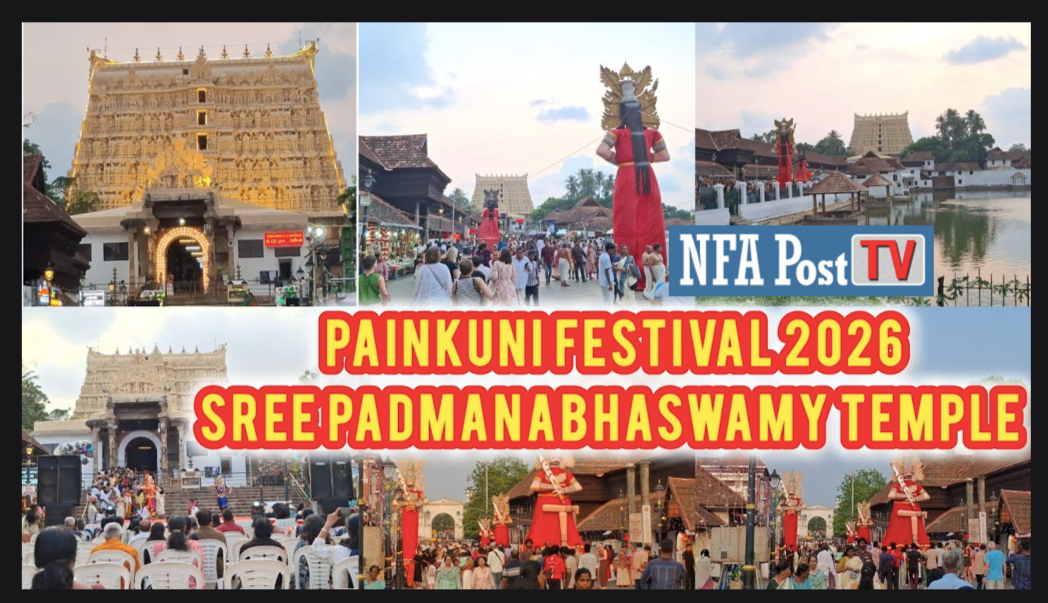
Thiruvananthapuram, NFAPost: Painkuni Mahotsavam 2026, the annual 10-day festival at Sree Padmanabhaswamy Temple, concluded with its arattu procession from Shangumugham beach after the deity’s holy bath in the seawater with the overwhelming participation of devotees along with the Travancore royal families.
Painkuni Mahotsavam, one of the main annual festivals at Sree Padmanabhaswamy Temple, the richest temple in India and located in the capital city of Keralam in Thiruvananthapuram, began on 25th March with the customary Kodiyettu ceremony, which includes the hoisting of the ceremonial flag.

The customary practice of the temple procession as part of Paikuni Arattu takes a route cutting the runway of Thiruvananthapuram Airport to reach the Shangumugham beach for the holy bath of the idols. The centuries-old tradition has been continuing even after the establishment of the airport in 1932.
The Adani Group-managed Thiruvananthapuram airport issued a NOTAM (Notice to Airmen) for holding the annual Paikuni Arattu procession. According to historians, in accordance with the Travancore King Sree Chithira Thirunal agreement with the airport authority, the facility would be open to the public for 363 days in a year and for two days for Lord Padmanabha, the titular deity of the royal family.

According to Harikumar from Ambalamukku in Thiruvananthapuram, Paikuni Arattu Mahotsavam commences on the Malayalam month’s Rohini star with the kodiyettu, the hoisting of the ceremonial flag, signalling the start of ten days of elaborate celebrations and rituals.
“Painkuni is marked by the installation of massive fibreglass figures of the Pandavas, the five sons of Pandu from the Indian epic Mahabharata, at the temple’s eastern entrance. These figures are believed to propitiate Indra, the Rain God, as part of the festival’s traditional practices. During my childhood, I used to go to the temple on the first day along with my mother,” states Harikumar.
The festival season at the Sree Padmanabhaswamy temple marks the period during when ‘Pancha Pandavas’ keep their annual tryst with the city. Standing guard at the forecourt along the eastern nada of the temple are gargantuan effigies of the five brothers – Yudhishtira, Bhima, Arjuna, Nakula and Sahadeva.

Clad in red robes, with massive headgear and wielding maces, the towering figures stand their ground in two rows facing the majestic temple as part of the ongoing 10-day Painguni festival, also known as Pancha Pandava Utsavam.
Each part – the limbs, torso, head – comprises detachable pieces. They are securely connected to the main frame. This entire unit is mounted onto sturdy bases of concrete plates firmly affixed about three metres into the ground. Once the structures are taken out, the bases are covered until the next festival season.
Though in earlier times, cotton was used for the colossal robes, polyester is opted for now. Balu estimates that about 350 m of red fabric, 100 m of yellow for the borders and 50 m for white used to wrap the maces are required for the stitching.

Each day of the festival is characterised by special rituals and offerings. One of the highlights of Painkuni is the palli vetta (royal hunt) ritual, performed on the ninth day by the head of the Travancore Royal Family near the Vettakorumakan Temple in the Fort area. This ritual is a symbolic hunt, reflecting the royal traditions and customs that have been maintained through the ages.
This festival witnesses an active participation of the Travancore royal families during the palli vetta (royal hunt) ritual near the Vettakkorumakan Temple in the fort area. During palli vetta, the head of the royal family shoots young coconuts with a bow and arrow, symbolising Lord Vishnu (presiding deity of the temple) hunting the demon. This ritual takes place in front of the Sundara Vilasam Palace inside the Thiruvananthapuram Fort.
During the Painkuni festival, huge fibreglass figures of the Pandavas are placed at the eastern entrance to the temple. As per popular beliefs, the statues of these popular figures are erected to please Indra – the god of rain.

The belief behind this custom, which is not seen in any other temple, is related to drought. Generations ago, Travancore was hit by a severe drought, which resulted in the destruction of agriculture. Following this, the Travancore king, who was ruling the country as Padmanabhan’s servant, performed a devaprasnam at the temple, dedicating the kingdom to Padmanabhan.
Based on this, the sculptures of the five Pandavas were installed in front of the temple. It is believed that this pleased Indra, the god of rain, and ensured sufficient rain. The sculptures were made of wood by bringing special craftsmen from Karnataka. The sculptures are not made specifically for each festival. They are usually repaired and reused. Only if they deteriorate over time, a new one is made. The sculptures in the temple now are made of fiberglass, made in 1990.