Mumbai, NFAPost: Reliance Industries — India’s largest conglomerate — and BlackRock — the world’s largest asset manager — partnered to launch mutual funds in India last year. And the titans observation on saving habits and the need for more stock market investment from individuals assumes significance.
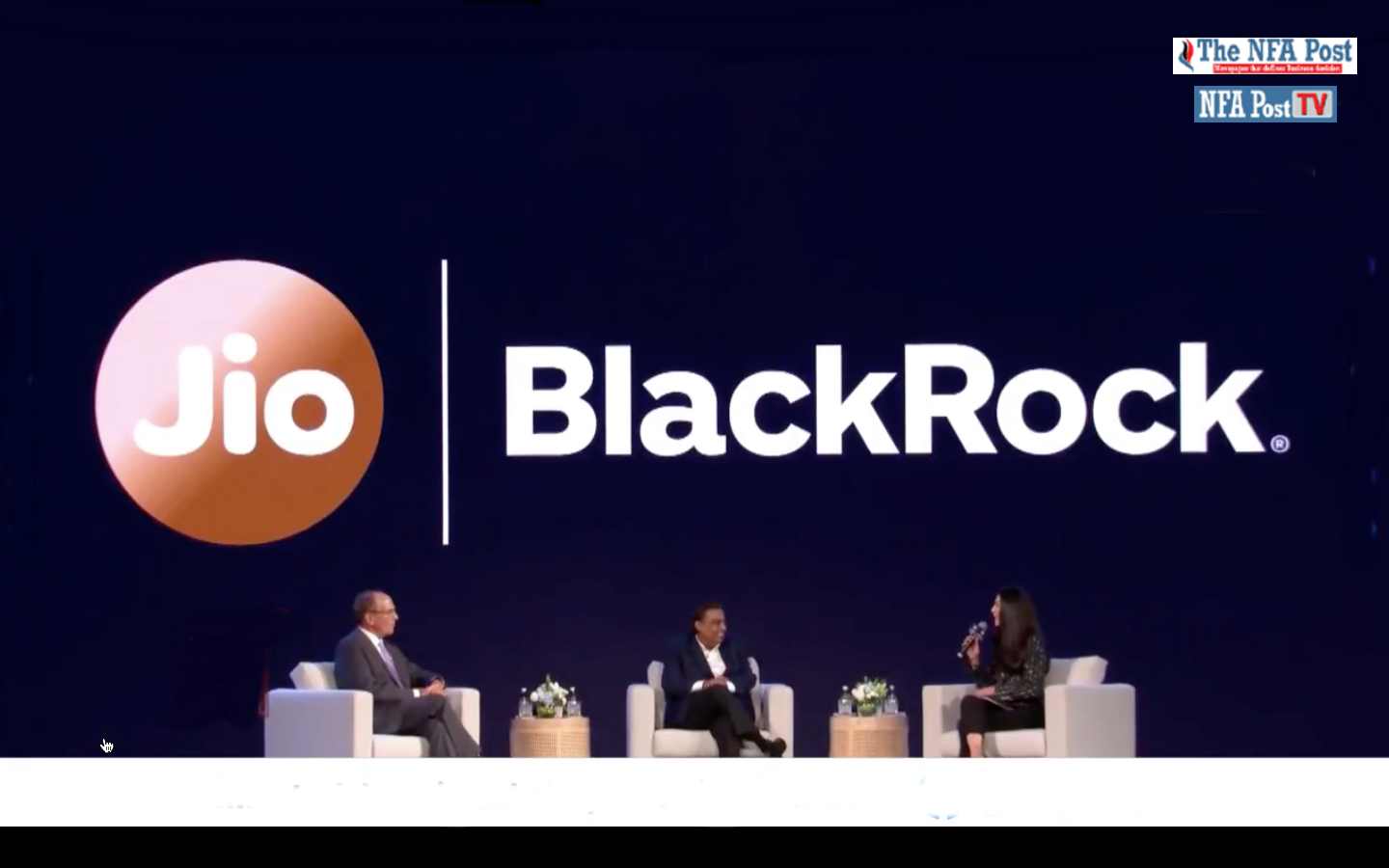
Addressing the audience at JioBlackRock’s ‘Investing for a New Era’ in the city, Larry Fink noted how investors in the United States who stuck with active funds witnessed stagnation of their investments, while those who invested in the capital market saw significant growth.
BlackRock CEO Larry Frank said there is a marked difference in the investment culture of citizens of US. To substantiate he pointed out that while majority of investors were stuck with active funds are witnessing stagnation of their investments but the those who invested in the capital market saw significant growth.
“What we’ve learned in the US for that segment of the population that had invested with the growth of America is that they’re far better off than those who just kept all their money in a bank account. If you believe in the era of India, which I believe in, we need to get more people investing alongside the growth of a country,” said BlackRock CEO Larry Frank.
Jio BlackRock Asset Management rolled out its first equity fund in August last year and as of December end, it had assets under management of Rs 31.98 billion($353 million) across its equity funds.
Mukesh Ambani called household savings in India “unproductive”, noting that while the country imported $60 billion worth of gold last year, it was for domestic savings, not industrial use.
“Just the last year, we as India imported $60 billion worth of gold and we imported $10-15 billion worth of silver and all of this not for industrial use, but really for domestic savings. This is unproductive,” said Reliance Industries Chairman Mukesh Ambani.
Notably, the share of equity and mutual funds in annual Indian household savings has surged from 2% in FY12 to over 15.2% in FY25, while the share of individual investors in equity ownership increased to 18.8% by September 2025, a clear indication of changing savings’ trends in the country.

The advice comes at a time when the yellow metal has been witnessing heightened volatility, while Indian stocks have been underperforming with the Nifty 50 down nearly 2% so far this year.
Active funds continue to dominate India’s mutual fund industry, with a assets under management (AUM) totalling Rs 80.55 lakh crore as of November 2025, though passive funds such as ETFs and index funds, have begun to gain momentum, surging 27% from Rs 11.11 lakh crore in 2024 to Rs 14.07 lakh crore as of November 2025, according to Fortune India.
Meanwhile, India’s capital markets are playing a vital role capital formation, with primary market mobilising a whopping Rs 53 lakh crore through equity and debt issuances in the last five years, including Rs 10.7 lakh crore in FY26.
During the conversation, Larry Fink and Mukesh Ambani emphasized the role of AI and related technologies in transforming asset management by making passive investing work at scale. “Through AI, you have better understanding of your clients, better understanding of your inventory controls. You have so many advantages by the application of AI and technology,” Fink said.
Mukesh Ambani urged Indian savers to use modern technologies to gain a competitive advantage. “We see that young Indians adapt to technology faster than everybody. We’ve seen it first hand over the last five years… we should use that to our competitive advantage, he said.
What Ambani and Fink said about capital market investments?
Mukesh Ambani and Larry Fink urged India’s youth to think in longer time spans, emphasizing the advantages of investing in the capital market than keeping money stagnant in a bank account.
“If India can grow 10% a year, let’s assume that the stock market only grows at 10% a year… that means you’re doubling your pool of money every six and a half years. That’s much better than keeping your money in a bank account,” Fink said.
Ambani noted that money invested in the stock market is compounding while bank accounts only offer simple interest. “Money in a bank account lying in simple interest is not compounding. Money in the stock market is compounding. And India has an efficient market. We have now regulated well.”
What are JioBlackRock’s plans for India?
Mukesh Ambani revealed how the partnership between Reliance and Fink’s BlackRock was forged over a five-minute car ride, and said that JioBlackRock wants to encourage Indians to save, but convert these savings into earnings.
“For us at JioBlackRock, the opportunity is to encourage Indians to save. But to make sure that we give them the options to convert those savings into earnings, and hopefully compound their earnings,” Ambani said.
Larry Fink laid down the philosophy behind JioBlackRock, stating, “If you are working on behalf of each and every client, and you’re serving that client over a long horizon with good advice, with maybe a degree of safety and importantly, just confidence building about the opportunities of compounding over a long period of time through the utilization of technology to intersect more often, more frequently, to have a deeper, broader relationship with your clients. That’s how disruption occurs.”
Why JioBlackRock is a nightmare for bankers?
Among those in the audience at Jio Convention Centre, sat top private and foreign bankers of India, while Mukesh Ambani and Larry Fink narrated the demerits of deposits their core business model.
The two business leaders hammered down the point how deposits are fundamentally a flawed method for wealth creation, arguing that saving, if left stagnant in bank accounts, would fail to capture the “era of India”.
“As more and more families invest alongside the growth of India, India has less needs for the importation of capital,” Fink asserted. The writing is on the wall for banker as the deposit war is intensifying and their best customers are being whisked away to capital market, though investors will need to figure out what suits them best; slow yet stable bank savings, or quick but volatile stock market investments.
A 5-minute car ride led to a $300 million joint venture
India’s billionaire Mukesh Ambai recalled how a million-dollar deal between him and BlackRock’s Larry Fink, which led to Jio BlackRock, was struck during a 5-minute car ride. The Reliance Industries Chairman recalled the incident while in conversation with the BlackRock CEO at the JioBlackRock’s ‘Investing for a New Era’ event held in Mumbai.
“It was a conversation that we had in 2023 and it just took me 5 minutes to say ‘Larry, Blackrock should be back in India’.” At this point, Fink added, “During a 5-minute car ride. We had to go to Point A and Point B and we accomplished it in a car ride.”
Ambani continues, “And here you are with your full team. So, thank you for coming back to India and India warmly welcomes you.”
According to the official website, it is a “joint venture that combines BlackRock’s global investment expertise with Jio Finance’s strong digital capabilities. Its goal is to make investing simpler, more accessible, and tailored to individual needs. Through a blend of advanced technology and professional investment management, JioBlackRock offers solutions designed to help more and more people to build and grow their wealth confidently, whether they are beginners or experienced investors.”
As per BlackRock’s office website, Jio Financial Services Limited (JFS) and BlackRock entered the joint venture with an initial investment of US$150 million each. According to Forbes, the founder and CEO of BlackRock has a net worth of $1.2 billion. His firm is considered one of the world’s largest asset managers. Currently, BlackRock has $11.6 trillion in assets under management.
Mukesh Ambani is the chairman of Reliance Industries, a $125 billion (revenue) conglomerate spread across several sectors, including media, retail, financial services, oil and gas, telecom, and petrochemicals. According to Forbes, his net worth is estimated at $103.3 billion.