At BIFFes, writers and critics revisit Hemavathi to examine gender, gaze and representation in Kannada cinema
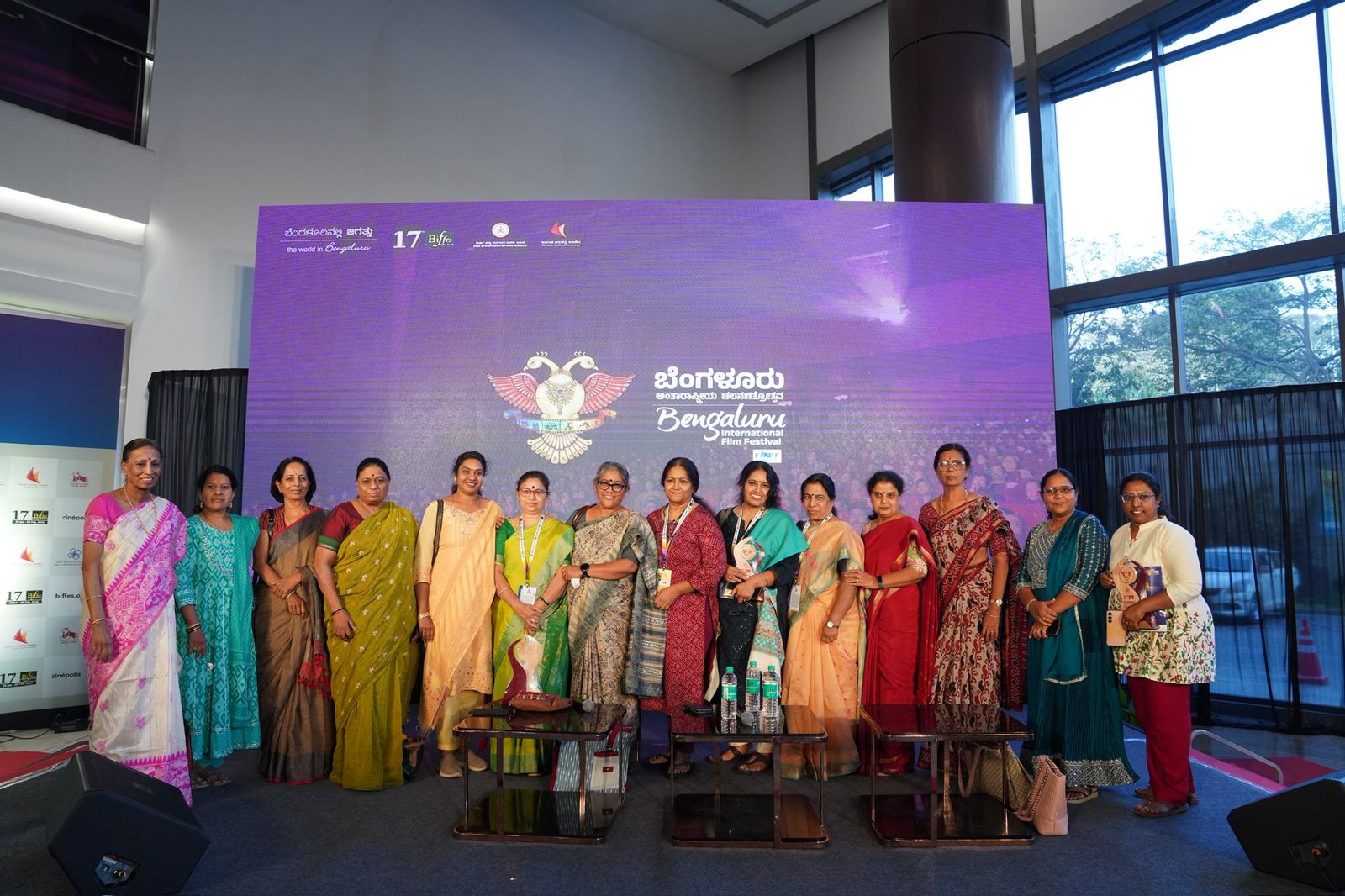
Bengaluru, NFAPost: Women-centric cinema should not automatically be mistaken for women-empowering cinema, observed noted writer and film critic Sandhyarani during a thought-provoking panel discussion at the 17th Bengaluru International Film Festival(BIFFes). The discussion, organised by the Karnataka Lekhakiyara Sangha, focused on filmmaker Siddalingaiah’s acclaimed film Hemavathi and its enduring relevance.
Sandhyarani drew a sharp distinction between films that merely place women at the centre of the narrative and those that genuinely advocate women’s agency and autonomy.
“There is a clear difference between women-centric films and pro-women films,” she said.
“Many of Puttanna Kanagal’s films were women-centric, but not necessarily pro-women.”
The Male Gaze in Women-Centric Narratives
Elaborating on her argument, Sandhyarani said that female characters in Puttanna Kanagal’s films often reflected what men desired women to be, rather than presenting women as autonomous individuals.
“The women in his films were shaped by patriarchal expectations,” she explained.
“In one film, the heroine sings that she is ‘the ideal woman of this century,’ only to lose her purse at the end of the song—after which men step in to rescue her.”
According to Sandhyarani, Kanagal’s cinema repeatedly reinforced the idea that a woman’s ‘victory’ lay in conforming to traditional cultural norms.
“In all his films, if a woman lives according to what conservative culture prescribes, she is rewarded,” she said.
“That is why we must understand that not every women-centric film is pro-women.”
Her remarks sparked engaged discussion among the audience, particularly younger viewers reassessing classic cinema through a contemporary gender lens.
Hemavathi as a Radical Departure
Senior journalist C H Raghunath offered a broader historical and cinematic context, calling Hemavathi a significant departure within Siddalingaiah’s filmography.
“Among Siddalingaiah’s films, Hemavathi stands apart,” he said.
“Before this, he had already made classics like Bangarada Manushya and Bhoothayyana Maga Ayyu.”
Raghunath noted that Hemavathi represented both an artistic risk and a new creative challenge for the director.
“Though Siddalingaiah does not directly retell the Ramayana, its shadow is clearly present,” he said.
“The story is not confined to one village—it could belong anywhere in the country.”
He pointed out that while the film is set in the pre-Independence period, its themes remain strikingly relevant today.
“In the Ramayana, Sita undergoes a trial by fire. Here, Hemavathi and Chenni face their own ordeals—each in different ways.”
Would Hemavathi Be Made Today?
Raghunath also raised a provocative question about censorship and creative freedom.
“If Hemavathi were made today, its release would be extremely difficult,” he said.
“Siddalingaiah himself might have struggled to make another film after it.”
He suggested that contemporary censorship regimes and political sensitivities would pose serious obstacles.
Changing Images of Women on Screen
Offering a broader sociocultural perspective, Sunandamma, President of the Karnataka Lekhakiyara Sangha, spoke about how women were historically portrayed in cinema.
“At one time, a woman on screen was valued only for her beauty,” she said.
“Talent, education and creativity did not matter. Beauty was everything.”
She acknowledged that while change has been slow, there are visible shifts today.
“The situation is gradually changing,” she noted.
Television and the Burden on Women
Journalist Manasa Chandrika turned attention to contemporary television narratives, especially women-centric serials.
“There are many women-centric serials on television,” she said.
“But it is always the woman who is shown suffering.”
She criticised how women who speak out against exploitation are often stigmatised.
“If a woman raises her voice, she is judged differently. If she confronts men, she is labelled aggressive,” Chandrika observed.
“First she must fight her own family, and only then can she fight society.”
A Dialogue That Reframes Classics
The session was sensitively moderated by senior journalist Bharathi Hegde, who guided the discussion across cinema history, gender politics and contemporary representation.
At BIFFes, the conversation around Hemavathi became more than a film analysis—it emerged as a wider reflection on how women have been written, framed and judged in Kannada cinema. The discussion underscored a crucial truth: placing women at the centre of a story is not enough—what truly matters is whether the story allows them agency, dignity and voice.