At BIFFes, the Polish filmmaker reflects on restraint, emotional truth, and why cinema must remain a deeply human experience
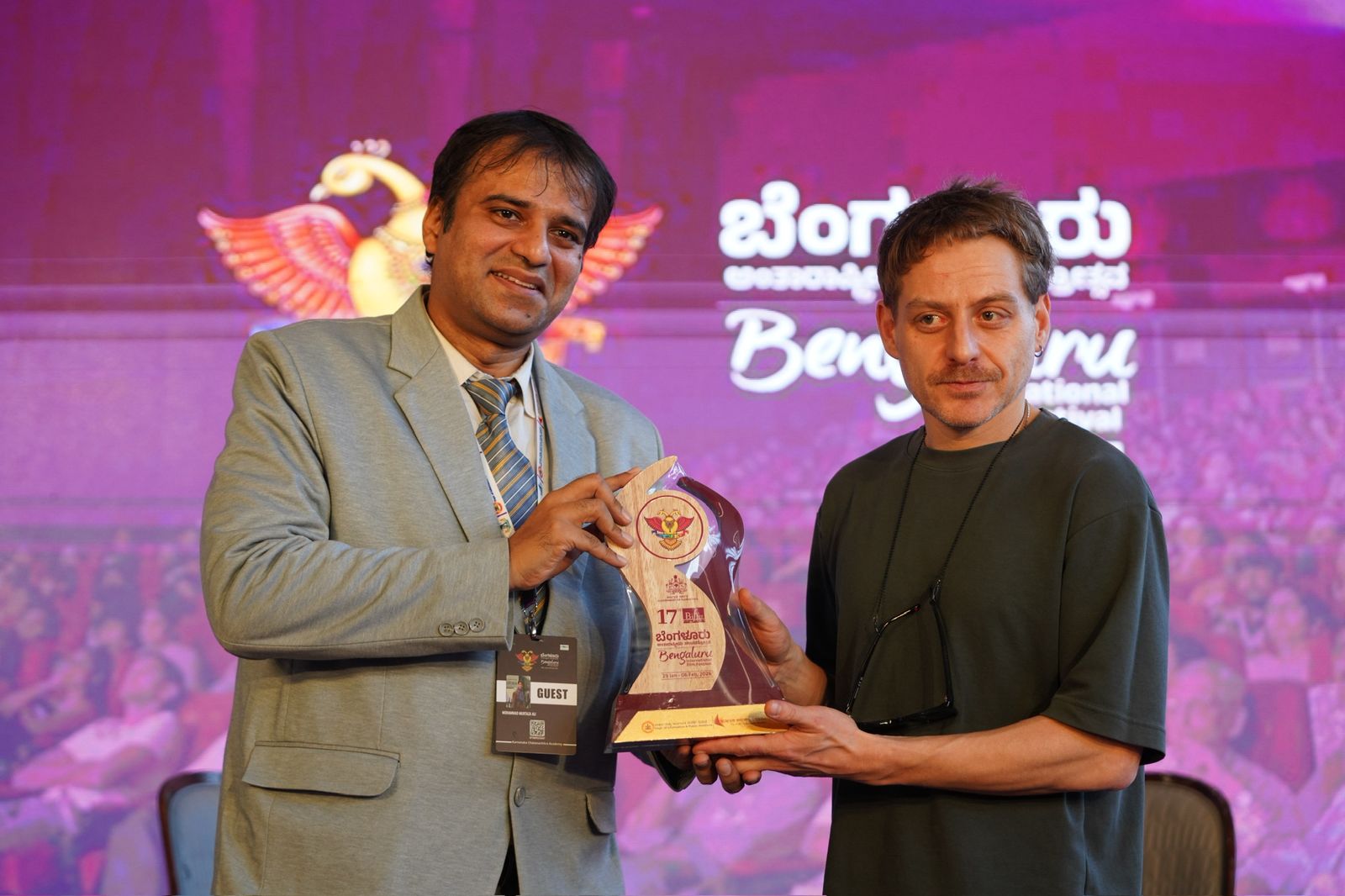
Bengaluru, NFAPost: Cinema does not always need to speak loudly to be heard. Sometimes, silence itself becomes the language. This was the central thought articulated by acclaimed Polish filmmaker Damian Kocur during an engaging session titled “From Short Films to Feature: Finding Cinematic Language” at the 17th Bengaluru International Film Festival (BIFFes).
Known internationally for films such as Bread and Salt and Under the Volcano, Kocur offered an introspective account of his journey from short films to feature-length storytelling, sharing how he approaches cinema as a sensory, emotional and fundamentally human medium rather than a spectacle-driven form.
The Power of Silence Over Noise
Kocur spoke at length about his preference for silence and restraint, arguing that cinema has the unique ability to communicate through the simplest of human sensations.
“I often prefer silence over too many images or too much narrative noise,” he said. “Cinema does not always need stimulation. It can rely on basic human sensations.”
For Kocur, reducing cinematic elements is not an aesthetic posture or a stylistic minimalism, but a conscious attempt to create space—for observation, reflection and feeling.
“It’s about removing distractions to reach something honest and essential,” he explained.
His films, marked by long takes, quiet moments and observational framing, invite audiences to lean in rather than be overwhelmed.
Cinema, Politics and the Question of Time
Addressing the relationship between cinema and politics, Kocur acknowledged the difficulty of responding directly to contemporary events through film.
“By the time a film is financed and completed, the political situation may have already changed,” he said, pointing to the long and uncertain timelines involved in filmmaking.
Rather than chasing topical relevance, Kocur said he is more interested in making films that endure emotionally.
“I try to make films that remain meaningful even when the political context fades.”
This approach, he believes, allows cinema to speak across borders and generations, without being trapped in a single moment in history.
Language, Emotion and What Cannot Be Translated
Kocur also reflected on the intimate connection between emotional truth and the language in which a story is conceived.
“Certain emotions and nuances belong to a specific language,” he said. “When you translate them, something is always lost.”
This sensitivity shapes his work with actors as well. He prioritises presence and authenticity over dramatic mechanics or neatly structured plot points.
“I’m less interested in perfectly constructed stories and more interested in moments that feel lived-in,” he said.
According to Kocur, cinema does not need to explain everything.
“Ambiguity is closer to real life than clear resolutions,” he observed.
Observation as the Core of Filmmaking
Everyday life remains Kocur’s primary source of inspiration. He spoke about the importance of observing people—how they move, interact, hesitate and exist in shared spaces.
“Watching people in ordinary places teaches you more than writing dramatic scenes,” he said.
These fleeting gestures and quiet interactions, he believes, are what give cinema its emotional resonance.
Discovering India Through the Streets
On his first visit to India, Kocur said he was deeply struck by the vitality of everyday life.
“The streets here are alive,” he said. “There is so much interaction, so much movement.”
He contrasted this with the more structured and predictable public spaces of Poland.
“That sense of discovery reminds me why curiosity is so important for an artist,” he added.
For Kocur, staying open to new environments and experiences is essential to remaining creatively alive.
Cinema Beyond the Screen Size
Speaking about OTT platforms and changing viewing habits, Kocur resisted the idea that cinema’s power lies only in theatrical scale.
“Cinema is a shared language,” he said. “It helps people feel less alone.”
Whether experienced on a large screen or a small device, he believes the emotional core of cinema remains intact when storytelling is sincere.
“Cinema is built from small sounds, quiet movements and fleeting expressions,” he said. “If treated with care, they can resonate far beyond the screen.”
A Quiet, Lasting Impression
The session, moderated by film critic and journalist Murtaza Ali Khan, stood out for its contemplative tone. Rather than offering formulas or techniques, Damian Kocur shared a philosophy of filmmaking rooted in listening, observing and trusting silence.
At BIFFes, his reflections served as a reminder that in an age of noise and speed, cinema’s greatest strength may still lie in its ability to pause—to stay human, attentive and deeply felt.