At BIFFes, the ‘Take Off’ director reflects on creative freedom, political lenses, and why filmmakers must constantly revisit ideas to keep cinema alive and relevant
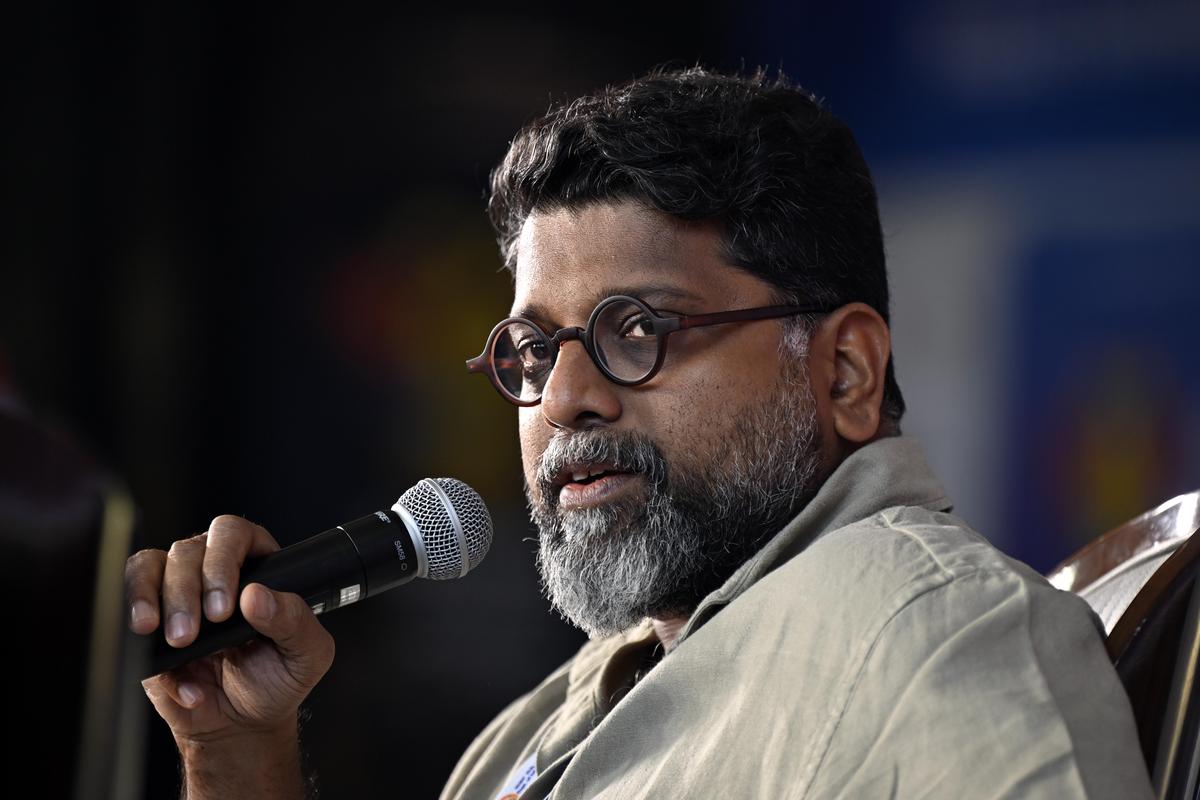
Bengaluru, NFAPost: Cinema, at its core, is an act of resistance—filtered through a director’s personal lens and shaped by the realities of the time. This was the thoughtful and introspective view shared by acclaimed Malayalam filmmaker Mahesh Narayanan during a panel discussion titled “Rethink Narrative” at the 17th Bengaluru International Film Festival (BIFFes).
Known for films such as Take Off and C U Soon, Narayanan spoke candidly about censorship, political interpretation, writing discipline and the responsibility of remaining truthful to lived experience—while acknowledging that cinema itself is ultimately a crafted illusion.
“Everyone reacts to an issue from their own point of view,” he said. “Cinema, too, is a form of resistance—it is a director’s response to something that disturbs or provokes them.”
Censorship Across Borders
Narayanan revealed that many of his films have encountered censorship issues—not only in India, but internationally as well.
“Almost all my films have faced some kind of censorship problem,” he said. “Even abroad, censorship exists. That is why I believe every director must be given creative freedom.”
Recounting an experience at an Iranian film festival, Narayanan spoke about conversations around the persecution of director Jafar Panahi.
“When I spoke about Panahi’s situation, people there dismissed it,” he said. “You see their reality through the lens of Western media, but the ground reality can be very different. Everyone looks at situations through their own lenses—we must learn to look through multiple lenses.”
Cinema Is Not Politics
Touching upon contemporary censorship debates, Narayanan referred to controversies surrounding actor Vijay’s upcoming film Jananayagan.
Drawing a historical parallel, he recalled an incident involving cinema icon M G Ramachandran.
“During an election, there was pressure to ban one of MGR’s films,” he said. “But Karunanidhi, who came from a film background, handled it with dignity. He reportedly said that if a two-hour film could pull people away from our party, then perhaps the party itself was weak.”
“Cinema is cinema, and politics is politics. We must learn to separate the two.”
Choosing Actors for Stories, Not Stardom
Speaking about his upcoming project Patriot, featuring Mohanlal and Mammootty, Narayanan emphasised that casting decisions stem from narrative needs, not star power.
“I didn’t choose them because they are stars,” he clarified. “I approached them because they were right for the story. They come to the set as artists, not as superstars.”
Why Every Idea Has a Deadline
One of the session’s most resonant ideas came from Narayanan’s reflections on writing discipline.
“Every idea has an expiry date,” he said. “That’s why you must revisit your screenplay every six months. Rewrite it. Refine it. A screenplay must evolve with time.”
He stressed the importance of continuous dialogue with writers and collaborators.
“I write using real incidents that disturb me deeply. I carry those incidents and characters with me. Over time, they grow, and eventually, they become a film.”
Telling Lies Close to the Truth
Narayanan offered a striking philosophical reflection on realism in cinema.
“I want to remain faithful to reality, to the characters and to the core incident,” he said. “But cinema is not reality. It is a lie—an imagination.”
“The filmmaker must be aware that they are lying. But it should be a lie that is very close to the truth.”
He explained that what guides his storytelling is not factual accuracy alone, but emotional authenticity—the moment in a real incident that shook him most deeply.
Actors as Ever-Evolving Collaborators
Expressing his desire to continue working with actors like Fahadh Faasil and Kunchacko Boban, Narayanan said he enjoys discovering new dimensions in familiar collaborators.
“If you watch my films, you’ll see a different Fahadh in each one,” he said. “That exploration excites me.”
Writing with the Audience in Mind
Narayanan concluded by sharing his unique approach to structuring a screenplay.
“I first imagine the final image of the film,” he revealed. “Only then can I write. That image may change later, but it must exist in my head.”
He added that the audience is always present in his creative process.
“I write with the audience in mind. My aim is to ensure they never disconnect.”
The session was sensitively moderated by Vishal Shinde, and left the audience with a rare, honest insight into the mind of a filmmaker who balances artistic conviction with humility and discipline.
At BIFFes, Mahesh Narayanan’s reflections stood as a reminder that cinema thrives not on permanence, but on constant questioning—of ideas, forms and freedoms.