Exemption from the three-year eligibility norm for DSIR recognition aims to fast-track early-stage deep-tech innovators as India sharpens its R&D and technology sovereignty ambitions
Bengaluru, NFAPost: India’s science and innovation ecosystem received a decisive policy push on Saturday as the government announced a major relaxation for deep-tech startups, removing the long-standing requirement of a minimum three-year existence to gain recognition from the Department of Scientific and Industrial Research (DSIR).
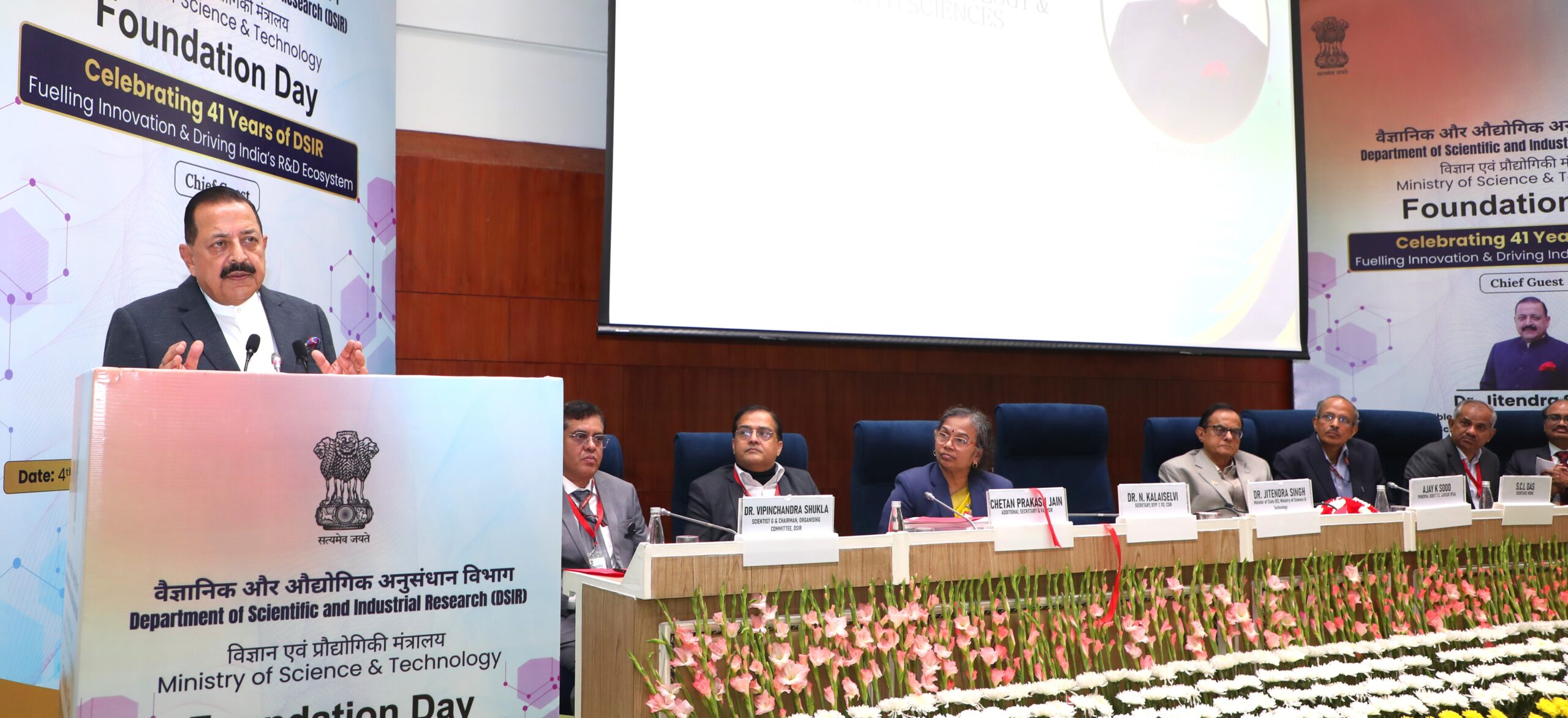
The announcement came during the 42nd Foundation Day celebrations of DSIR in New Delhi and was made by Dr. Jitendra Singh, Union Minister of State (Independent Charge) for Science & Technology, Earth Sciences, and several key departments including Space and Atomic Energy.
Describing the move as a “huge relief and support” for early-stage innovators, Dr. Singh said the exemption would provide critical momentum to deep-tech startups at a stage when access to institutional recognition often determines their survival and scale.
“The removal of the three-year existence requirement is a significant incentive to help deep-tech startups scale faster, even before they are fully on their own,” the Minister said, adding that the reform reflects the government’s trust in India’s innovators and confidence in their intent and sustainability.
Accelerating Early Innovation
Until now, startups seeking DSIR recognition under the Industrial Research and Development Promotion (IRDP) framework were required to demonstrate at least three years of operational existence. While this ensured stability, it often excluded early-stage deep-tech ventures working on long-gestation technologies.
Dr. Singh explained that although flagship initiatives like the ₹1 lakh crore Research, Development and Innovation (RDI) Fund have generated nationwide enthusiasm, they are primarily designed for startups that have already achieved a certain level of technological maturity.
“For early-stage innovators, a wide basket of schemes already exists across departments such as DST, CSIR and TDB. This reform bridges a crucial gap by enabling deep-tech startups to gain recognition and support much earlier in their journey,” he said.
The Minister noted that even earlier, institutions like CSIR had extended financial assistance—sometimes up to ₹1 crore—to startups, but these were conditional on proving sustainability over three years. “That requirement has now been done away with, while maintaining appropriate evaluation standards linked to technological maturity,” he said.
DSIR–CSIR: An Intergenerational Partnership
Congratulating the DSIR fraternity, Dr. Singh described the relationship between DSIR and CSIR as an “intergenerational symbiosis”. Drawing an analogy with a joint family, he said DSIR, which emerged from CSIR, now plays a facilitative role that enables technology transfers, industry partnerships, and MoUs across the research ecosystem.
This close coordination, he said, has helped transform interdisciplinary science into intergenerational collaboration—an essential ingredient for sustaining innovation at scale.
Beyond Atmanirbhar Bharat
In a broader reflection on India’s technological trajectory, Dr. Singh argued that the country has moved beyond the phase of Atmanirbhar Bharat into a stage where global economies are increasingly reliant on Indian products and technologies.
Citing examples from vaccines, medical devices, and indigenous technologies, he pointed to India’s transition from import dependence to exports worth several crores.
“We are not only self-reliant; we are making others rely on us,” he said, underlining India’s growing credibility in global science and technology markets.
Four Pillars and Four New Initiatives
Reiterating DSIR’s four pillars—science, industry, R&D, and technology transfer—the Minister stressed that meaningful research cannot be sustained without early industry participation. He also highlighted DSIR’s expanding role, which now includes fiscal incentives such as customs duty exemptions, making collaboration more attractive for industry, MSMEs, and startups.
The Foundation Day celebrations saw the launch of four significant initiatives:
- DSIR Guidelines for Recognition of In-House R&D Centres of Deep-Tech Startups, formally incorporating the relaxation of the three-year eligibility norm
- PRISM Network Platform – TOCIC Innovator Pulse, to strengthen innovation pipelines
- Creative India 2025 under the PRISM scheme, promoting innovation-led entrepreneurship
- DSIR Disaster Management Plan, aimed at enhancing preparedness and institutional resilience
Strengthening Women-Led Innovation
A notable highlight of the event was the emphasis on women’s participation in India’s innovation ecosystem. Dr. Singh revealed that more than 10,000 women beneficiaries are currently availing support under DSIR schemes, including over 55 women-led Self Help Groups.
Calling this trend “healthy and irreversible”, he said it reflected a deeper cultural shift in how innovation and entrepreneurship are taking shape across the country.
MoUs and Technology Transfers
Several MoUs and agreements were exchanged in the presence of senior leadership, reinforcing DSIR’s role as a bridge between research and deployment.
Key among them was an agreement under the Technology Development and Utilisation Programme for Women (TDUPW) to establish a Skill Satellite Centre at Dhamtari, Chhattisgarh, in collaboration with NIT Raipur, aimed at technology-led skill development and livelihood generation for rural women.
Transfer of Technology agreements were also signed for innovations developed under the Common Research and Technology Development Hubs (CRTDH) programme supported to CSIR-CEERI, Pilani, strengthening MSME-focused R&D infrastructure nationwide.
Voices from the Ecosystem
Addressing the gathering, Dr. N. Kalaiselvi, Secretary, DSIR, highlighted the department’s role in recognising in-house R&D units, SIROs, and publicly funded research institutions. She noted that DSIR’s unique structure—combining a government department, an autonomous organisation like CSIR, and PSUs such as CEL and NRDC—positions it as a vital connector between government, academia, and industry.
Prof. Ajay Kumar Sood, Principal Scientific Advisor to the Government of India, underscored the importance of technology sovereignty amid global geopolitical shifts. Referring to the RDI Fund, he stressed the need to scale innovations from lab to market, particularly at Technology Readiness Levels (TRL) 4 and above. He also highlighted the National Technology Readiness Assessment Framework (NTRF) and platforms such as Manthan and Uthaan that are enabling demand-driven innovation beyond metropolitan centres.
A Future-Ready Signal
Concluding the event, Dr. Jitendra Singh said DSIR’s initiatives are closely aligned with national missions spanning energy transition, critical and emerging technologies, manufacturing, semiconductors, robotics, AI, and space.
“This Foundation Day is not just a celebration of the past, but a decisive step towards building a future-ready, technology-sovereign India,” he said.
With the relaxation of a key regulatory barrier, the message from DSIR’s 42nd Foundation Day is clear: India is prepared to back its deep-tech innovators earlier, faster, and with greater institutional confidence than ever before.