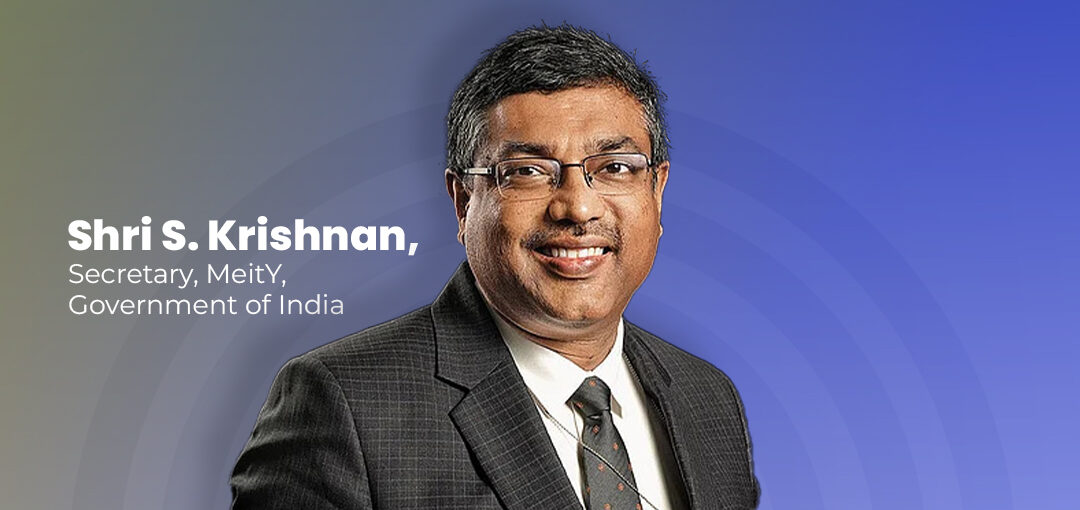
How MeitY Secretary S. Krishnan is positioning India as a global convener for outcome-driven, inclusive artificial intelligence
Bengaluru, NFAPost: As artificial intelligence accelerates across economies and societies, the real question confronting governments is no longer whether to regulate or promote AI—but how to translate ambition into outcomes that citizens can see, trust, and benefit from. At the heart of India’s response to this challenge stands S. Krishnan, Secretary of the Ministry of Electronics and Information Technology (MeitY), a policymaker navigating the intersection of technology, governance, and national capability at a decisive moment in India’s digital evolution.
That convergence is most clearly reflected in the India AI Impact Summit 2026, to be hosted by MeitY in New Delhi in February. Unlike earlier global AI gatherings dominated by safety discourse or abstract principles, this summit is deliberately framed around impact—measurable, inclusive, and scalable outcomes that move beyond declarations and into deployment.
“Rather than only participating in high-level debates, India is now shaping a practical, outcomes-oriented agenda that prioritises demonstrable benefits for people, economies, and societies,” Krishnan says.
From Frameworks to Outcomes
India’s decision to foreground “impact” signals a maturation in its global AI posture. Where earlier conversations centred on ethics or risk in isolation, MeitY’s approach is to anchor AI firmly within governance outcomes—citizen-centric services, resilient digital ecosystems, and long-term strategic capacity.
This philosophy mirrors India’s broader technology trajectory: digital public infrastructure at population scale, indigenous electronics manufacturing, and a growing emphasis on AI and semiconductors as instruments of sovereignty as much as efficiency.
Krishnan is clear that AI is not being pursued as an end in itself. “Technology has to be judged by what it delivers in the real world,” he notes, situating AI policy within the larger framework of inclusion, trust, and institutional depth.
The Sutras and the Chakras: A Conceptual Architecture
At the core of the Summit’s design lie the three sutras—people, planet, and progress—paired with seven chakras that translate these principles into actionable domains. Together, they form what officials describe as a “full-stack” view of AI: human capital, inclusion, safety, resilience, science, access to resources, and economic development.
“These principles ensure that AI discussions remain grounded in societal outcomes rather than technology alone,” Krishnan explains.
Notably, the framework did not emerge behind closed doors. MeitY conducted five rounds of public consultations, global outreach sessions across cities such as Paris, Berlin, New York, Geneva, Bangkok, and Tokyo, and regional dialogues across India. More than 600 citizen submissions via MyGov and inputs from over 500 organisations helped shape the agenda.
The result is a summit architecture designed to produce usable outputs: shared repositories, playbooks, reference frameworks, and a leaders’ declaration oriented toward implementation rather than symbolism.
India as a Global South Convener
India’s role as the first Global South host of an AI summit of this scale is not incidental. It reflects a strategic intent to rebalance the global AI narrative—one that has often been shaped by advanced economies—towards the realities of emerging and developing nations.
“Hosting the summit enables India to translate Global South perspectives into a structured, action-oriented platform,” Krishnan says.
Drawing on its experience with digital public infrastructure and scalable AI use cases, India is positioning itself as a bridge between frontier innovation and development needs. The goal is not to dilute global standards, but to make them adaptable—recognising different capacities, contexts, and constraints.
Governing AI at Scale
With nearly 100 global CEOs and around 20 heads of state and ministers expected to attend, the Summit is also a test of India’s ability to shape international cooperation on AI governance.
Rather than prescriptive or fragmented regulation, MeitY is advocating collaborative frameworks that evolve governance, ethics, and deployment together. The seven thematic working groups are designed to do precisely that—aligning policy intent with industry realities in sectors such as healthcare, agriculture, education, and manufacturing.
“We are moving global cooperation on AI from alignment on principles to coordination on action,” Krishnan observes.
Inclusion as Strategy, Not Slogan
The Summit’s flagship initiatives—Udaan Global AI Pitch Fest, YuvaAI Global Youth Challenge, AI by HER, the Global Innovation Challenge, a Research Symposium, and an AI Expo—are carefully curated to reflect India’s strategic priorities.
Youth, women-led innovation, and Global South researchers are not peripheral participants but central actors. “Inclusion, resilience, safety, and shared innovation are embedded in both participation and outcomes,” Krishnan says, underscoring that talent development and access are foundational to sustainable AI ecosystems.
Measuring What Matters
Unlike conventional conferences, success for the India AI Impact Summit will not be measured by attendance alone. MeitY is focused on three markers: the inclusivity of engagement, the actionability of outputs, and continuity beyond the event.
“The summit is positioned as a catalytic moment within a longer cooperation cycle rather than an end point,” Krishnan notes.
Post-summit mechanisms include structured engagement with working groups, expert-led follow-ons, and integration of outcomes into national and international programmes. Innovations emerging from global challenges will be linked to public systems, industry consortia, and multilateral collaborations.
From Declarations to Delivery
In Krishnan’s telling, the Summit is less about spectacle and more about state capacity—how governments learn, adapt, and collaborate in an era of technological flux. By anchoring AI firmly within governance outcomes and national interest, MeitY is attempting something ambitious: to turn global consensus into local change.
“The objective,” he says, “is to ensure that the benefits of AI materialise in governance, industry applications, and citizen-facing services—especially in underserved regions.”
As India’s digital journey enters its next phase, the India AI Impact Summit 2026 may well be remembered not for what was promised, but for what it helped deliver.