How India is building silicon sovereignty through policy, partnerships, and patient capital
Bengaluru, NFApost: India’s semiconductor story in 2025 is no longer one of intent alone—it is one of execution under construction. For decades, the country stood at the periphery of global chip manufacturing, despite being one of the world’s largest consumers of semiconductors and a global hub for chip design talent. Today, that imbalance is being deliberately corrected. Factory shells are rising in Gujarat and Assam, advanced packaging lines are being commissioned, and India’s first “Made in India” commercial chips have already rolled off pilot lines.
The moment gained national and global attention at Semicon India 2025, when Prime Minister Narendra Modishowcased India’s first indigenous processor, Vikram3201. The gesture was symbolic, but the underlying shift was structural. India has moved decisively from policy articulation to capital deployment and early-stage production—an inflection point few emerging economies have successfully crossed in the semiconductor domain.
Market Scale: Demand That Justifies the Bet
India’s semiconductor push is underwritten by a powerful domestic market story. Semiconductor consumption in India crossed USD 52 billion in FY 2024–25, driven by smartphones, IT hardware, industrial electronics, and network infrastructure. Industry projections place the market at USD 100–110 billion by 2030, implying a compound annual growth rate of roughly 15 percent—far exceeding the global average.
This growth is not a cyclical rebound but a structural shift. Mobile handsets and computing still dominate demand, accounting for nearly 70 percent of current consumption. However, the fastest acceleration is coming from electric vehicles, power electronics, 5G networks, data centers, artificial intelligence workloads, and defense electronics. Each of these segments is semiconductor-intensive and long-duration in nature, creating predictable, sustained demand rather than short-term spikes.
India today represents approximately 6–7 percent of global semiconductor demand. By the end of the decade, that share is expected to rise materially, giving the country a rare advantage: a large, growing domestic market capable of anchoring early manufacturing capacity.
The Strategic Imperative: Reducing Import Dependence
Despite its consumption scale, India remains heavily import-dependent. Nearly 90–95 percent of semiconductor components used domestically are sourced from abroad, primarily from China, Taiwan, Malaysia, South Korea, and Singapore. In 2024 alone, semiconductor imports surged to nearly USD 24 billion.
This dependence became painfully visible during the global chip shortage of 2020–2022, when Indian automotive plants shut down and electronics supply chains stalled. For policymakers, semiconductors moved from being an industrial concern to a national security priority—critical to defense systems, space missions, telecom infrastructure, and energy transition technologies.
At the same time, exports offer a glimpse of upside potential. India’s semiconductor and photosensitive device exports rose from just USD 160 million in 2018 to nearly USD 2 billion by 2023. While still modest, the trajectory demonstrates that once capacity exists, India can compete globally in select segments.
Policy Architecture: The India Semiconductor Mission
At the core of India’s transformation lies the India Semiconductor Mission, launched in December 2021 with a financial commitment of ₹76,000 crore (approximately USD 9 billion). The mission is not a single subsidy program but a comprehensive industrial framework covering fabrication, assembly and testing, chip design, workforce development, and supply chain enablement.
The government has paired ISM with Production Linked Incentive (PLI) schemes for electronics manufacturing and a Design Linked Incentive (DLI) program for chip startups. Together, these policies aim to offset the extraordinary capital costs of semiconductor manufacturing, shorten learning curves, and crowd in private and foreign investment.
Unlike earlier industrial initiatives, ISM is explicitly multi-year in nature. Semiconductor fabs take 5–7 years to mature, and policy continuity is essential. The Indian government’s repeated reaffirmation of long-term commitment has been critical in convincing global players to take execution risk.
Manufacturing Reality: From Announcements to Assets
Tata Electronics and the Dholera Fab
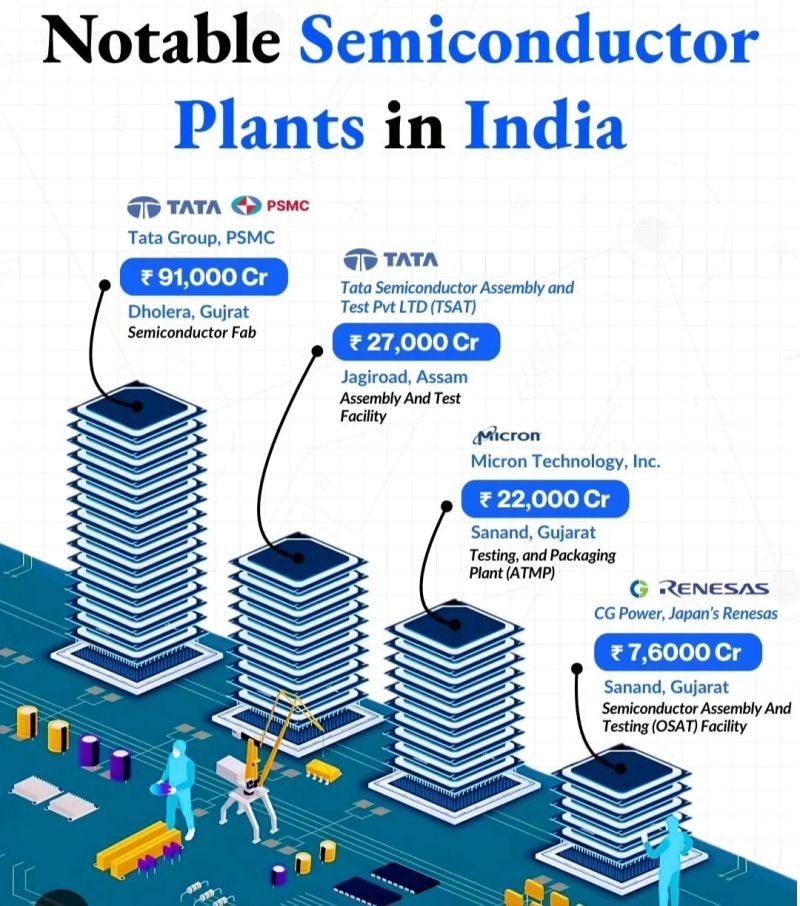
India’s most ambitious semiconductor project is being led by Tata Electronics. Its fabrication plant at Dholera, Gujarat—developed in partnership with Taiwan’s Powerchip Semiconductor Manufacturing Corporation—represents India’s first serious entry into wafer fabrication.
With an investment exceeding ₹91,000 crore, the facility is designed to produce 28nm to 110nm chips, targeting automotive electronics, power management ICs, display drivers, and industrial applications. While these nodes are not cutting-edge by global standards, they represent the workhorse technologies underpinning a majority of real-world electronic systems.
Commercial production is expected later in the decade, but the strategic importance lies in capability creation—process discipline, yield optimization, and fab operations expertise that can be built upon in subsequent generations.
Assembly, Testing, and Packaging: Faster Wins
Recognizing the long gestation of fabs, India has prioritized OSAT and ATMP facilities to achieve near-term manufacturing output.
- Micron Technology’s ATMP facility in Sanand, Gujarat is nearing completion, with India-made DRAM and NAND components expected to enter global supply chains.
- CG Power’s OSAT facility in Sanand has already commissioned its pilot line, making it the first operational commercial semiconductor production unit in the country.
- Additional investments from Kaynes Semicon and others are expanding packaging and testing capacity across automotive and industrial segments.
These facilities play a critical role in integrating India into global supply chains while generating skilled employment and operational know-how.
Specialization Over Scale: Silicon Carbide and Advanced Packaging
Rather than competing head-on with Taiwan or South Korea in advanced logic nodes, India has adopted a more pragmatic strategy—specialization.
Silicon Carbide (SiC) semiconductors have emerged as a focal point. SiC devices are essential for electric vehicles, renewable energy inverters, rail traction, and high-voltage power systems. Facilities in Odisha and other states aim to establish India as a credible producer of SiC wafers, MOSFETs, and power modules—segments expected to see explosive growth through 2030.
Advanced packaging technologies such as System-in-Package (SiP) and glass substrate packaging are also being pursued. As Moore’s Law slows, packaging innovation is becoming as critical as transistor scaling, offering India an opportunity to leapfrog in a high-value segment.
Vikram3201: Symbolism Backed by Substance
The Vikram3201 processor, developed by ISRO and the Semiconductor Laboratory in Chandigarh, represents India’s first fully indigenous, space-qualified microprocessor. Fabricated at a 180nm node, the chip is radiation-hardened and designed for extreme reliability—requirements far more stringent than consumer electronics.
While technologically mature rather than advanced, Vikram3201 proves a critical point: India can design, fabricate, package, test, and qualify chips for mission-critical applications. In strategic domains like space and defense, sovereignty and reliability outweigh transistor density.
Design Talent: India’s Enduring Advantage
India’s strongest semiconductor asset remains its people. Roughly 20 percent of the global semiconductor design workforce operates out of India, supported by over 100,000 VLSI engineers and a deep pipeline from IITs, IIITs, and research institutions.
Global companies—from Intel and Qualcomm to Renesas and Samsung—run large design centers in India. The government-backed DLI scheme has further catalyzed domestic startups working on surveillance SoCs, power management chips, satellite communications, and AI accelerators.
To bridge the manufacturing skill gap, initiatives such as Chips to Startup (C2S), SMART Labs, and industry-led workforce programs aim to train tens of thousands of fab-ready engineers over the next five years.
Global Partnerships and Geopolitical Context
India’s semiconductor rise is inseparable from global geopolitics. Supply chain concentration in Taiwan, export controls on China, and rising geopolitical risk have pushed governments and corporations to seek diversification.
India’s partnerships reflect this reality:
- Taiwan’s Powerchip brings fab expertise.
- Japan, through Renesas and Tokyo Electron, supports packaging, design, and equipment collaboration.
- The United States, via Micron and broader strategic alignment, views India as a long-term supply chain partner.
Rather than autarky, India’s approach is integration—embedding itself into trusted global semiconductor networks while gradually building indigenous depth.
Challenges: Execution Will Decide Outcomes
The obstacles remain formidable. Semiconductor fabs demand billions in sustained capital, ultra-clean infrastructure, and years of yield optimization. India’s infrastructure—power, water, logistics—must operate at near-perfect reliability. Workforce development must keep pace with capacity expansion. And access to advanced tools and IP remains constrained by global export regimes.
Perhaps most critically, India must convert pilot success into high-yield, cost-competitive manufacturing—a transition where many late entrants have faltered.
Outlook: A Measured, Credible Trajectory
Between 2025 and 2030, India is unlikely to challenge the world’s leading semiconductor powers. But it does not need to. By establishing itself as a reliable secondary hub—strong in OSAT, power semiconductors, automotive chips, and specialized packaging—India can secure strategic relevance in a USD 1 trillion global industry.
The semiconductor journey is a marathon, not a sprint. India has cleared the most difficult hurdle: moving from ambition to execution. What follows will be determined by discipline, patience, and the ability to learn at industrial scale.
For global investors, technology firms, and policymakers, India’s semiconductor sector in 2025 is no longer a question mark. It is a long-term experiment in industrial transformation—one whose outcome will shape global technology supply chains for decades to come.