From disaster response to debris mitigation, artificial intelligence is reshaping the way the world observes, understands, and protects our planet — but global cooperation and responsible governance remain essential.
NFAPost, Bengaluru: Artificial intelligence (AI) is transforming nearly every sector on Earth — and now, it is rapidly redefining our relationship with outer space. From enhancing disaster management to improving climate resilience, AI-driven space technologies are opening unprecedented opportunities for governments, scientists, and humanitarian agencies worldwide. Yet, as these tools become more deeply embedded in critical missions, the need for global standards, fairness, and robust governance has never been more urgent.
At the centre of this emerging landscape stands the United Nations Office for Outer Space Affairs (UNOOSA), which is working to ensure that the benefits of AI in space are shared equitably among all nations.
AI Supercharges Space-Based Intelligence
AI’s greatest strength lies in its ability to collect, process, and interpret massive datasets with extraordinary speed. Nowhere is this more impactful than in space, where satellites generate terabytes of Earth Observation (EO) data every day.
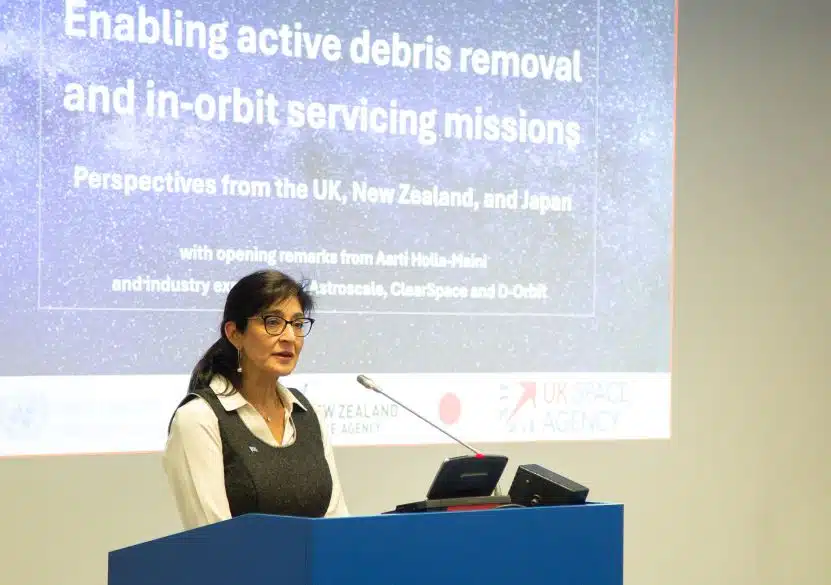
“Much of the data coming down from space is unused, archived, or not as high-resolution as required,” said UNOOSA Director Aarti Holla-Maini. “But you can enhance it with AI. For instance, we apply geospatial artificial intelligence (GeoAI) to transform open satellite data into disaster response tools.”
Through AI, satellite images can be rapidly filtered, enhanced, and prioritized, enabling near-real-time insights into floods, droughts, forest fires, and other emergencies. AI systems can also scan for anomalies in spacecraft operations, detect sensor degradation, and predict failures before they occur — extending satellite lifespans and reducing debris risks.
Hamid Mehmood, Head of the UN-SPIDER Beijing Office, highlighted the real-world impact:
“Through UN-SPIDER, we help countries turn Earth Observation and AI into services like flood and drought mapping, rapid damage assessment, and crop health monitoring.”
By integrating data from satellites, drones, and ground sensors, AI-driven platforms are improving early warning systems, helping governments protect vulnerable communities with greater precision and speed.
Digital Twins: Testing the Future Before It Happens
One of the most promising applications of AI in space is the creation of digital twins — dynamic 3D virtual replicas of real-world environments. These models allow governments to simulate disasters, evaluate infrastructure risks, and test climate adaptation strategies.
“You can simulate flood scenarios, storm surges, and identify vulnerable infrastructure,” Holla-Maini explained. “You can test response plans before disasters hit.”
Digital twins are becoming essential tools for urban planning, climate resilience, and national disaster preparedness.
Strengthening Space Sustainability
Beyond Earth, AI is increasingly critical for managing congestion in orbit and mitigating space debris.
On-board AI can:
- Filter unusable imagery
- Detect anomalies in real time
- Trigger safe-mode operations
- Prevent mission-threatening faults before they escalate
Ground-based AI helps optimize collision avoidance, fuel usage, and manoeuvre planning — crucial as Earth’s orbital environment grows more crowded.
“Opaque autonomy and weak human oversight can lead to unsafe actions during operations,” Mehmood warned. “AI must be fair, auditable, and regionally transferable, especially for users in the Global South.”
He also stressed the need to manage the high energy footprint of large AI models.
Ethical Risks and Global Gaps
AI’s benefits come with significant challenges that the global community must urgently address:
1. Fairness and Inclusivity
AI models trained on limited or region-specific data may misinterpret conditions elsewhere. Many developing nations lack access to high-quality EO data, powerful computing systems, or skilled personnel.
2. Data Integrity
The risk of manipulated satellite images poses a direct threat to humanitarian response.
“We cannot risk that images provided to first responders have been tampered with,” Holla-Maini warned. “The consequences can be dire.”
3. Sustainability
Operating AI for space missions consumes substantial energy. Ensuring environmentally responsible development across the AI life cycle is essential.
UNOOSA advocates for transparent, human-controlled AI systems, clear ownership frameworks, trustworthy processing pipelines, and resilient safeguards against data manipulation.
UN Leadership in Responsible AI for Space
During the Global Dialogue on AI Governance 2025, UN Secretary-General António Guterres emphasized the need for global unity:
“The trajectory of Artificial Intelligence will depend on our readiness to listen, to adapt, and to cooperate — across borders and disciplines.”
UNOOSA plays a key role in translating these principles into actionable frameworks. Working closely with the UN Committee on the Peaceful Uses of Outer Space (COPUOS), the agency promotes global standards for safety, transparency, and cooperation.
Through its Access to Space for All initiative, UNOOSA provides training, webinars, and capacity-building programmes to ensure that nations — regardless of economic standing — can benefit from AI-enabled space technologies.
A Shared Future — If Managed Responsibly
AI and space technologies together hold immense potential to accelerate sustainable development, strengthen disaster preparedness, and provide earlier warnings of humanitarian crises. But for these tools to truly serve all of humanity, they must be guided by strong norms and ethical frameworks.
“We need a code of practice for AI in space that ensures explainability, human control, safety checks, and post-incident learning,” Mehmood emphasized. “Equitable access and clear provenance are essential if AI in space is to serve everyone.”
Looking ahead, global cooperation will be the determining factor. With thoughtful governance, transparency, and inclusivity, AI in space can evolve into a shared platform for resilience, innovation, and peace — rather than a source of inequality or conflict.
As the world races toward the next great frontier, the choices made today will shape how AI helps humanity navigate the challenges of tomorrow.