At the Emerging Science, Technology and Innovation Conclave in New Delhi, Prime Minister Modi urges scientists, startups, and industry to build a “modern ecosystem of innovation” and make India a pioneer of transformation through technology.
NFAPost, Bengaluru: In a landmark address at the Emerging Science, Technology and Innovation Conclave (ESTIC) 2025, Prime Minister Narendra Modi launched a ₹1 lakh crore Research, Development, and Innovation (RDI) Scheme, marking one of the largest-ever investments in India’s R&D ecosystem. Speaking before a gathering of more than 3,000 participants — including scientists, innovators, Nobel Laureates, and industry leaders — the Prime Minister outlined a bold vision for India’s ascent as a global technology powerhouse.
“When science meets scale, when innovation becomes inclusive, and when technology drives transformation, the foundation for great achievements is laid,” the Prime Minister declared to resounding applause at Bharat Mandapam, New Delhi.
A Vision for a Self-Reliant, Innovation-Driven India
Setting the tone for the three-day conclave, Modi said that the 21st century belongs to nations that innovate, design, and lead through science and technology. He emphasised that India’s transformation from a technology consumer to a technology pioneer was well underway.
“India is no longer just a consumer of technology — it has become a pioneer of transformation through technology,” he said. “Our policies and reforms are creating a modern ecosystem where innovation flourishes and scientific ideas turn into real-world solutions.”
The Prime Minister said the government’s focus is shifting from “Ease of Doing Business” to “Ease of Doing Research”, ensuring that scientists, startups, and enterprises have the freedom and support to innovate. He pointed to reforms in procurement, financial rules, and supply chains that now allow research prototypes to move more swiftly from lab to market.
The ₹1 Lakh Crore Push for Research and Innovation
The centrepiece of Modi’s address was the announcement of the ₹1 lakh crore RDI Scheme, designed to stimulate private sector-led research, high-risk innovation, and cutting-edge industrial R&D.
“For the first time, capital is being made available for high-risk, high-impact projects,” the Prime Minister said. “We are promoting an ecosystem where our private sector, academia, and startups can work together to achieve global excellence in research.”
This funding builds upon the establishment of the Anusandhan National Research Foundation (NRF), which aims to strengthen India’s university research ecosystem and boost public-private collaboration in innovation.
The Prime Minister also announced that 10,000 new fellowships will be awarded over the next five years under the Prime Minister’s Research Fellowship, ensuring steady support for young scientists and researchers.
India’s R&D Transformation: From Lagging to Leading
Modi highlighted India’s striking progress in science and technology over the past decade. He noted that R&D expenditure has doubled, the number of patents filed has increased 17-fold, and India now ranks as the world’s third-largest startup ecosystem, with over 6,000 deep-tech startups operating in fields such as clean energy, advanced materials, and quantum computing.
“Our bio-economy has grown from $10 billion in 2014 to nearly $140 billion today,” he said. “Our semiconductor ecosystem is taking off, and our space programme has reached the Moon and Mars while helping farmers and fishermen back on Earth.”
Modi underscored India’s achievements in green hydrogen, quantum technologies, deep-sea research, and critical minerals, calling them “sunrise sectors” that will define the next generation of industrial progress.
The Power of Digital Public Infrastructure
Highlighting India’s success in building one of the world’s most robust Digital Public Infrastructures (DPI), the Prime Minister credited it as the backbone of India’s large-scale implementation capacity — from digital payments to healthcare and space missions.
“Today, India has the world’s most successful digital public infrastructure,” he said. “Over two lakh gram panchayats are connected with optical fibre, mobile data is democratised, and the benefits of technology are reaching every citizen.”
He noted that this technological inclusion has not only improved governance but has also transformed the innovation landscape, allowing millions to participate in the digital economy.
Inclusive Innovation and Women in Science
In one of the most inspiring segments of his address, Modi spoke about inclusive innovation and the rising participation of women in STEM.
“When innovation is inclusive, its beneficiaries become its leaders,” he said. “A decade ago, fewer than 100 patents were filed annually by women. Today, the number exceeds 5,000.”
He added that women now account for 43% of STEM enrolments in India — well above the global average — and cited the role of Indian women scientists in ISRO’s lunar and planetary missions as a source of national pride.
Investing in the Next Generation: From Curiosity to Creation
Modi stressed that India’s future scientific success depends on nurturing curiosity among the youth. Recalling the excitement generated by Chandrayaan missions and India’s first space station crewed mission, he said such moments ignite lifelong scientific ambition.
“The more young minds we can guide towards science, technology, and innovation, the stronger our nation will become,” he said.
The Prime Minister announced the establishment of 25,000 new Atal Tinkering Labs, in addition to the 10,000 existing labs that have already engaged more than one crore students in scientific experimentation.
He also highlighted the creation of hundreds of new universities, seven new IITs, and sixteen IIITs, and pointed out that under the National Education Policy (NEP), STEM courses are now being offered in local languages to make science education more inclusive.
India’s AI Leadership: Ethical and Human-Centric
The Prime Minister devoted a significant part of his address to Artificial Intelligence, calling it one of the defining technologies of the future.
“India is shaping the global framework for ethical and human-centric AI,” Modi said, adding that under the India AI Mission, an investment of over ₹10,000 crore is being made to promote AI applications in healthcare, agriculture, and public services.
He announced that India will host the Global AI Summit in February 2026, which will focus on balancing innovation with safety and accelerating inclusive and responsible AI development.
From Food Security to Nutrition Security: Expanding Scientific Horizons
Calling for new directions in research, the Prime Minister challenged India’s scientific community to address pressing global challenges such as malnutrition, soil health, clean energy, and genomics.
“Can India develop next-generation biofortified crops to help combat global malnutrition? Can we innovate affordable clean-energy storage and enhance soil health with bio-fertilisers?” he asked, urging scientists to lead breakthroughs in sustainability and human well-being.
He called for self-reliance in critical inputs where India remains dependent on imports, reinforcing the link between scientific independence and strategic autonomy.
“Jai Vigyan, Jai Anusandhan”: A New Scientific Ethos
Concluding his address, Modi called upon India’s scientific community to pursue discovery with courage, collaboration, and a sense of national mission.
“The government stands firmly with every innovator, every researcher, every scientist,” he said. “Together, let us build a roadmap that takes Indian innovation to new heights.”
He ended his speech with an invocation of India’s new scientific mantra:
“Jai Jawan, Jai Kisan, Jai Vigyan, Jai Anusandhan.”
About ESTIC 2025
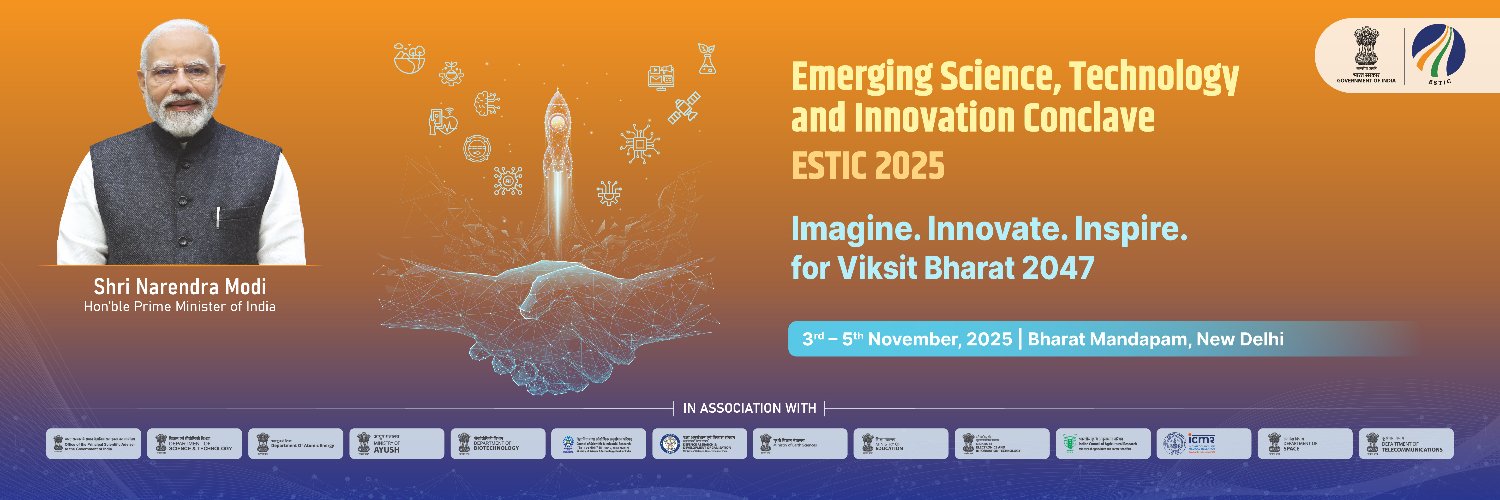
The Emerging Science, Technology and Innovation Conclave (ESTIC) 2025 is being held from November 3–5 at Bharat Mandapam, New Delhi. The event brings together more than 3,000 participants from academia, research institutions, industry, and government, alongside Nobel Laureates and global experts.
The conclave’s deliberations cover 11 key thematic areas, including AI, quantum science, bio-manufacturing, energy, advanced materials, semiconductors, health technologies, the blue economy, and space technologies — all critical to India’s journey toward a Viksit Bharat by 2047.