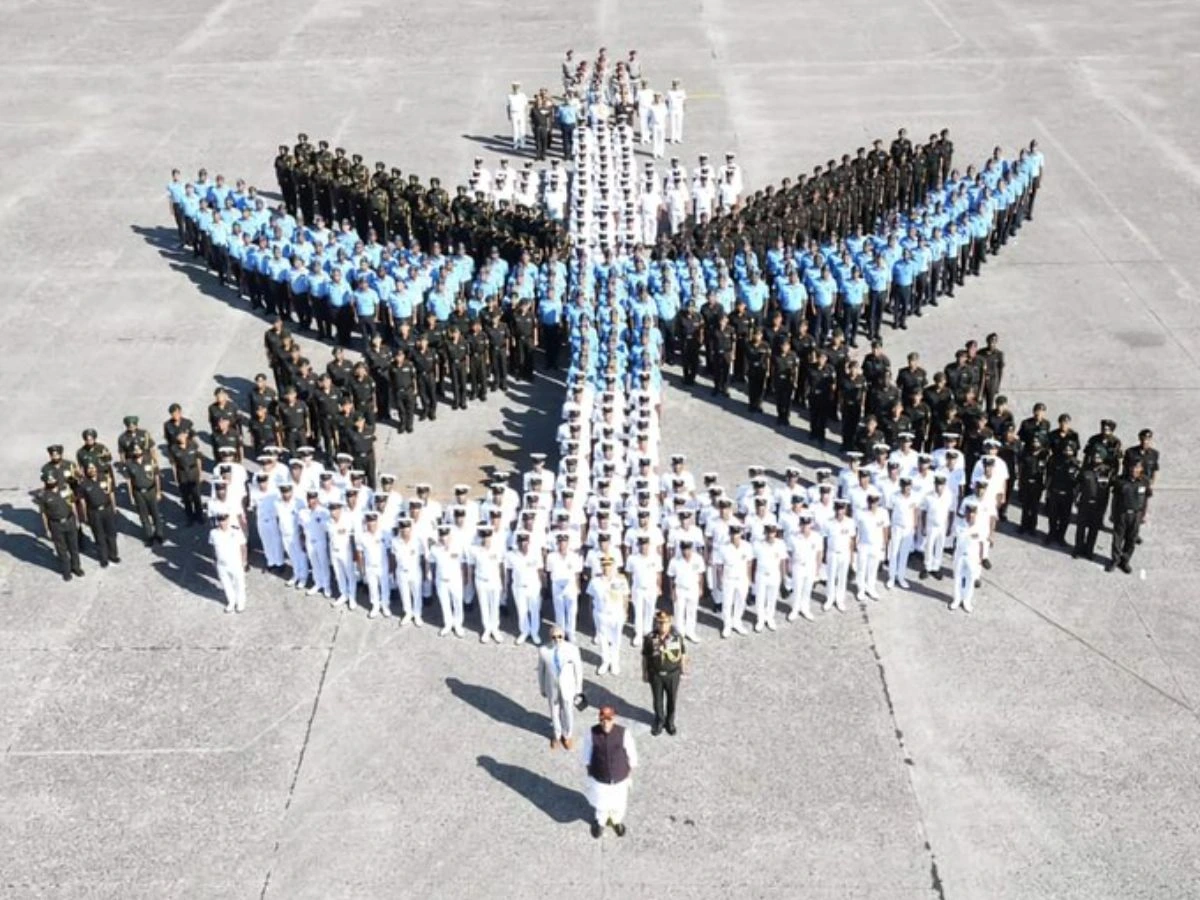
Army, Navy, and Air Force unite for a high-intensity tri-service drill across Gujarat and Rajasthan, reinforcing India’s integrated defence strategy and readiness along the Pakistan border.
NFAPost, Bengaluru: In a major show of military strength and inter-service coordination, India has commenced ‘Exercise Trishul’, a tri-service military drill bringing together the Army, Navy, and Air Force along the western border with Pakistan. Conducted from October 30 to November 10, 2025, across Gujarat and Rajasthan, the exercise marks a significant stride in India’s push toward joint command operations and integrated defence preparedness.
The large-scale manoeuvres — involving more than 20,000 personnel, cutting-edge air, land, and naval assets, and key paramilitary support — aim to bolster operational synergy among India’s armed forces and test real-time response capabilities under simulated combat scenarios.
“Exercise Trishul underscores the Indian military’s ability to operate as one cohesive force,” said a senior defence official. “It’s not just about readiness, but about redefining how India projects strength, coordination, and deterrence in a dynamic security environment.”
Building a Unified Defence Front
The core objective of Ex Trishul is to enhance interoperability — the ability of the Army, Navy, and Air Force to operate seamlessly together during combat and crisis situations. The exercise focuses on joint mission planning, cross-domain coordination, and rapid response mechanisms across air, land, and sea theatres.
Each phase of the drill is led by one of the three services, reflecting the integrated nature of modern warfare:
- Phase I: Led by the Indian Navy, the opening segment focuses on coastal defence, sea-air coordination, and maritime surveillance in the Arabian Sea region.
- Phase II: Commanded by the Indian Army, this phase centres on armoured manoeuvres, mechanised warfare, and battlefield logistics across the desert stretches of Rajasthan.
- Phase III: Concluding under the Indian Air Force, the final leg tests air dominance, long-range strike missions, and joint targeting operations using frontline fighters such as Rafale and Sukhoi-30MKI.
The Border Security Force (BSF) and Indian Coast Guard are also participating, providing real-time intelligence and coastal security integration — a hallmark of India’s comprehensive national defence architecture.
Power in Numbers and Technology
The scale of Ex Trishul reflects its ambition. Over 20,000 troops are taking part, supported by advanced military hardware including:
- T-90S Bhishma and Arjun Main Battle Tanks for ground dominance
- Attack helicopters and short-range missile systems for tactical support
- Rafale and Sukhoi-30MKI fighter jets for aerial precision strikes
- Frigates and destroyers from the Indian Navy for maritime superiority
According to senior military sources, these integrated drills simulate real battlefield conditions — testing communication networks, joint command systems, and AI-assisted logistics coordination.
“Trishul is not just about muscle, it’s about mastering multi-domain warfare,” said a senior Indian Air Force officer. “From satellite-linked data sharing to real-time combat simulations, we’re training for a future where speed, intelligence, and cooperation win wars.”
Strategic Significance Along the Western Front
The Gujarat–Rajasthan corridor, where the exercise is being held, holds immense strategic value due to its proximity to Pakistan’s Sindh province and coastal access near Sir Creek — a historically sensitive maritime boundary.
Defence experts view Trishul as a signal of deterrence and a message of readiness, particularly amid regional developments and shifting threat perceptions.
Earlier this month, Defence Minister Rajnath Singh had cautioned that any “aggression in the Sir Creek region would be met with a strong and historic response.” His remarks now resonate even more strongly in the context of the ongoing tri-service exercise.
Interestingly, ahead of the exercise, Pakistan reportedly altered certain flight routes over Karachi and Lahore, an indication of heightened alertness in response to India’s military mobilisation.
Towards an Integrated Theatre Command
Ex Trishul also serves as a precursor to India’s upcoming Integrated Theatre Command (ITC) — a major structural reform under consideration by the Ministry of Defence. The ITC aims to consolidate command operations across services, enabling faster decision-making and a unified response in times of crisis.
“Jointness is the future of warfare,” noted a senior Army officer involved in the exercise. “Trishul is part of that transition — where India’s three services don’t just cooperate, but operate as one force, backed by technology and trust.”
A Step Toward Strategic Maturity
As the exercise progresses, analysts see Trishul as more than just a combat drill — it is a symbol of India’s maturing defence doctrine. By combining tactical realism, technological integration, and inter-service harmony, India is demonstrating that its defence modernisation is both comprehensive and forward-looking.
The message is clear: India is prepared, united, and capable of safeguarding its sovereignty across every domain — land, air, and sea.