From radars and seekers to quantum-secure communications, DRDO’s indigenous electronics are powering India’s next-generation defence systems—and building the foundation for a sovereign semiconductor ecosystem.
NFAPost, Bengaluru: India’s quest for self-reliance in defence electronics is no longer a distant ambition—it’s unfolding across laboratories, production lines, and operational platforms. The Defence Research and Development Organisation (DRDO) has quietly but decisively built a systems-first technology roadmap: designing, realising, and integrating indigenous electronics into complete weapon and surveillance systems.
From radar arrays that track threats at long range to seekers guiding precision missiles and electronic warfare (EW) suites shielding naval fleets, DRDO’s electronics now underpin India’s operational readiness and strategic autonomy.
“Indigenous defence electronics—sensors, seekers, radars, and EW—are central to credible deterrence and supply-chain sovereignty,” said Dr Samir V. Kamat, Secretary, Department of Defence R&D and Chairman, DRDO. “Our focus remains rigorous trials, user readiness, and industry scale-up so that Indian systems equip Indian platforms at pace.”
From Laboratory to Frontline: India’s Electronic Arsenal
Over the past decade, DRDO has moved from technology demonstrators to combat-ready systems across domains.
Electronic Warfare and Radar Systems:
The ‘Shakti’ ship-borne advanced EW suite, handed over to the Indian Navy in November 2021, marked a leap in naval survivability. Complementing it are new generations of surveillance radars: active electronically scanned array (AESA) radars, long-range tracking radars, and Over-the-Horizon (OTH) sensors. Even the development of Medium Range Microwave Obscurant Chaff Rockets (MR-MOCR) reflects India’s growing capability in radio-frequency deception.
Missile Systems:
Electronics now define precision in missile warfare. The Akash-NG (January 2024), Pralay (November 2023), and Astraair-to-air missile (trialled in March 2025 at extended ranges) demonstrate maturity in guidance, seeker, and avionics integration.
Surface systems like VL-SRSAM (July 2023) and VSHORADS (tested in October 2024 and February 2025) extend layered air defence through compact, miniaturised electronics—entirely designed and tested in India.
Naval Warfare and Undersea Systems:
Underwater electronics have advanced with the Varunastra heavy-weight torpedo (tested June 2023), the SMART missile-assisted torpedo delivery system (May 2024), and the High Endurance Autonomous Underwater Vehicle (HEAUV), which achieved its maiden surface run in 2024. The Naval Anti-Ship Missile (NASM), successfully demonstrated from an aerial platform in February 2025, adds a new dimension to naval strike capability.
Space Security and Directed Energy:
The 2019 Mission Shakti anti-satellite test validated hit-to-kill precision through integrated sensors and fire-control electronics. More recently, on April 13, 2025, India showcased a 30-kW directed-energy weapon, defeating fixed-wing UAVs and swarm drones—a milestone in indigenous laser tracking, beam control, and kill-assessment electronics.
Electronics Behind the Machines
On land, the Arjun Mk-IA main battle tank (inducted February 2021) integrates advanced sighting and fire-control electronics, while its anti-tank guided missile (ATGM) completed trials in 2023. The Indian Light Tank, tested in 2024, carries indigenous control systems developed under DRDO’s armoured vehicle electronics programmes.
In the air, the Integrated Life Support System (ILSS) with Onboard Oxygen Generation (OBOGS) for the LCA Tejas completed flight testing in March 2025, demonstrating India’s ability to merge avionics and life-support electronics seamlessly.
In propulsion-linked domains, DRDO has achieved breakthroughs in active-cooled scramjets, small turbofans for cruise missiles, solid-fuel ducted ramjets (SFDRs), and Air Independent Propulsion (AIP) systems for submarines—all dependent on advanced control, health-monitoring, and sensor electronics.
Even communications security is being redefined: a Quantum Key Distribution (QKD) link spanning 100 km between Prayagraj and Vindhyachal was demonstrated in 2022, setting the stage for quantum-secure defence networks.
Ecosystem for Scale: Industry and Academia in Sync
DRDO’s technology translation model—anchored in Development-cum-Production Partnerships (DcPP) and Technology Transfers (ToT)—is maturing into a full-fledged industrial ecosystem.
To date, DRDO has:
- Identified 183 systems and subsystems for industry-led development,
- Onboarded 136 DcPP partners,
- Signed 2,135 ToT agreements,
- Opened over 2,780 IPRs to Indian firms,
- Funded 81 projects worth ₹324 crore under the Technology Development Fund (TDF), and
- Supported 281 projects across 52 institutes through 15 DRDO Industry-Academia Centres of Excellence (CoEs) with cumulative funding of ₹1,095 crore.
Five dedicated Young Scientist Labs (DYSLs) now focus on frontier domains: artificial intelligence, quantum technologies, cognitive electronics, asymmetric warfare systems, and smart materials.
“Our model is evolving from ‘lab-to-user’ to ‘lab-with-industry’,” said a senior DRDO official. “Every sensor, every radar, every processor we indigenise multiplies the nation’s resilience.”
ESTIC 2025: The Electronics and Semiconductor Imperative
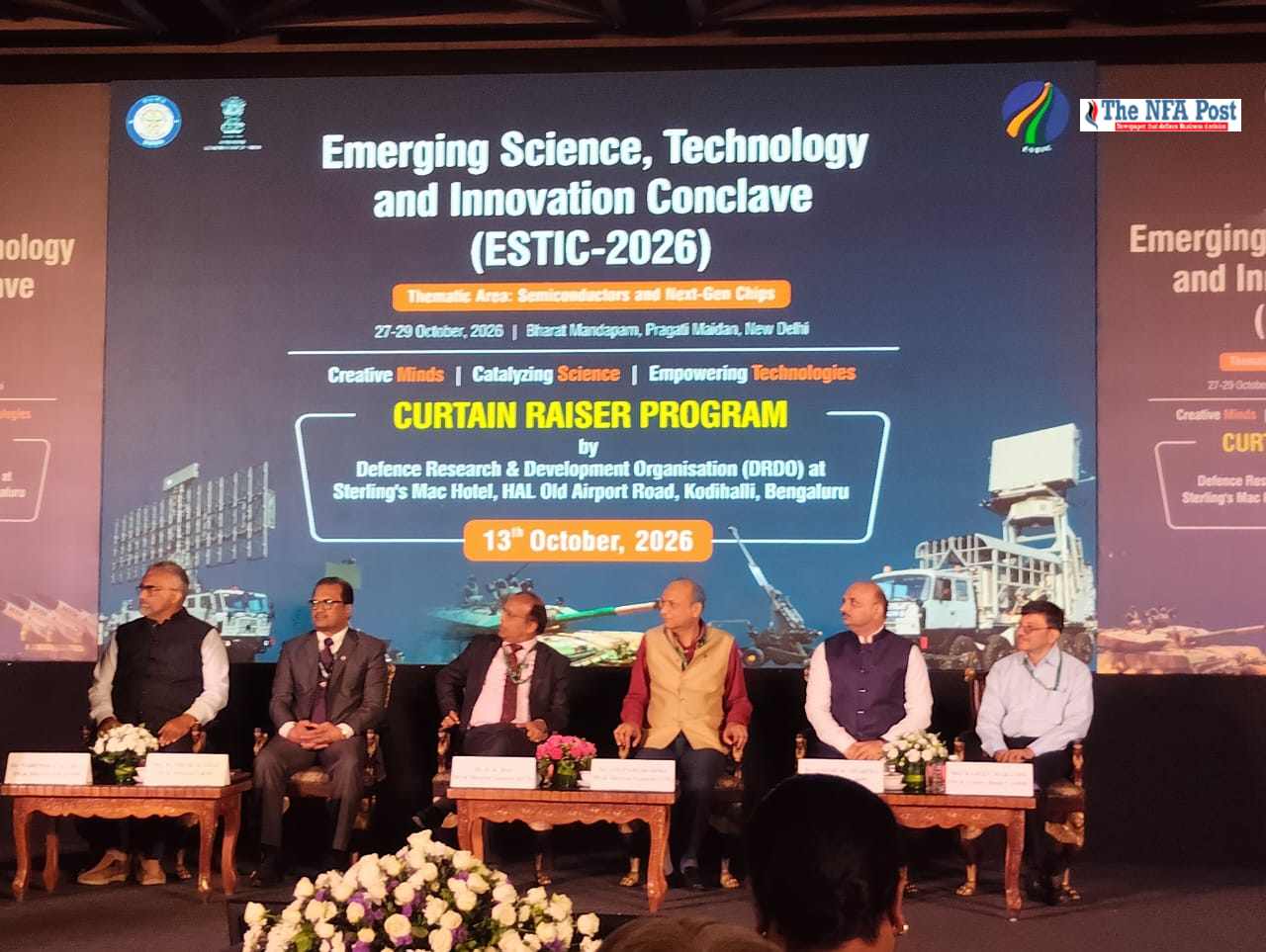
At the upcoming Electronics & Semiconductor Technology Integration Conference (ESTIC-2025), DRDO will showcase its roadmap for scaling indigenous electronic components—from sensors and seekers to processors and power systems. The focus: maturing successful prototypes into serial production and embedding MSMEs and startups deeper into critical sub-assembly ecosystems.
Priorities include:
- Localisation of radar front-ends, high-power GaN-based amplifiers, and EW processors,
- Strengthening test, qualification, and environmental reliability standards,
- Integrating indigenous semiconductors into next-generation platforms such as the AMCA stealth fighter, AEW&C Mk-II, KUSHA long-range surface-to-air missile, indigenous AIP submarines, and space-based ELINT systems.
Technology Depth Meets Strategic Vision
DRDO’s approach to electronics manufacturing is incremental yet relentless—technology by technology, project by project. Each indigenous milestone contributes to a broader national framework: Viksit Bharat 2047, which envisions India as a global technology power rooted in self-reliance and innovation.
By coupling pioneering innovation (like directed-energy weapons, quantum encryption, and autonomous underwater systems) with deep technology maturity (in radars, seekers, and EW), DRDO is redefining what indigenous capability means in practice.
“The delivery approach remains executional—technology by technology—so that Indian electronics equip Indian platforms on predictable schedules,” Dr Kamat emphasised.
From Dependence to Dominance
In 2025, DRDO’s electronics ecosystem is no longer a promise—it’s a performance reality. With mission-proven systems, open intellectual property, and industrial partnerships driving scale, India’s defence electronics sector stands at a strategic inflection point.
The path forward is clear: from dependence to dominance, powered by indigenous design, resilient supply chains, and a generation of innovators who are building, chip by chip, the nation’s technological sovereignty.