At Bengaluru’s flagship defence-industry meet, DRDO hands over 12 technology transfer agreements to major and emerging players, reaffirming India’s stride toward self-reliance in defence manufacturing.
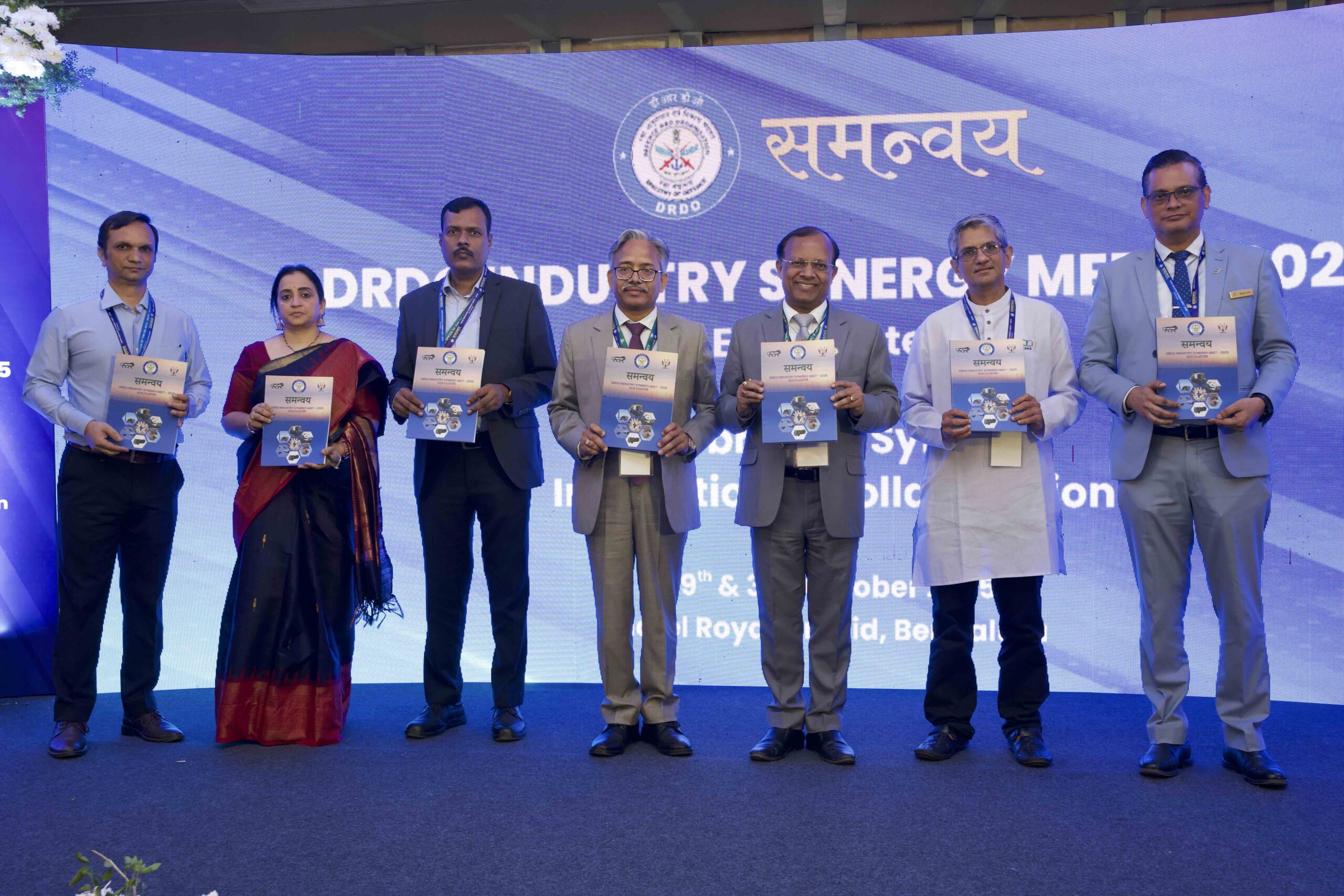
NFAPost, Bengaluru: In a major boost to India’s indigenous defence manufacturing ecosystem, the Defence Research and Development Organisation (DRDO) transferred 12 Licensing Agreements for Transfer of Technology (LATOTs) covering eight advanced systems to leading public and private sector partners during the inaugural session of SAMANVAY 2025 — a two-day industry synergy meet organised by DRDO’s Electronics and Communication Systems (ECS) cluster in Bengaluru.
The event, attended by over 150 industry partners including MSMEs and startups, marked another milestone in the government’s Aatmanirbhar Bharat initiative aimed at strengthening the country’s defence industrial base.
A New Chapter in Defence-Industry Collaboration
Virtually addressing the gathering, Dr Samir V. Kamat, Secretary, Department of Defence R&D and Chairman, DRDO, emphasised the growing partnership between research laboratories and industry.
“By uniting innovation and industry, DRDO is empowering Indian defence manufacturing for a self-reliant tomorrow. From research laboratories to real-world capabilities, we are partnering with the industry to realise the Government’s vision of ‘Make in India, Make for the World’,” Dr Kamat said.
He announced that DRDO has instituted Industry Interaction Groups at all its laboratories, centres, and headquarters to enhance understanding of its policies and facilitate smoother engagement with industry partners.
Technologies Transferred: From Lasers to Electronic Warfare
The transfers covered some of DRDO’s most sophisticated systems, developed across its premier research establishments:
| Laboratory | Technology | Industry Partner(s) |
|---|---|---|
| Combat Aircraft System Development & Integration Centre | D-29 Electronic Warfare Suite | Bharat Electronics Limited (BEL), Bengaluru |
| Defence Electronics Application Laboratory | NATSAT-Handheld & NATSAT-Mini Terminals | BEL, Panchkula |
| Defence Electronics Research Laboratory | Sarang Electronic Support Measure System (Programme SAMUDRIKA) | BEL, Bengaluru |
| Dolphin-II | BEL, Bengaluru | |
| Instruments Research & Development Establishment | Laser Beam Rider Guidance System with Eye-safe Laser Range Finder | BEL, Pune & Bharat Dynamics Limited (BDL), Hyderabad |
| Athermal Laser Target Designator | BEL, Pune | |
| Laser Photoacoustic Spectroscopy Equipment | DH Limited (Ghaziabad), Enertech Engineering Pvt Ltd (Hyderabad), Beam Infotech Pvt Ltd (Gurgaon), Nibe Ltd (Pune) | |
| Microwave Tube Research & Development Centre | M-Type Dispenser Cathode | Panacea Medical Technologies Pvt Ltd, Malur (Karnataka) |
These technologies span key defence domains — from precision laser systems and electronic warfare suites to advanced communications and sensor technologies — offering new opportunities for Indian industry to scale up manufacturing and integration capabilities.
Innovation as a National Imperative
Delivering the keynote address as Guest of Honour, Padma Vibhushan Dr R.A. Mashelkar, former Director General of the Council of Scientific and Industrial Research (CSIR), urged deeper collaboration between research institutions and the private sector.
“India must move from incremental innovation to disruptive innovation,” Dr Mashelkar said. “When industry, academia, and research work in synergy, India can pole vault to the next level of technological leadership.”
Dr B.K. Das, Director General of DRDO’s ECS cluster, congratulated the participating industries for their enthusiasm and urged startups to take bold steps in developing large-scale defence systems.
“Startups must not limit themselves to niche components — think big, innovate big. The government and major industries will support you in turning ideas into deployable products,” he said.
Building the Ecosystem for Self-Reliance
SAMANVAY 2025 features ten thematic sessions focusing on strengthening industry participation, fostering MSME and startup engagement, and enhancing development and production partnerships. Discussions also cover DRDO policy reforms, challenges in defence R&D, and pathways to accelerate indigenous manufacturing.
This initiative aligns with DRDO’s revised Transfer of Technology (ToT) Policy announced earlier this year, which streamlines processes, waives fees for certain categories, and provides financial support through the Technology Development Fund (TDF) — offering up to ₹50 crore per project for eligible industry partners.
India’s defence production touched ₹1.51 lakh crore in FY 2024–25, marking an 18% year-on-year increase, with the private sector now contributing 23% of total output. The technology transfers at SAMANVAY 2025 reflect a continuation of DRDO’s recent drive — following ToT handovers in June 2025 (nine systems to ten partners) and August 2025 (three advanced materials technologies in Hyderabad).
Empowering Industry, Empowering India
As India deepens its defence-industrial ecosystem, events like SAMANVAY 2025 highlight a clear shift in DRDO’s strategy — from being a sole developer of defence technologies to becoming a catalyst for industry-led innovation.
In the words of Dr Kamat:
“The future of Indian defence R&D lies in partnership — where DRDO provides the science, industry drives the scale, and together, we build strength for the nation.”