The new national standard for Software Defined Radios marks a milestone in India’s defence communication self-reliance, fostering interoperability, innovation, and export potential
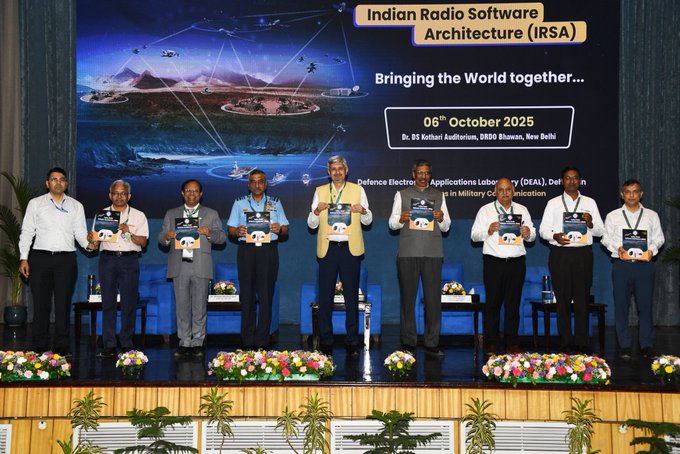
NFAPost, Bengaluru: In a landmark move toward achieving complete self-reliance in defence communication systems, the Defence Research and Development Organisation (DRDO), in collaboration with the Integrated Defence Staff (IDS) and the Tri-Services, has formally released Indian Radio Software Architecture (IRSA) Standard 1.0. The announcement was made during a national workshop held on October 7, 2025, at DRDO Bhawan, New Delhi, in the presence of top defence officials, industry representatives, and academic leaders.
The IRSA standard establishes a comprehensive software specification for Software Defined Radios (SDRs) — a core enabler of modern, flexible, and secure military communications. It defines standardized interfaces, APIs, execution environments, and waveform portability mechanisms, ensuring that different radio systems used across the Army, Navy, and Air Force can seamlessly interoperate.
“IRSA is not just a standard — it’s a strategic enabler,” said Dr. Samir V. Kamat, Secretary, Department of Defence R&D, and Chairman, DRDO. “It will unify our communications infrastructure across the services, empower indigenous industry participation, and lay the foundation for India to become a global supplier of secure communication systems.”
Building the Foundation for Self-Reliance
The release of IRSA 1.0 is being hailed as a transformative milestone in India’s defence modernization journey. Designed with a “Designed in India, for India — and ready for the world” philosophy, IRSA ensures waveform portability, interoperability, certification, and conformance among diverse SDR systems.
The standard is also future-ready, with the flexibility to evolve as operational requirements and communication technologies advance. It provides a modular, scalable framework to integrate next-generation innovations, such as AI-driven cognitive radios, 5G/6G tactical networks, and quantum-resistant encryption.
A Collaborative Effort
The national workshop that marked the launch of IRSA 1.0 offered a deep dive into the standard’s development journey, technical framework, and ecosystem roles. Participants included key stakeholders from the Indian Armed Forces, Department of Defence Production (DDP), Defence Public Sector Undertakings (DPSUs), private industry, and academia.
“The true strength of IRSA lies in the collaboration between the tri-services, DRDO, academia, and industry,” said Air Marshal Ashutosh Dixit, Chief of Integrated Defence Staff. “This partnership approach ensures that operational needs are directly translated into technical capabilities.”
“Standardisation enables innovation,” added Dr. Rajat Moona, Director, IIT Gandhinagar. “By defining common interfaces and frameworks, IRSA will open up opportunities for startups and research institutions to develop compatible solutions and new waveforms.”
From Vision to Reality
The IRSA initiative traces its roots to 2021, when the growing dependence on Software Defined Radios in tactical operations highlighted the need for a nationally standardised software architecture. A core technical team led by DRDO initiated the effort in 2022, working closely with the IDS and Services to capture user and operational requirements.
Following extensive reviews, field validations, and stakeholder consultations, IRSA Version 1.0 was formally approved by the High-Level Advisory Committee (HLAC) in 2025, marking the creation of India’s first national software standard for SDRs.
Positioning India as a Global Benchmark
Beyond enabling domestic interoperability, the vision for IRSA is strategic and global. The standard is expected to serve as a benchmark for friendly nations, opening avenues for the export of IRSA-compliant communication systems and positioning India as a leader in secure radio technologies.
“With IRSA, India takes a bold step toward not only achieving Atmanirbharta in defence communications but also setting global standards in SDR technology,” said a senior DRDO official. “This is how nations move from being technology adopters to technology exporters.”
Key Highlights of IRSA 1.0
- Standardized Software Architecture: Enables waveform portability and cross-platform operability.
- Interoperability Across Services: Seamless communication between Army, Navy, and Air Force SDR systems.
- Future-Ready Design: Supports integration of advanced technologies like AI and quantum communication.
- Ecosystem Driven: Encourages participation from industry, startups, and academia.
- Export Potential: Framework for developing IRSA-compliant systems for friendly nations.
The release of IRSA 1.0 marks not just a technological advancement but a strategic leap in India’s quest for defence autonomy and innovation. It represents a future where communication dominance, security, and adaptability form the backbone of India’s military strength — powered by indigenous innovation and collaborative excellence.