Bengaluru set to host global stakeholders on September 8–9 as India targets $44 billion space industry by 2033
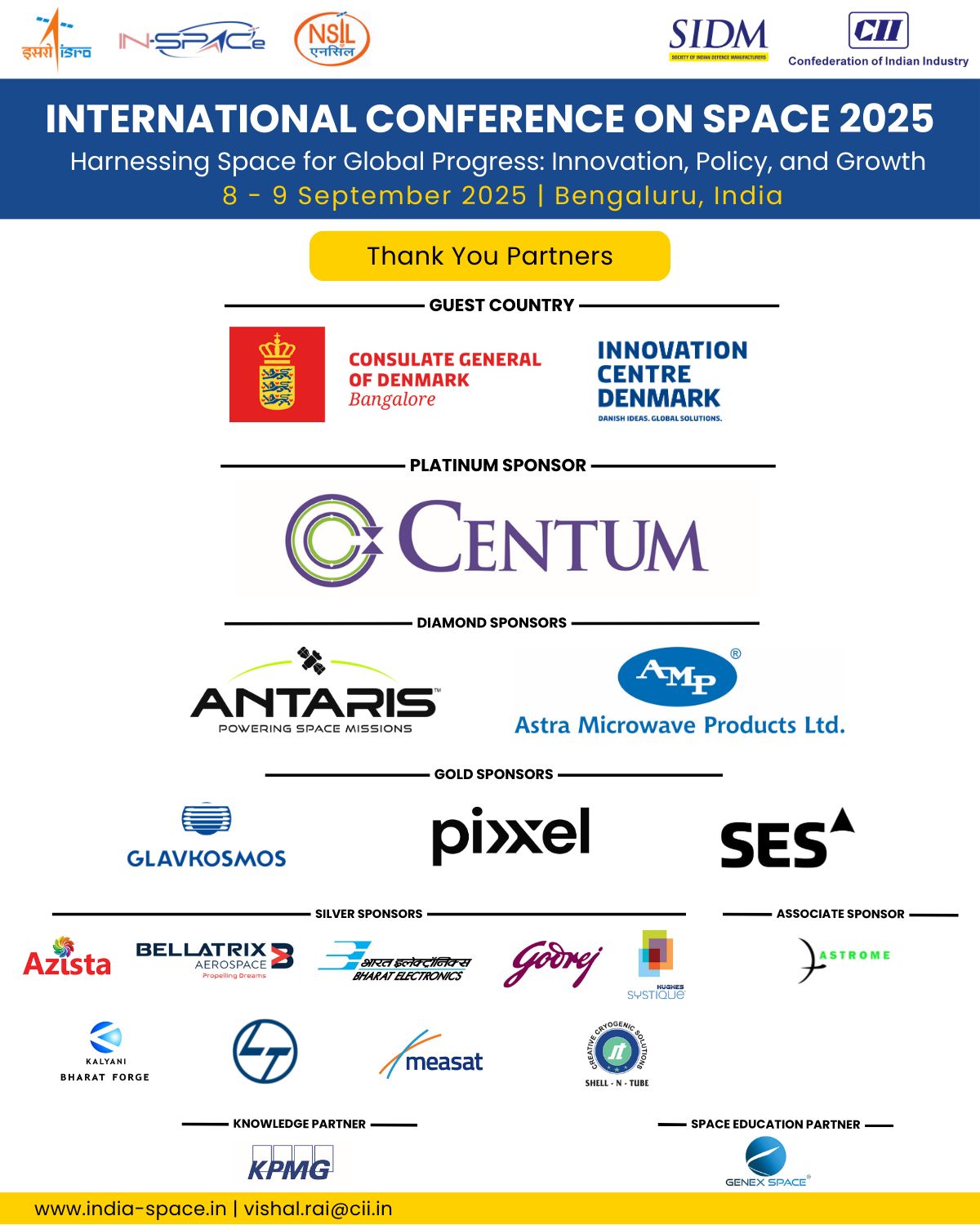
Bengaluru, NFAPost: The Indian space sector, once a government-driven enterprise, is rapidly evolving into a dynamic ecosystem of innovation, private enterprise, and global partnerships. This transformation will take centre stage at the International Conference on Space (ISCE) 2025, to be held on September 8–9 at Taj Yeshwantpur, Bengaluru, where policymakers, scientists, industry leaders, and startups will converge to chart the next decade of space growth.
Organized by the Confederation of Indian Industry (CII) with support from national space agencies, ISCE 2025 will explore how innovation, policy frameworks, and international collaboration can accelerate India’s emergence as a major space power.
India’s Expanding Space Economy
India’s space industry is currently valued at USD 8.4 billion, accounting for only 2% of the global space economy. However, projections suggest it could grow nearly fivefold to USD 44 billion by 2033, with exports alone contributing USD 11 billion.
Fuelled by the Indian Space Research Organisation (ISRO), the rise of nearly 200 private startups, and policy shifts such as the Indian Space Policy 2023, the liberalisation of FDI in 2024, and the establishment of IN-SPACe and NSIL, the sector is moving towards becoming a global growth engine.
The global space economy, valued at USD 596 billion in 2024, is projected to exceed USD 1.8 trillion by 2035, growing at nearly 9% annually. India aims to expand its share from 2% to 8% over the next decade, driven by cost-effective launch systems, satellite manufacturing, and rapidly growing downstream applications.
A Platform for Dialogue and Innovation
Themed “Harnessing Space for Global Progress: Innovation, Policy, and Growth”, ISCE 2025 promises forward-looking discussions on how space can serve as a driver of sustainable development, national resilience, and commercial opportunity.
Planned sessions will cover:
- Bridging Policy and Execution Gaps: Examining regulatory clarity, private capital, R&D infrastructure, and skilled talent as foundations for accelerating reforms.
- Private Sector Leadership: Exploring how enterprises are driving breakthroughs across the upstream and downstream segments of the space value chain.
- Strengthening Indigenous Capabilities: Scaling domestic satellite and launch systems, reducing import dependence, and building resilience.
- Next-Gen Satellite Communication: Enabling 5G/6G, IoT, and digital infrastructure while ensuring national resilience.
- Earth Observation (EO) Data Opportunities: Unlocking EO for agriculture, climate monitoring, disaster response, and urban planning.
- Startups as Ecosystem Builders: Highlighting the role of India’s 200+ space startups in democratising access and driving innovation.
- International Collaboration: Leveraging over 260 cooperation agreements to build sustainable exploration and co-develop next-gen technologies.
- Space and Defence: Integrating satellite technologies for surveillance, communication, and security under initiatives like Mission DefSpace.
- Building a Skilled Workforce: Addressing talent gaps across engineering, regulation, and entrepreneurship to prepare for the future space economy.
Startups at the Forefront
India’s burgeoning startup ecosystem will receive special focus. With more than 200 registered ventures, supported by IN-SPACe and an enabling policy framework, young companies are increasingly shaping the New Space Economythrough innovations in satellite manufacturing, data analytics, and launch services.
Sessions will also spotlight funding opportunities, incubator support, and challenges faced by startups as they scale operations to compete globally.
A Global, Collaborative Outlook
Space today is inherently international, with over 90 countries participating in the global space economy. India has already signed 260 space cooperation agreements with more than 60 nations, enabling joint missions, technology transfers, and data sharing.
ISCE 2025 will highlight how such collaborations can foster sustainable exploration, reduce costs, and accelerate innovation.
Defence and Security Dimensions
With defence emerging as a major driver of demand, the integration of space assets into India’s strategic framework will be another key theme. Satellite-enabled ISR (Intelligence, Surveillance, and Reconnaissance), navigation, and communication are already central to modern military preparedness.
Speakers will discuss policy frameworks to deepen civil-military cooperation, technical capacity building, and the role of emerging technologies in ensuring space security and resilience.
Building the Workforce of the Future
Perhaps the most critical enabler of India’s ambitions is human capital. As the sector evolves, there is a growing demand for an interdisciplinary workforce adept in engineering, regulatory frameworks, systems integration, and entrepreneurship.
ISCE 2025 will address strategies for skilling, upskilling, and aligning academia with industry, as well as policies to encourage STEM careers for women and young professionals, ensuring inclusive and sustainable sectoral growth.
A Catalyst for the Next Decade
Positioned at the crossroads of policy, innovation, and international collaboration, ISCE 2025 is designed to be a catalyst for dialogue and action, offering a platform to unlock the full potential of space as a driver of progress.
As India seeks to increase its share of the global space economy to 10% by 2033, the conversations and partnerships forged at Bengaluru will be vital in shaping a future where the country not only participates in but also leads the global space race.