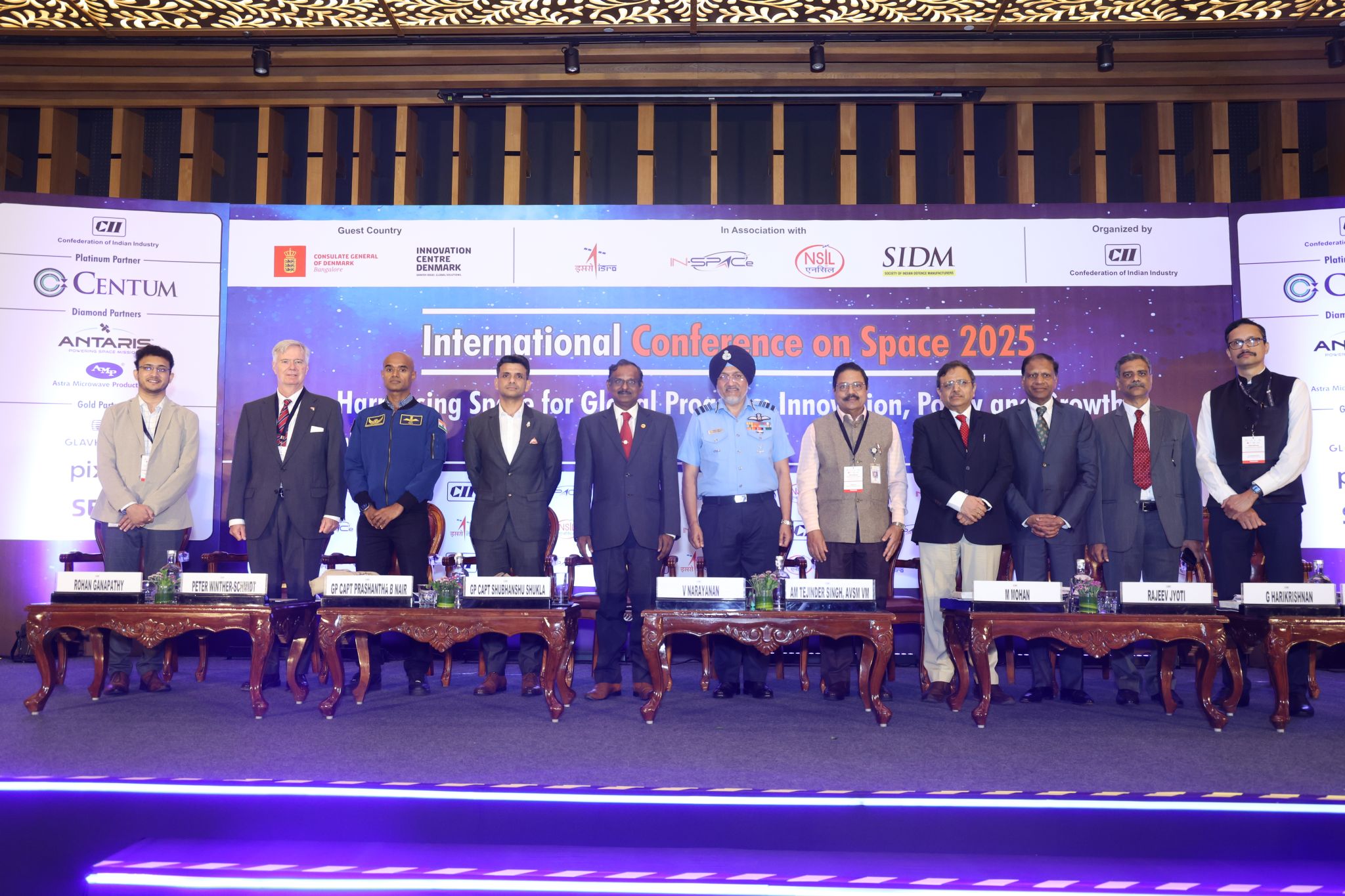
At CII International Conference on Space 2025, leaders hail India’s transformative space journey, military readiness, and astronaut achievements as markers of a new era.
Bengaluru, NFAPost: India’s space programme is undergoing its most transformative phase yet, with policy reforms, private sector participation, and human spaceflight ambitions steering the nation into a new era of global leadership, said Union Minister of State (Independent Charge) for Science and Technology, Dr. Jitendra Singh, while addressing the International Conference on Space 2025 via video conferencing.
Calling the opening up of the space sector to private players the “biggest reform in the last 11 years”, Dr. Singh said the government’s bold move has ushered in a wave of innovation, start-ups, and collaborations that are reshaping India’s role as a spacefaring nation.
“From once being limited to government-led projects, India today has hundreds of start-ups developing technologies with applications ranging from interplanetary exploration to governance. The mantra of reform, perform, and transform is driving this sector forward,” Dr. Singh said.
He noted that Prime Minister Narendra Modi’s vision—that the 21st century belongs to India and that space will be one of the frontiers of global recognition—has been central to this transformation.
From Chandrayaan to Human Spaceflight
Dr. Singh highlighted India’s landmark achievement of being the first nation to land on the Moon’s South Pole with Chandrayaan-3, calling it a defining moment that signalled to the world that “India has arrived and is no longer a follower.”
He also pointed to the upcoming Gaganyaan human spaceflight mission, where Indian astronauts will for the first time venture into low-earth orbit aboard an indigenous spacecraft.
“India’s astronauts reflect the Prime Minister’s flagship mantras in space missions. Their achievements combine traditional strengths with modern innovation,” Dr. Singh said, stressing that astronaut training and participation in international missions have strengthened India’s readiness.
Astronauts Inspire a Generation
The conference spotlighted the achievements of Group Captain Shubhanshu Shukla, who became the first Indian to travel to the International Space Station (ISS) as part of the Axiom-4 mission earlier this year.
Recounting his experiences as mission pilot of the Crew Dragon spacecraft, Shukla described the mission as a milestone not just for him but for India’s future in human spaceflight.
“This mission gave us insights that cannot be documented on paper. These lessons will be critical as India prepares for Gaganyaan and beyond,” Shukla said.
He recalled his live interactions with schoolchildren during the mission, where young Indians asked how they too could become astronauts.
“That, for me, was the biggest win—that kids are already dreaming of space. The good news is ISRO and India are ready to make these dreams a reality,” he said, urging youth to believe in their space ambitions.
Group Captain Prasanth B. Nair, who trained alongside Shukla, said India’s participation in international missions had brought immense respect abroad.
“The world looks at India’s progress with admiration, often surprised at the scale of our achievements made with humility. Our approach to space is rooted in inclusivity and shared benefit,” Nair said, adding that India’s scientists, policymakers, and citizens together underpin the nation’s space ambitions.
ISRO’s Expanding Horizons
Dr. V. Narayanan, Secretary, Department of Space and Chairman, ISRO, outlined India’s ambitious roadmap, including the Gaganyaan mission, Chandrayaan-4, the Venus Orbiter Mission, and the Bharatiya Antriksh Station.
India’s first space station module is expected to be launched by 2028, with full operational capacity by 2035, he said. By 2040, Narayanan added, India’s space programme will stand at par with global leaders.
“The approval for the Next Generation Launcher (NGL) by the Prime Minister is another step toward self-reliance. Our space journey is not just about symbolic feats but building capabilities that benefit humanity,” Narayanan said.
Space: The New High Ground for Defence
The military dimension of India’s space strategy was highlighted by Air Marshal Tejinder Singh, Air Officer Commanding-in-Chief, IAF Training Command, who emphasised that modern warfare is inseparable from space capabilities.
“Air and space are a continuum. Space is the new high ground,” he said, underlining that satellite-enabled intelligence, surveillance, reconnaissance (ISR), navigation, and communication are now critical to national security.
Referring to Operation Sindoor, he explained how real-time satellite data proved indispensable for target tracking and post-strike assessments, making space situational awareness a strategic priority.
India plans to expand its satellite constellations from 12 today to 78 by 2031, including a dedicated naval constellation expected by 2027 to enhance regional Positioning, Navigation and Timing (PNT) services.
The Air Marshal also flagged Mission DefSpace as a model for fostering collaboration between start-ups, academia, and defence.
“The armed forces are committed to being both stewards and beneficiaries of India’s space capabilities. We must work together—civil, military, industry, and friendly nations—to strengthen our preparedness,” he said.
A Golden Period for Indian Space
As the conference drew to a close, speakers agreed that India is entering a golden period of space exploration. With reforms enabling private participation, astronauts inspiring a new generation, ISRO charting bold missions, and defence recognising space as the new frontier, the country is poised to play a defining role in global space leadership.
Group Captain Shukla perhaps summed it up best:
“India has some very big ambitions—Gaganyaan, Bharatiya Antriksh Station, even a future lunar landing. This is a golden period for the country as far as space exploration is concerned.”